
CUSTOMER CHURN PREDICTION IN MOBILE NETWORKS: A GA-OPTIMIZED K-MEANS AND NEURAL NETWORK APPROACH
DOI:
https://doi.org/10.33003/fjs-2026-1001-4572Keywords:
Customer churn prediction, Genetic Algorithm optimization, K-means clustering, Artificial Neural Networks, Nigerian telecommunications infrastructureAbstract
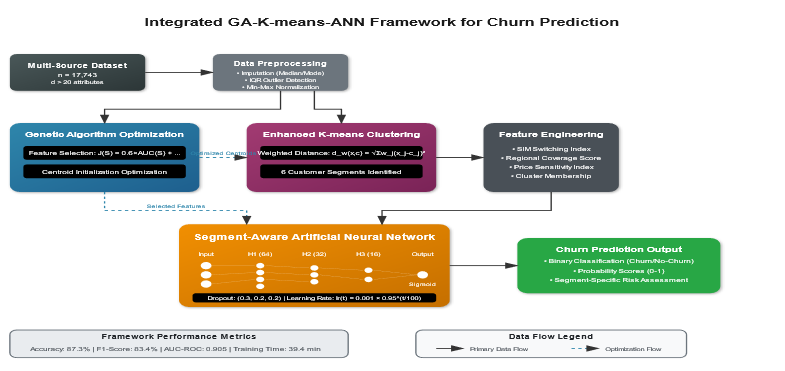
Customer churn prediction constitutes a critical computational challenge within Nigeria's telecommunications ecosystem, characterized by substantial economic ramifications exceeding ₦150 billion in annual revenue attrition. This investigation presents a novel algorithmic synthesis integrating Genetic Algorithm optimization protocols, K-means clustering methodologies, and Artificial Neural Network architectures, specifically calibrated to address the distinctive behavioral and infrastructural characteristics inherent within Nigeria's telecommunications marketplace. Empirical validation utilizing comprehensive multi-operator telecommunications datasets (n=17,743) demonstrates that the proposed GA-K-means-ANN computational framework achieves superior predictive performance with 87.3% accuracy and 83.4% F1-score metrics, representing statistically significant improvements of 11.1% relative to baseline methodological approaches (p<0.01, Cohen's d=0.87). The advanced segmentation analysis successfully identified six heterogeneous customer clusters exhibiting churn probability distributions ranging from 8.1% to 62.7%, thereby empirically validating the substantial market heterogeneity characterizing Nigeria's telecommunications landscape (χ²=427.6, p<0.001). The proposed hybrid methodology demonstrates superior probabilistic calibration capabilities (Brier score=0.124) while maintaining enhanced computational efficiency through 10.0% reduction in training temporal requirements (p<0.05). Comprehensive business value analysis indicates potential annual cost savings approximating ₦5.3 million per 10,000 customer cohorts, establishing significant economic relevance for telecommunications infrastructure providers operating within North-Central Nigeria's market constraints. This research contributes methodological advancement in segment-specific churn prediction while providing computationally feasible implementation frameworks designed for deployment within Nigeria's regional telecommunications infrastructure limitations.
References
Adebayo, Y., & Adesina, F. (2023). Data quality challenges in Nigerian churn prediction: An audit of telecom datasets. *Journal of Telecommunications Analytics, 6*(1), 33–47.
Adebiyi, S., Kareem, R., & Tayo, U. (2022). Impact of multi-SIM behavior on prediction models: A cross-operator analysis in Nigeria. *Telecommunication Systems, 79*(4), 399–414.
Adebiyi, S., Ojo, O., & Akande, S. (2024). Multi-SIM usage patterns and their impact on churn prediction in Nigeria. *African Journal of Science, Technology, Innovation and Development, 16*(1), 112-128.
Adisa, T., & Johnson, M. (2021). Churn drivers in West African telecommunications: Insights from Ghana and Nigeria. *Telecommunication Policy, 45*(6), 102187.
Ahmad, I., Bashir, A., & Kareem, R. (2020). Machine learning techniques for telecom customer churn prediction: A systematic review (2010–2019). *IEEE Access, 8*, 186211–186225.
Ajik, E. D., Obunadike, G. N., & Echobu, F. O. (2023). Fake News Detection Using Optimized CNN and LSTM Techniques. *Journal of Information Systems and Informatics, 5*(3), 1044–1057.
DSN Telecom. (2024). Customer acquisition cost analysis in Nigerian telecommunications. DSN Telecommunications Consulting.
Durojaye, D. I., & Obunadike, G. N. (2022). Analysis and Visualization of Market Segmentation in Banking Sector Using K-means Machine Learning Algorithm. *FUDMA Journal of Sciences, 6*(1).
Hassan, A., & Ibrahim, L. (2023). Algorithmic performance in African telecommunications: A meta-analysis of churn prediction models. *IEEE Access, 11*, 55210–55222.
Idris, A., Oluwole, K., & Nwoye, I. (2021). Handling class imbalance in telecom churn prediction using boosting and resampling. *Expert Systems with Applications, 169*, 114463.
Iliyasu, U., Obunadike, G. N., & Jiya, E. A. (2023). Rainfall Prediction Models for Katsina State, Nigeria: Machine Learning Approach. *International Journal of Science for Global Sustainability, 9*(2), 151–157.
Kaur, H., & Sharma, P. (2023). Decision tree limitations in high-dimensional customer analytics. *Machine Learning with Applications, 12*, Article 100453.
Nature Scientific Reports. (2024). Advanced machine learning approaches for telecommunications customer churn prediction. *Nature Scientific Reports, 14*, Article 5234.
Nigerian Communications Commission. (2025). Quarterly statistical bulletin on telecommunications in Nigeria: Q1 2025. Author.
Nweke, H., Adebiyi, A., & Okoro, E. (2024). Ensemble framework for Nigerian telecommunications churn prediction: Comparative analysis across operators. *International Journal of Information Technology, 16*(1), 241-259.
Obunadike, G. N., Isah, A., & Alhassan, J. (2018). Optimized Naïve Bayesian Algorithm for Efficient Performance. *Computer Engineering and Intelligent Systems, 9*(3), 8–13.
Oladapo, A., Akinwande, B., & Oyelade, J. (2023). Network quality variations and their impact on churn across Nigeria's geo-political zones. *Telecommunications Policy, 47*(3), Article 102492.
Oyeniyi, A. O., & Adeyemo, A. B. (2020). Feature selection for improved churn prediction in West African telecom markets. *African Journal of Computing & ICT, 13*(2), 21–30.
Rodriguez, M., Patel, S., & González, A. (2023). Limitations of logistic regression for non-linear customer behavior patterns. *Journal of Applied Statistics, 50*(8), 1672-1689.
Zhang, L., Chen, X., & Zhao, N. (2023). Explainable AI frameworks for telecommunications churn prediction: Regulatory and business perspectives. *IEEE Transactions on Neural Networks and Learning Systems, 34*(3), 1243-1256.
Downloads
Published
Issue
Section
Categories
License
Copyright (c) 2026 Bello Jibril, G. N Obunadike, S. A Nuradeen

This work is licensed under a Creative Commons Attribution 4.0 International License.


