
MINING CLINICAL DATA FOR HYPERTENTION PREDICTION PERFORMANCE EVALUATION OF SIX SUPERVIVED LEARNING ALGORITHMS
DOI:
https://doi.org/10.33003/fjs-2026-1001-4543Keywords:
Hypertension, Imbalance data, Machine Learning, Prediction model, Supervised learningAbstract
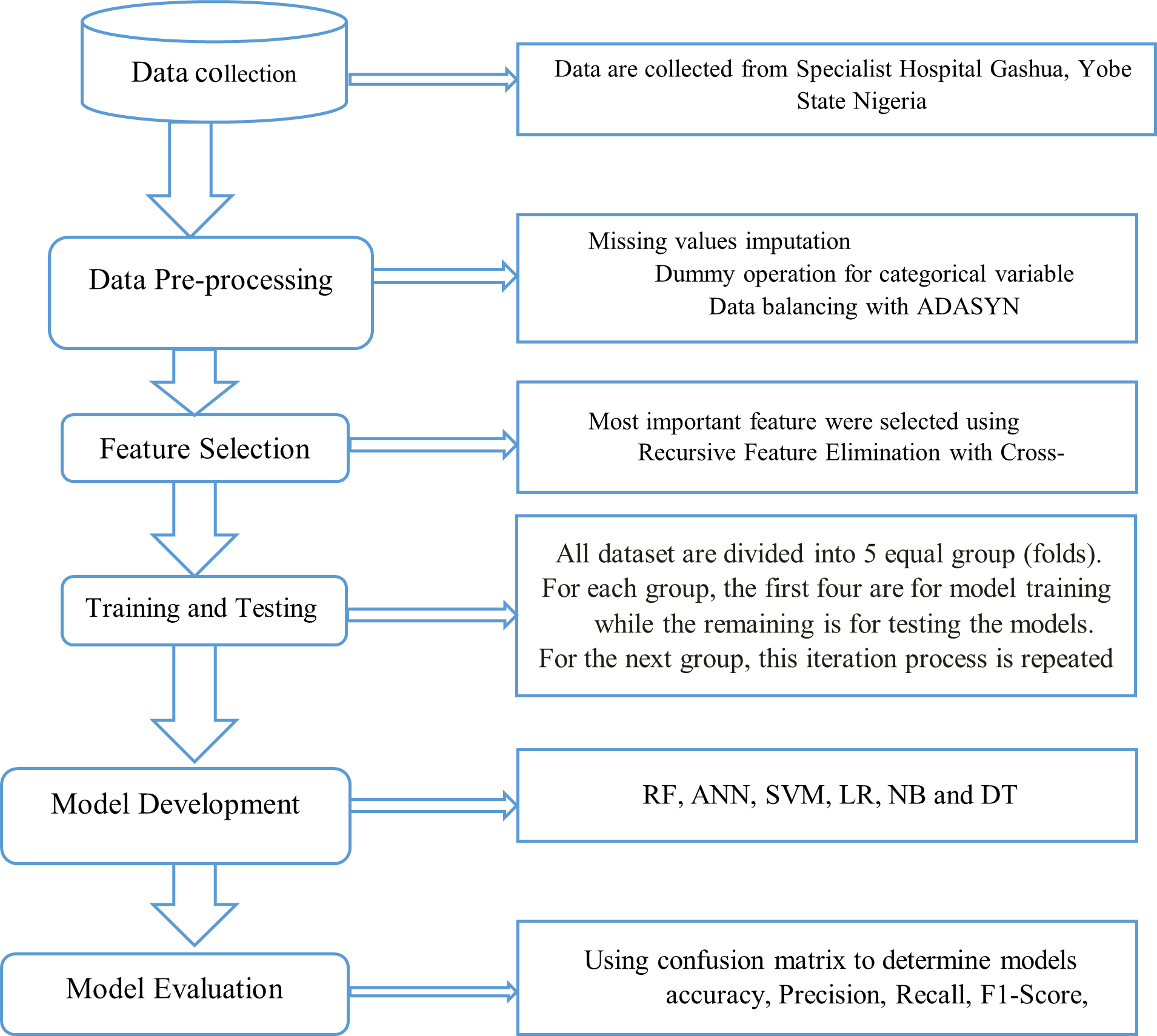
Machine learning classifiers usage in medicine has been on a rise over the years due to increase in available clinical data. Hypertension, one of the cardiovascular heart diseases is a global health concern with several risk factors where early detection could prevent related heart diseases complications. With abundant clinical data piling within our health facilities here in Nigeria, little or non-research on hypertension prediction using local dataset has been done. This research work is aimed at developing models for predicting individuals with likelihood of hypertension even without necessary going through medical procedures. A sample of 294 clinical data from Specialist Hospital Gashua was used. Random Forest, Decision tree, Artificial neural network, Support vector machine, Logistic regression and Naïve bayes algorithms were used for classification. To minimised issues of over-fitting due to the number of available data, ADASYN balancing technique was used for data balancing. Using Root Means Square Error (RMSE), Accuracy, Recall, F1-score and ROC values as parameter matrix for evaluating the models, our results showed that machine learning can be utilised in predicting hypertension diseases for quick preventive measures. Furthermore, this research work further illustrate that Random Forest has proven to be the most efficient and best algorithms for hypertension prediction having performance supremacy over all others five algorithms with 92% prediction accuracy, 100% Precision, Recall values of 91%, 91% F1-score value, RMSE of 29% and AUC value of 97%. Thereby, stressing the significant of balancing dataset for enhanced model accuracy (and all other metrics).
References
Alhadeethy, N. F. A., Zeki, A. M., & Shah, A. (2021). Deep Learning Model For Predicting And Detecting Overlapping Symptoms Of Cardiovascular Diseases In Hospitals Of UAE. Turkish Journal of Computer and Mathematics Education (TURCOMAT), 12(14), 5212-5224.
AlKaabi, L. A., Ahmed, L. S., Al Attiyah, M. F., & Abdel-Rahman, M. E. (2020). Predicting hypertension using machine learning: Findings from Qatar Biobank Study. Plos one, 15(10), e0240370.
Al-Zaben, A., Fora, M., & Obaidat, A. (2018, March). Detection of premature ventricular beats from arterial blood pressure signal. In 2018 IEEE 4th Middle East Conference on Biomedical Engineering (MECBME) (pp. 17-19). IEEE.
Bagley SC, White H, Golomb B.A. (2001) Logistic regression in the medical literature: standards for use and reporting, with particular attention to one medical domain. J Clin Epidemiol. 54:979–85. https://doi.org/10.1016/s0895-4356(01)00372-9
Breiman L. 2001) Random forests, machine learning 45. J Clin Microbiol. (2:199–228. doi: 10.1023/A:1010933404324
Chandramohan, R. M. (2022). Stroke Detection and Prediction Using Deep Learning Techniques and Machine Learning Algorithms (Doctoral dissertation, Dublin, National College of Ireland).
Chang, W., Liu, Y., Xiao, Y., Yuan, X., Xu, X., Zhang, S., & Zhou, S. (2019). A machine-learning-based prediction method for hypertension outcomes based on medical data. Diagnostics, 9(4), 178.
Chang, W., Liu, Y., Xiao, Y., Yuan, X., Xu, X., Zhang, S., & Zhou, S. (2019). A machine-learning-based prediction method for hypertension outcomes based on medical data. Diagnostics, 9(4), 178.
Chandrashekar, G. & Sahin, F. A (2014) Survey on feature selection methods. Comput. Electr. Eng. https://doi.org/10.1016/j.compeleceng.2013.11.024
Dey, J., Gaurav, A., & Tiwari, V. N. (2018, July). InstaBP: cuff-less blood pressure monitoring on smartphone using single PPG sensor. In 2018 40th annual international conference of the IEEE engineering in medicine and biology society (EMBC) (pp. 5002-5005). IEEE.
Fang, M., Chen, Y., Xue, R., Wang, H., Chakraborty, N., Su, T., & Dai, Y. (2023). A hybrid machine learning approach for hypertension risk prediction. Neural Computing and Applications, 35(20), 14487-14497.
Faul, A. C. (2019). A concise introduction to machine learning. CRC Press.
Fitriyani, N. L., Syafrudin, M., Alfian, G., & Rhee, J. (2019). Development of disease prediction model based on ensemble learning approach for diabetes and hypertension. Ieee Access, 7, 144777-144789.
Fuchs, F. D., & Whelton, P. K. (2020). High blood pressure and cardiovascular disease. Hypertension, 75(2), 285-292.
Haldar, R. N. (2013). Global brief on hypertension: silent killer, global public health crisis. Indian J Phys Med Rehabil, 24(1), 2.
Islam, S. M. S., Talukder, A., Awal, M. A., Siddiqui, M. M. U., Ahamad, M. M., Ahammed, B., ... & Maddison, R. (2022). Machine learning approaches for predicting hypertension and its associated factors using population-level data from three south asian countries. Frontiers in Cardiovascular Medicine, 9, 839379.
Johnson, A. E., Pollard, T. J., Shen, L., Lehman, L. W. H., Feng, M., Ghassemi, M., ... & Mark, R. G. (2016). MIMIC-III, a freely accessible critical care database. Scientific data, 3(1), 1-9.
Kwong, E. W. Y., Wu, H., & Pang, G. K. H. (2018). A prediction model of blood pressure for telemedicine. Health informatics journal, 24(3), 227-244.
LaFreniere, D., Zulkernine, F., Barber, D., & Martin, K. (2016, December). Using machine learning to predict hypertension from a clinical dataset. In 2016 IEEE symposium series on computational intelligence (SSCI) (pp. 1-7). IEEE.
Leha, A., Hellenkamp, K., Unsöld, B., Mushemi-Blake, S., Shah, A. M., Hasenfuß, G., & Seidler, T. (2019). A machine learning approach for the prediction of pulmonary hypertension. PloS one, 14(10), e0224453.
Liang, Y., Chen, Z., Liu, G., & Elgendi, M. (2018). A new, short-recorded photoplethysmogram dataset for blood pressure monitoring in China. Scientific data, 5(1), 1-7.
Liang, Y., Chen, Z., Ward, R., & Elgendi, M. (2018). Photoplethysmography and deep learning: enhancing hypertension risk stratification. Biosensors, 8(4), 101.
López-Martínez, F., Núñez-Valdez, E. R., Crespo, R. G., & García-Díaz, V. (2020). An artificial neural network approach for predicting hypertension using NHANES data. Scientific Reports, 10(1), 10620.
López-Martínez, F., Núñez-Valdez, E. R., Crespo, R. G., & García-Díaz, V. (2020). An artificial neural network approach for predicting hypertension using NHANES data. Scientific Reports, 10(1), 10620.
Lopez-Martinez, F., Schwarcz, A., Núñez-Valdez, E. R., & Garcia-Diaz, V. (2018). Machine learning classification analysis for a hypertensive population as a function of several risk factors. Expert Systems with Applications, 110, 206-215. Mahadi, N., & Borodo, S. M. (2025). Enhancing Sentiment Analysis For Hausa Language With Improved Hausa Text Stemmer (Hts) And Machine Learning Models. Fudma Journal Of Sciences, 9(12), 629-638.
Marin, I., & Goga, N. (2019, September). Hypertension detection based on machine learning. In Proceedings of the 6th Conference on the Engineering of Computer Based Systems (pp. 1-4).
Martinez-Ríos, E., Montesinos, L., & Alfaro-Ponce, M. (2022). A machine learning approach for hypertension detection based on photoplethysmography and clinical data. Computers in Biology and Medicine, 145, 105479.
Martinez-Ríos, E., Montesinos, L., Alfaro-Ponce, M., & Pecchia, L. (2021). A review of machine learning in hypertension detection and blood pressure estimation based on clinical and physiological data. Biomedical Signal Processing and Control, 68, 102813.
Mazzanti, M., Shirka, E., Gjergo, H., & Hasimi, E. (2018). Imaging, health record, and artificial intelligence: hype or hope?. Current cardiology reports, 20, 1-9.
Nour, M., & Polat, K. (2020). Automatic classification of hypertension types based on personal features by machine learning algorithms. Mathematical Problems in Engineering, 2020, 1-13.
Ramampiandra, E. C., Scheidegger, A., Wydler, J. & Scuwiirth, N. (2023) A comparison of Machine Learning and Statistical species Distribution Models. “Quantifying over-fitting supports model interpretation” Ecological Modelling 481 (2023) 110353.
Tjahjadi, H., & Ramli, K. (2020). Noninvasive blood pressure classification based on photoplethysmography using k-nearest neighbors algorithm: a feasibility study. Information, 11(2), 93.
Tjahjadi, H., Ramli, K., & Murfi, H. (2020). Noninvasive classification of blood pressure based on photoplethysmography signals using bidirectional long short-term memory and time-frequency analysis. IEEE Access, 8, 20735-20748.
Ye, C., Fu, T., Hao, S., Zhang, Y., Wang, O., Jin, B., ... & Ling, X. (2018). Prediction of incident hypertension within the next year: prospective study using statewide electronic health records and machine learning. Journal of medical Internet research, 20(1), e22.
Zhang, L., Yuan, M., An, Z., Zhao, X., Wu, H., Li, H. & Wu, W. (2020). Prediction of hypertension, hyperglycemia and dyslipidemia from retinal fundus photographs via deep learning: A cross-sectional study of chronic diseases in central China. PloS one, 15(5), e0233166
Zhou B, Carrillo-Larco RM, Danaei G, Riley LM, Paciorek CJ, Stevens GA, et al. (2021) Worldwide trends in hypertension prevalence and progress in treatment
and control from 1990 to 2019: a pooled analysis of 1201 population representative studies with 104 million participants. Lancet. 398: 957–80. https://doi.org/10.1016/S0140-6736(21)01330-1
Downloads
Published
Issue
Section
Categories
License
Copyright (c) 2026 Awuza Abdulrashid Egwa, Abdullahi Musa Bello, Sikirat Kehinde Aina, Saadatu Gimba

This work is licensed under a Creative Commons Attribution 4.0 International License.


