
GEOSPATIAL MODELLING AND SOCIOECONOMIC PROFILING OF FUELWOOD CONSUMPTION PATTERNS IN DOROK DISTRICT, PLATEAU STATE, NIGERIA
DOI:
https://doi.org/10.33003/fjs-2026-1001-4540Keywords:
Biomass Energy Dependence, Socio-Demographic Determinants, Remote Sensing and NDVI, Rural Household EnergyAbstract
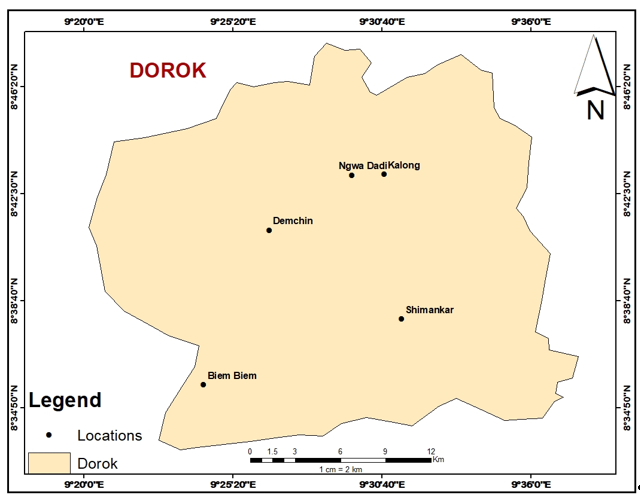
Household reliance on biomass energy is a major driver of land-cover change in rural Nigeria. This study used socio-economic surveys (n = 150), statistical analyses, and NDVI-based Land Use and Land Cover (LULC) assessment from multi-temporal Landsat imagery (1990–2025) to examine fuelwood consumption and vegetation dynamics in Dorok District, Plateau State. Results show high fuelwood use, with mean daily consumption of 14.27 kg per household (1.78 kg per capita). Female-headed households consumed more than male-headed households, and consumption increased with household size, while education had minimal effect. NDVI analysis revealed that vegetation loss was not significantly driven by fuelwood harvesting, with broader land-use changes as the dominant factor. The 2025 LULC classification showed high reliability: water bodies and built-up areas were mapped most accurately, while vegetation classes had moderate accuracy due to heterogeneous landscapes. Overall Accuracy (85%) and Kappa (0.77) confirm the dataset’s robustness for spatial and ecological analysis. These findings highlight the need for gender-sensitive energy interventions, adoption of alternative household fuels, and community-based conservation. The study demonstrates the value of validated LULC datasets for monitoring landscape change, understanding vegetation dynamics, and informing sustainable land management in rural Nigeria.
References
Abubakar, I. R., Dano, U. L., & Sadiq, A (2024). Household energy choice and fuelwood consumption patterns in rural Nigeria: Socioeconomic and policy implications. Energy for Sustainable Development, 78, 101-113.
Adepoju, K., & Salami, A. (2024). Assessment of land cover classification accuracy in heterogeneous savanna ecosystems: Impacts of spectral similarity and mixed pixels. Remote Sensing Applications: Society and Environment, 28, 101695.
Alem, Y., Beyene, A D., Kohlin, G., & Mekonnen, A. (2023). Modeling household cooking fuel choice: Evidence from rura I Africa. Energy Economics, 117, 106453.
Alfred, B. Y., Haruna, A K., Sule, J., Nyadar, B. M., & Timnan, N. (n.d.). The causality of deforestation in North-Central Nigeria: Case study of Shendam Urban Area, Plateau State. Journal of Environment and Earth Science, 7(7), 64-91.
Akinyemi, F. T., & Sangodoyin, A Y. (2022). Quantitative assessment of the relationship between land use/land cover (LULC), topographic elevation, and land surface temperature in Ilorin, Nigeria. Remote Sensing Applications: Society and Environment, S2352-9385(22).
Arnold, J. E. M., Kohlin, G., & Persson, R. (2006). Woodfuels, livelihoods, and policy interventions: Changing perspectives. World Development, 34(3), 596- 61l.
Bhattacharya, S. c., Abdul Salam, P., & Sharma, M. (2002). Energy transition in rural Asia: Biomass use and fuel switching. Energy, 27(11), 1011-1025.
Chidumayo, E. N., & Gumbo, D. J. (2013). The dry forests and woodlands of Africa: Managing for products and services. London: Earthscan/Routledge.
Chaskda, A. A., Mwansat, G. S., & Ombugadu, A. (2021). Analysis of fuelwood utilisation and existing reforestation strategy on local biodiversity in Northern Plateau State, Nigeria. Journal of Ecology and the Natural Environment, 13(2), 18-25.
Choji, V.D., Nanchang., D. (2025). ASSESSING LAND COVER CHANGE IN LANGTANG–SOUTH LOCAL GOVERNMENT AREA, PLATEAU STATE, NIGERIA USING GIS AND REMOTE SENSING TOOLS: A CASE STUDY APPROACH. PLASU JOURNAL OF ENVIRONMENTAL SCIENCES, 1(1), 170-192.
Cohen, L., Manion, L., & Morrison, K. (2018). Research methods in education (8th ed.). Routledge.
Food and Agriculture Organization of the United Nations. (2017). Sustainable woodfuel for food security: A smart choice: Green, renewable and affordable (Working paper). Rome, Italy: FAO. Retrieved from http://www.fao.org/3/aOi7917e.pdf
Food and Agriculture Organization of the United Nations. (2020). Global forest resources assessment 2020: Main report. Rome, Italy: FAO. Retrieved from https://openknowledge.fao.orglitems/d6fOdf61-cb5d-4030-8814- Oe466176d9a1
Food and Agriculture Organization of the United Nations. (2024). The state of the world's forests 2024: Forest-sector innovations towards a more sustainable future. Rome, Italy: FAO. Retrieved from https://openknowledge.fao.org/handle/20.500.14283/cd1211 en
Igbe Akeh, F., Okoye, C. 0., & Nwafor, J. C. (2023). Socioeconomic determinants of household fuelwood consumption in rura I communities of Nigeria. Journal of Environmental Management, 325, 116522.
International Energy Agency. (2023). World energy outlook 2023. Paris: IEA. Retrieved from https://www.iea.org/reports/world-energy-outlook-2023
Karekezi, S., & Kithyoma, W. (2003). Renewable energy strategies for rural Africa: Is a PV-led renewable energy strategy the right approach? Energy Policy, 31(11), 1071-1086.
Lambin, E. F., Geist, H. J., & Lepers, E. (2003). Dynamics of land-use and land-cover change in tropical regions. Annual Review of Environment and Resources, 28, 205-24l.
Lawal, 1. A., & Gulma, U. L. (2024). Assessment of land use land cover change detection for Argungu Urban. Intemational Joumal of Science and Research Archive, 13(2), 1434-1439.
National Bureau of Statistics. (2024). Nigeria residential energy demand-side survey 2024 (NREDSS 2024). Abuja, Nigeria: National Bureau of Statistics.
Ologunde, o. H., Kelani, M. 0., Bi111, M. K., Olayemi, A. B., & Nunes, M. R. (2025). Land use and land cover changes: A case study in Nigeria. Land, 14(2),389.
Pretty, J., & Smith, D. (2004). Social capital in biodiversity conservation and management. Conservation Biology, 18(3), 631-638.
Reed, M. S. (2008). Stakeholder participation for environmental management: A literature review. Biological Conservation, 141(10), 2417-243l.
Salisu, M., Muhammad, N. D., & Umar, A. R. (2019). MAPPING OF FUELWOOD MARKETING POINTS AT KIYAWA TOWN, JIGAWA STATE, NIGERIA. FUDMA JOURNAL OF SCIENCES, 3(1), 104-110.
Saunders, M., Lewis, P., & Thornhill, A. (2023). Research methods for business students (9th ed.). Pearson.
Shankar, A. v., Quinn, A. K., Dickinson, K. L., Williams, K. N., Masera, 0., Charron, D., ... Rosenthal, J. P. (2020). Everybody stacks: Lessons from household energy case studies to inform design principles for clean energy transitions. Energy Policy, 141, 111468.
Song, X. P., Hansen, M. C., Stehman, S. V., et a1. (2018). Global land change from 1982 to 2016. Nature, 560, 639-643.
Tahir, Z., Haseeb, M., Mahmood, S. A., Batool, S., Abdullah-Al-Wadud, M., Ullah, S., & Tariq, A. (2025). Predicting land use and land cover changes for sustainable land management using CA-Markov modelling and GIS techniques. Scientific Reports, 15(1), 327l.
Van der Kroon, B., Brouwer, R., & van Beukering, P. J. H. (2013). The energy ladder: Theoretical myth or empirical truth? Results from a meta-analysis. Renewable and Sustainable Energy Reviews, 20, 504-513.
World Health Organization. (2022). Household energy database. Geneva: WHO. Retrieved from https://www.who.int/data/gho/data/themes/airhousehold-energy-db
World Health Organization. (2024). Household air pollution and health. Geneva: WHO. Retrieved from https://www.who.int/newssheets/detail/household-air-pollution-and-health
Zulu, L. c., & Richardson, R. B. (2013). Charcoal, livelihoods, and poverty reduction: Evidence from sub-Saharan Africa. Energy for Sustainable Development, 17(2), 127-137.
Downloads
Published
Issue
Section
Categories
License
Copyright (c) 2026 Vincent Choji, Kyalak Yakubu, Barnabas David, Magnus Chris, Ayodeji Ifegbesan

This work is licensed under a Creative Commons Attribution 4.0 International License.