
EFFECT OF DIFFERENT CONCENTRATIONS OF HONEY ON SELECTED MICROORGANISMS
DOI:
https://doi.org/10.33003/fjs-2026-1001-4526Keywords:
Honey, Antimicrobial activity, Phytoecological profile, Zone of inhibition, NigeriaAbstract
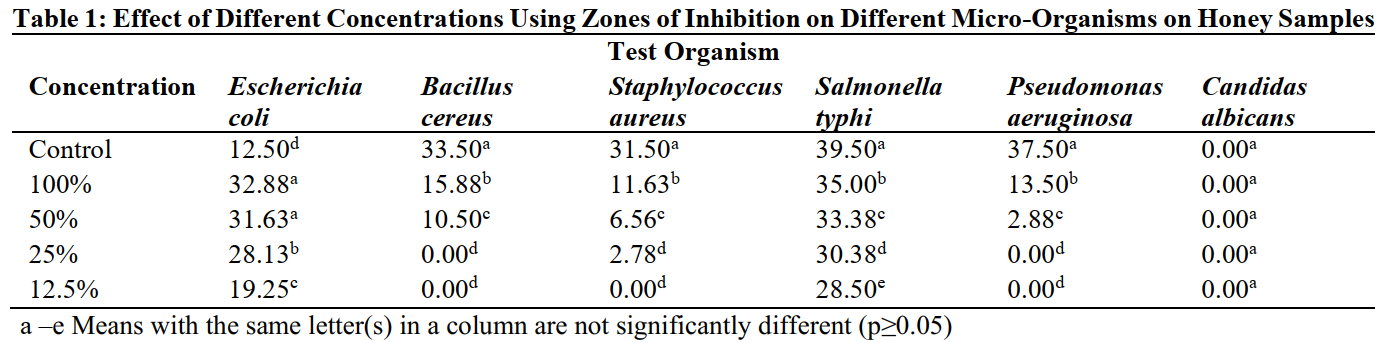
This study investigated the antimicrobial properties of honey and the role of honey’s botanical origin on its antimicrobial efficacy at varying concentrations (12.5%, 25%, 50%, and 100%) against five pathogenic microorganisms: Escherichia coli, Bacillus cereus, Staphylococcus aureus, Salmonella typhi, and Pseudomonas aeruginosa. A ciprofloxacin control was used. Honey samples from Bauchi, Gombe, Plateau, and Kaduna States were tested via agar well diffusion. Results revealed significant (p<0.05) variation in antimicrobial activity across concentrations and microbial strains. All honey samples were ineffective against Candida albicans. Honey’s effectiveness was dose-dependent, with maximum inhibition seen at 100% concentration. Pollen analysis identified key phytoecological plant families contributing to honey's bioactivity. Pollen analysis identified plant families, with Combretaceae/Melastomataceae common across all samples.
References
Adekanbi, O. H., & Ogundipe, O. T. (2014). Palynological analysis of honey from four vegetation zones of Nigeria. Palynology, 38 (2), 242–253. (https://doi.org/10.1080/01916122.2013.872440).
Agbagwa, O. E., & Frank-Peterside, N. (2011). Effect of raw commercial honeys from Nigeria on selected pathogenic bacteria. African Journal of Microbiology Research, 5(18), 2920–2923. (https://doi.org/10.5897/AJMR.9000406)
Agwu, C. O. C., & Akanbi, T. O. (2014). Pollen analysis of honey from four vegetation zones of Nigeria. Journal of Biology, Agriculture and Healthcare, 4(25), 65-74.
Ahmed, M., Hussain, S., Abbas, K., & Ali, T. (2020). Evaluation of antibacterial potential of Pakistani honey against multidrug-resistant pathogens. Pakistani Journal of Medical Sciences, 36(2), 232–237.
Akinpelu, D. A., & Olajide, O. O. (2020). Antimicrobial activity of local Nigerian honey on clinical isolates. Journal of Natural Sciences Research, 10(5), 75–80.
Allen, K. L., Molan, P. C., & Reid, G. M. (1991). A survey of the antibacterial activity of some New Zealand honeys. Journal of Pharmacy and Pharmacology, 43(12), 817–822.
Alvarez-Suarez, J. M., Gasparrini, M., Forbes-Hernandez, T. Y., Mazzoni, L., & Giampieri, F. (2020). The composition and biological activity of honey: A focus on Manuka honey. Foods, 9(1), 64.
Anupama, D., Bhat, K. K., & Sapna, V. K. (2003). Sensory and physicochemical properties of commercial samples of honey. Food Research International, 36(2), 183–191.
Aristotle. (1910). History of Animals (Vol. 1, D’Arcy Thompson, Trans.). Oxford: Clarendon Press. (Original work published ~350 BCE).
Bucevic Popovic, I., Spoljaric, M., & Blazevic, I. (2023). Honey and its derivatives in the fight against Pseudomonas aeruginosa: A review. International Journal of Molecular Sciences, 24(5), 4567.
Carter, D. A., Blair, S. E., & Cokcetin, N. N. (2016). The therapeutic potential and application of honey in antimicrobial wound care. Clinical Microbiology Reviews, 29(3), 603–644.
Clinical and Laboratory Standards Institute (CLSI). (2007). Performance Standards for Antimicrobial Susceptibility Testing; 17th Informational Supplement (CLSI Document M100-S17). CLSI.
Davies, J., Molan, P., & Weston, R. J. (2020). The antibacterial activity of honey and its role in treating infections. Microbiology Today, 47(1), 14–17.
Dawoud, D. M., Abd El-Aziz, M., & El-Sayed, W. S. (2019). In vitro evaluation of the antibacterial activity of some Egyptian honeys against multidrug-resistant bacteria. Veterinary World, 12(9), 1426–1431.
Erdtman, G. (1960). The acetolysis method: A revised description. Svensk Botanisk Tidskrift, 54, 561–564.
Estevinho, L., Pereira, A. P., Moreira, L., Dias, L. G., & Pereira, E. (2011). Antioxidant and antimicrobial effects of phenolic compounds extracted from Northeast Portuguese propolis. Food and Chemical Toxicology, 49(7), 1606–1613.
European Directive. (2001). Council Directive 2001/110/EC of 20 December 2001 relating to honey. Official Journal of the European Communities, L10, 47–52.
Fadhel, F. H., & Al-Ghamdi, A. A. (2021). The antibacterial effect of different types of Saudi honey on Bacillus cereus. Saudi Journal of Biological Sciences, 28(3), 1707–1712.
Garcia, C. A., Vilela, R., & Cury, J. A. (2023). Honey: A novel therapeutic option for infected wounds and inflammatory diseases. Phytotherapy Research, 37(4), 2034–2044.
Jesumirhewe, C., & Bekee, R. (2019). Comparative antibacterial activity of Nigerian honey on Escherichia coli and Staphylococcus aureus isolated from wound infections. African Journal of Clinical and Experimental Microbiology, 20(1), 37–44.
Johnson, M. M., Osei-Tutu, A., & Nartey, E. T. (2023). Antimicrobial resistance: Global patterns and local challenges. International Journal of Infectious Diseases, 125, 28–35.
Jones, G. D., & Bryant, V. M. (2004). Melissopalynology. In Pollen grains: Production, transport and effects (pp. 147–157). Palynological Research Laboratory.
Kassim, M., Achoui, M., Mustafa, M. R., Mohd, M. A., & Yusoff, K. M. (2021). Honey as an alternative medicine: A review of its antimicrobial activity. Current Medicinal Chemistry, 28(5), 972–985.
Kim, S. H., & Lee, D. S. (2022). Antibiotic resistance: Mechanisms and new antimicrobial strategies. Journal of Microbiology and Biotechnology, 32(6), 773–780.
Kwakman, P. H., te Velde, A. A., & de Boer, L. (2011). How honey kills bacteria. FASEB Journal, 25(6), 1957–1965.
Louveaux, J., Maurizio, A., & Vorwohl, G. (1970). Methods of melissopalynology. Bee World, 51(3), 125–138.
Miller, S. M., Harper, T. J., & Singh, R. (2024). A review on the mechanisms of antimicrobial activity of honey. Journal of Natural Antimicrobials, 3(1), 1–14.
Molan, P. C. (1992). The antibacterial activity of honey. The nature of the antibacterial activity. Bee World, 73(1), 5–28.
Molan, P. C. (2006). The evidence supporting the use of honey as a wound dressing. International Journal of Lower Extremity Wounds, 5(1), 40–54.
Mohapatra, D. P., Thakur, V., & Brar, S. K. (2022). Antibacterial efficacy of raw honey on Escherichia coli isolates from clinical sources. Journal of Applied and Natural Science, 14(1), 24–30.
Noori, S., Al-Khafaji, N. J., & Ghosh, S. (2021). Evaluating antifungal activity of local honey samples against Candida species. Journal of Mycology Research, 3(2), 45–52.
Obaro, S. K., Olayemi, L., & Onabolu, B. (2015). Salmonella infections in Nigeria: The neglected threat. Journal of Health, Population and Nutrition, 33(1), 41–48.
Odetoyinbo, B. B., & Akinniyi, J. A. (2017). Antibacterial activity of honey on some bacterial isolates. Journal of Microbiology and Biotechnology Research, 7(1), 1–6.
Rodriguez, R., De La Cruz, M., & Vicente, F. (2021). Emerging antifungal resistance and the search for new therapeutic agents. Current Opinion in Microbiology, 64, 86–92.
Sawadogo, W. R., Boly, R., Lompo, M., Some, N., Lamien, C. E., Guissou, I. P., & Nacoulma, O. G. (2016). Antibacterial activities of selected medicinal plants from Burkina Faso. African Journal of Traditional, Complementary and Alternative Medicines, 13(4), 183–188. (https://doi.org/10.21010/ajtcam.v13i4.24)
Singh, A. K., & Kumar, R. (2020). Natural products as a source for new antimicrobial agents: A comprehensive review. Phytomedicine, 73, 153281.
Smith, S. I., Fowora, M. A., & Baba, R. A. (2016). Antibiotic resistance pattern of Salmonella enterica serovar Typhi in Nigeria. African Journal of Clinical and Experimental Microbiology, 17(4), 258–263.
Wang, L., Zhang, Y., & Chen, H. (2024). Factors influencing the therapeutic efficacy of honey: A comprehensive review. Food Chemistry, 432, 137267.
Zulkipli, I. N., Yusoff, K. M., & Bakri, M. M. (2017). Therapeutic effects of honey for the treatment of wounds and cancers: A review. Evidence-Based Complementary and Alternative Medicine, 2017, Article ID 7892528.
Downloads
Published
Issue
Section
Categories
License
Copyright (c) 2026 J. A. Ibegbulem, S. K. Musa, S. S. Idoko, Dahiru Baba, H. A. Abuh

This work is licensed under a Creative Commons Attribution 4.0 International License.


