
POST-HARVEST FUNGAL PATHOGENS OF ONION BULBS SOLD IN MARKETS IN JOS METROPOLIS, NIGERIA
DOI:
https://doi.org/10.33003/fjs-2026-1001-4523Keywords:
Isolation, Fungi, Spoilage, Post-harvest, Allium cepa (Onion bulb)Abstract
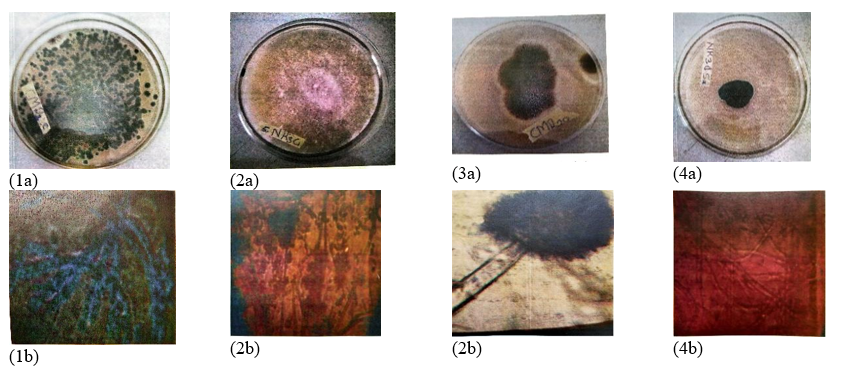
Onions (Allium cepa L.) are an important vegetable crop in Nigeria, contributing substantially to food security and economic sustainability. However, post-harvest fungal spoilage remains a major constraint, resulting in considerable losses. This study investigated the fungal pathogens associated with onion bulb deterioration in markets within the Jos metropolis, Plateau State, Nigeria. A total of 180 onion bulbs were sampled from four major markets, including 120 visibly spoiled bulbs collected directly from vendors and cultured on Potato Dextrose Agar. In addition, 120 apparently healthy bulbs from the same markets were monitored for fungal infection and spoilage progression over a three-week period, while 40 bulbs (10 per market) served as controls. Data were analyzed using descriptive statistics, including frequencies and percentages. Four fungal species were isolated and identified: Aspergillus niger, Cladosporium cladosporioides, Fusarium oxysporum, and Penicillium citrinium. Aspergillus niger was the predominant pathogen, recording the highest frequency of occurrence, spoilage rate (99.9%), disease incidence, and associated weight loss. This was followed by C. cladosporioides (40%), F. oxysporum (33.33%), and P. citrinium (19.97%). The results confirm that these fungi are key contributors to post-harvest onion bulb decay in the study area. Some of the isolated fungi are also of public health concern, while others accelerate product deterioration. Effective control of contamination during harvesting, handling, storage, and distribution is therefore essential to reduce spoilage, minimize economic losses, and lower the risk of food-borne illnesses associated with raw onion consumption.
References
Adebajo, S. A., & Diyaolu, S. A. (2003). Mycology and spoilage of retail cashew nuts. African Journal of Biotechnology, 2(10), 369–373. https://www.ajol.info/index.php/ajb/article/view/14941
Adeoye, I. B., Oyedele, O. O., Adebisi-Adelani, O., Idris, B. A., & Shuaibu, M. (2022). Assessment of information, training needs and challenges of onion producers in Kano and Kebbi States, Nigeria. Nigerian Journal of Horticultural Science, 26(3), 118–130. https://hortson.org.ng/images/Journals/2022volume/Adeoye_et_al_2022_compressed.pdf
Adongo, B. A., Kwoseh, C. K and Moses, E. (2015). Storage rot fungi and seed-borne pathogens of onion. Journal of Bangladesh Agricultural University, 35(2): 13-21. DOI: https://10.4314/just.v35i2.2.
Ara, M. A. H., Khatun, M. L., & Ashrafuzzaman, M. (2008). Fungi causing rot in onions at storage and market. Journal of Bangladesh Agricultural University, 6(2), 245–251. https://www.banglajol.info/index.php/JBAU/article/view/4826.
Baiyewu, R. A., Musa, N. A., Ayoola, O. A., & Babalola, O. O. (2007). Survey of the post-harvest disease and aflatoxin contamination of marketed pawpaw fruit (Carica papaya L.) in South Western Nigeria. African Journal of Agricultural Research, 2(4), 178–181. http://www.academicjournals.org/AJAR/PDF/pdf2007/Apr/Baiyewu%20et%20al.pdf
Barnett, H. L. and Hunter, B. B. (1998). Illustrated Genera of Imperfect Fungi. 4th edition. APS Press, St Paul, Minnesota.C. https://apsnet.org/apsstore/Pages/41922.aspx
Benkelia N. (2004). Antimicrobial activity of essential oil extracts of various onions (Allium cepa) and garlic (Allium sativum). Food science and technology, 37(2):263-268. DOI: https://10.1016/j.lwt.2003.09.001.
Chukwuka K. S., Okonko I. O., and Adekinle A. A (2010). Microbial ecology of organism causing Paw-paw (Carica Papaya L.) fruit decay in Oyo State, Nigeria. American Eurasian Journal of toxicological science 2(1):43– 50. http://www.idosi.org/aejts/2(1)10/7.pdf
Dimkpa S. and Onuegbu B. A. (2010). Microflora of copra and effect of bringing on some properties of copra in Nigeria. Agriculture and biology Journal of North America. 1(3): 391-394. http://www.idosi.org/abjna/abjna1(3)10/17.pdf
Emam, A. A. (2011). Evaluating marketing efficiency of tomato in Khartoum State, Sudan. Journal of Agriculture & Social Sciences, 7(1), 21–24. https://www.fspublishers.org/published_papers/41634.pdf
Esuola C. O and Ortega-Beltran A. (2025). Fumonisin and ochratoxin-producing strains of Aspergillus sector Nigri are associated with onion (Allium cepa L.) bulbs sold in markets in Southwest Nigeria. Frontiers Fungal biology. 6:1563824. DOI: https://10.3389/ffunb.2025.1563824.
FAO. (2024). Agricultural production statistics 2010–2023. FAOSTAT Analytical Briefs, No. 96. Rome. https://openknowledge.fao.org/handle/20.500.14283/cd3755en.
Jidda, M. and Benjamin F. (2016), Identification of Fungi Associated with Storage Bulb Rot and Seed of Onion (Allium cepa L.) in Maiduguri, Northeastern Nigeria, International Journal of Modern Botany, 6 (2), pp. 26-30. DOI: https://10.5923/j.ijmb.20160602.02
Ko. S., Huang. J., Wang, J., Subramanyam. S. and Chang, W. (2002). Evaluation of onion cultivars for resistance to Aspergillus niger. the causal agent of black mold. Journal of American Society of Horticultural Science. 127(4): 697-702.
Muhhamd S., Shehu K., Amusa N. A. (2004). survey of market disease and aflatoxin contamination of fruit and vegetable in Sokoto, North Western Nigeria. Nutrition and food science, 34(2):72-76. DOI: https://10.1108/00346650410529032.
Narayana K. J, Srikanth M., Vijayalakshmi M, et al. (2007). Toxic Spectrum of Aspergillus niger causing black mold rot of Onions. Research Journal of Microbiology. 2(11):881-884. DOI: https://10.3923/jm.2007.881.884.
Onuorah S. and Ifeanyi O. (2015). Fungi Associated with the deterioration of Post-Harvest Onion bulb sold in some markets in Akwa, Nigeria. Bioengineering and Bioscience (CEASE PUBLICATION), 3(5) 90-94. DOI: https://10.13189/bb.2015.030503.
Raju K., and Naik M.K. (2006). Effect of pre-harvest spray of fungicides and botanicals on storage disease on onion. Indian phyto- pathology ,59(2)133-141. URL
:https://epubs.icar.org.in/index.php/IPPJ/article/view/17322
Raju K. and Naik. M. K. (2007). Survey and assessment for the post-harvest diseases of onion in North-Eastern Karnataka. Karna¬taka Journal of Agriculture Science. 20(1): 16-1-165. Retrieved from https://www.ecologyjournal.in/assets/archives/2020/vol2issue4/2-3-151-976.pdf
Roopa V.N., Suvarna, V.C. and Natesh N. (2014). Antimicrobial activity of plant extract against post-harvest spoilage of onion. International Journal of current microbiology and applied science. 3, (55):388-394. URL (full PDF): https://ijcmas.com/vol-3-5/V.M.Roopa%2C%20et%20al.pdf
Sampath K.P., DebjitBhowmik, C.B. and Pankaj, T. (2010). Allium cepa: A traditional medical herb and its health benefits. Journal of chemical and Pharmaceutical research. (1):283-291. https://www.jocpr.com/articles/allium-cepa-a-traditional-medicinal-herb-and-its-health-benefits.pdf
Shehu K. and Muhammad, S. (2011). Fungi associated with storage rots of onion onion bulbs in Sokoto, Nigeria. International Journal of Modern Biology 1(1): 1-3. DOI: https://10.5923/j.ijmb.20110101.01.
Shehu, K. Salau, I. A. and Kasimu, S.M (2024). Fungi associated with Post-Harvest Deterioration of Stored Onion Bulbs in North-Western Nigeria. Savana Journal of Basic and Applied Science. 6(2):191-195. https://www.sjbas.com.ng/journal/044753Shehu%20et%20al.pdf
Shika A. and Doug, W. (2001). Onion post-harvest and storage. Department of plant science, university of Sask, Chewen. www.usask.ca/agriculture/plantsci/vegetable/resources
Srinivasan, R., Shanmugham, V., Kamalakannan, A. and Surendran, M. (2002). Influence of fertilizer, host factors and storage conditions in relation to disease severity; a case study of black mold rot of onion. Acta-Phytopathologies Entomological Hungarica, 37:119-135. DOI: https://10.1556/APHYT.37.2002.1-3.13.
Tyson J.R., and Fullerton R.A. (2004). Effect of soil borne inoculum on incidence of onion black mold (Aspergillus niger). New Zealand plant protection 57,138-141. DOI: https://10.30843/nzpp.2004.57.6923.
Uzeh R.E., Alade F.A., and Bankole M. (2009). The microbial quality of pre-packed mixed vegetable salad in some retail outlet of Lagos, Nigeria. African Journal of foods science, 3(9): 270 – 271. URL:https://www.internationalscholarsjournals.org/articles/the microbial quality of prepacked mixed vegetable salad in some retail outlets in lagos nigeria.pdf
Zhao X, Lin F, Li H, Li H.B, Wu D, Geng F, Ma W, Wang Y, Miao B and Gan R (2021).Recent Advances in Bioactive Compounds, Health Functions, and Safety Concerns of Onion (Allium cepa L.), EVIEW article Front. Nutrition. Accessed on Feb, 2022.DOI: https://10.3389/fnut.2021.669805
Downloads
Published
Issue
Section
Categories
License
Copyright (c) 2026 Telzin Dinchi P., Damdam Nanven A., Iro Ibrahim I., Obidola Shakirdeen M., Dogun Ojochogu, Habib Lawal I.

This work is licensed under a Creative Commons Attribution 4.0 International License.


