
IMPACT OF WEEDING REGIMES AND LEMONGRASS AND PAPAYA LEAF EXTRACTS ON INSECT PEST SUPPRESSION AND OKRA (ABELMOSCHUS ESCULENTUS) YIELD IN ILORIN
DOI:
https://doi.org/10.33003/fjs-2026-1001-4508Keywords:
Abelmoschus esculentus, lemon grass extract, pawpaw leaf extract, weeding regime, and botanical insecticideAbstract
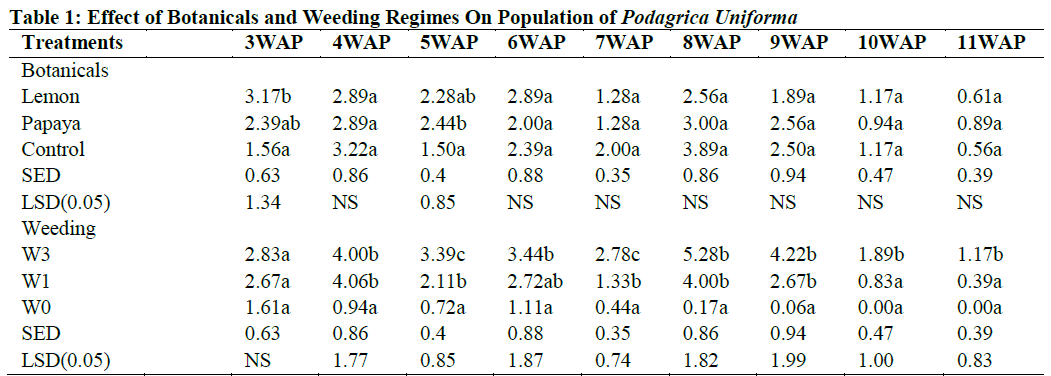
Field experiments were conducted at the Teaching and Research Farm, Faculty of Agriculture, University of Ilorin, Nigeria, to evaluate the efficacy of two botanical insecticides and different weeding regimes on insect pest infestation and yield of okra (Abelmoschus esculentus L. Moench). The study was carried out in the southern Guinea savannah ecological zone on sandy loam soil using a Randomized Complete Block Design (RCBD) with three replications. Treatments consisted of lemongrass (Cymbopogon citratus) extract, pawpaw (Carica papaya) leaf extract, and an untreated control, each combined with three weeding regimes (no weeding, one weeding, and three weedings). Botanical extracts were prepared using ethanol and applied weekly from six weeks after planting. Insect populations were visually assessed twice weekly, while yield and pod damage parameters were recorded throughout the cropping period. Data were square-root transformed and subjected to analysis of variance. Lemongrass extract showed relatively lower populations of Podagrica sjostedti at 4, 7, and 11 weeks after planting (WAP), while pawpaw extract was more effective at 5 and 9 WAP; however, botanical treatments did not differ significantly from the control for flea beetle populations. Weeding regimes significantly influenced pest infestation, with unweeded plots consistently recording the lowest pest populations. Lemongrass extract significantly increased okra fruit yield compared to pawpaw extract and the control, while weeding regimes had no significant effect on yield. Notably, lemongrass combined with three weedings produced the highest yield.
References
Abdullahi, M. S., Yusuf, A. A., & Lawal, B. O. (2022). Nutritional composition and antioxidant properties of okra (Abelmoschus esculentus (L.) Moench) seeds. Journal of Food Composition and Analysis, 110, 104562. https://doi.org/10.1016/j.jfca.2022.104562
Adebayo, O. S., Adebola, P. O., & Olatunji, T. L. (2020). Consumption patterns and culinary uses of okra in southwestern Nigeria. African Journal of Food, Agriculture, Nutrition and Development, 20(6), 16789–16803.
Adeniji, O. T., Olaniyi, J. O., & Kareem, I. A. (2021). Production constraints and economic importance of okra (Abelmoschus esculentus) in Nigeria. Journal of Agricultural Sciences, 66(2), 145–156. https://doi.org/10.2298/JAS2102145A
Adeoye, I. B., Adebisi-Adelani, O., & Olajide-Taiwo, F. B. (2021). Smallholder and commercial vegetable production systems in Nigeria. Acta Horticulturae, 1322, 59–66. https://doi.org/10.17660/ActaHortic.2021.1322.8
Adetuyi, F. C., Adebayo, O. S., & Ogunlade, I. O. (2021). Growth, yield and harvest timing of Abelmoschus esculentus (okra) in southwestern Nigeria. Journal of Horticultural Science and Crop Research, 13(4), 56–65.
Akinyele, B. O., & Temikotan, O. M. (2021). Industrial and pharmaceutical applications of okra (Abelmoschus esculentus (L.) Moench) mucilage: A review. Journal of Natural Polymers, 17(2), 123–135.
Akinyele, B. O., Ogunwale, J. A., & Sadiq, I. A. (2024). Growth and yield response of okra to temperature and moisture stress under tropical conditions. Environmental and Experimental Agriculture, 24(1), 88–101.
Al Sadi, H. I., Numan, N. A. M., Samien, L. H., & Tawfiq, F. A. (2024). Potential role of okra (Abelmoschus esculentus) mucilage in pharmaceutical fields. International Journal of Medical Informatics, 13(4), Article 1205.
Asare Bediako, E., Addo Quaye, A., & Bi Kusi, A. (2014). Comparative efficacy of phytopesticides in the management of Podagrica spp. Journal of Experimental Agriculture International.
Babalola, O. O., Adesemoye, A. O., & Ojuederie, O. B. (2022). Origin, domestication and genetic diversity of okra (Abelmoschus esculentus). Frontiers in Plant Science, 13, 843211. https://doi.org/10.3389/fpls.2022.843211
Bello, M. O., Jimoh, W. A., & Afolayan, A. J. (2023). Harvesting frequency and pod quality of okra (Abelmoschus esculentus): Implications for market supply. Journal of Vegetable Production, 9(1), 15–22.
Bello, M. O., Jimoh, W. A., & Afolayan, A. J. (2024). Indigenous vegetable-based soups and their role in food security in Nigeria. Journal of Ethnic Foods, 11(1), 12. https://doi.org/10.1186/s42779-024-00176-4
Chaudhary, D., Chauhan, S., Kumar, R., & Singh, J. K. (2024). Seasonal incidence of shoot and fruit borer (Earias vittella) in okra. International Journal of Plant & Soil Science, 36(8), 309–315. https://doi.org/10.9734/ijpss/2024/v36i84859
Food and Agriculture Organization of the United Nations (FAO). (2021). Traditional vegetables and sustainable diets in Africa. FAO.
Halder, J., Pandey, K. K., & Behera, T. K. (2022). Evaluation and economic analysis of ecofriendly biological approaches for the management of shoot and fruit borer (Earias vittella F.) of okra. Entomologia Hellenica. https://doi.org/10.12681/eh.30254
Ibrahim, H. Y., Musa, S. A., & Danjuma, M. N. (2023). Utilization of okra residues as livestock feed and industrial fiber sources. Renewable Agriculture and Food Systems, 38(3), 356–364. https://doi.org/10.1017/S1742170522000417
Igberaese, P. O., Akinkunmi, O. Y., Okoyo, M. E., & Shokalu, A. O. (2024). Chemical composition, insecticidal and repellent activities of essential oils against flea beetle (Podagrica uniforma) on okra. Nigerian Journal of Horticultural Science, 28(1). — documents adult flea beetle damage on okra leaves and impacts on plant growth and yield.
Khan, M. A., Ahmad, N., & Hussain, S. (2024). Functional and nutraceutical potential of okra seeds: A review. Food Bioscience, 56, 103218. https://doi.org/10.1016/j.fbio.2024.103218
Kuor, F., Osei Adu, M., & Nyadanu, D. (2025). Assessment of breeding value and gene action of okra germplasm for tolerance to Podagrica species, okra leaf curl and mosaic virus diseases. Ecological Genetics and Genomics, 35, 100358. https://doi.org/10.1016/j.egg.2025.100358 — discusses feeding damage by Podagrica spp. and its effects on leaf area and yield, and links these pests with viral disease transmission.
Lawal, A. O., Salami, A. E., & Ogunniyi, L. T. (2023). Profitability and adoption of improved okra varieties among Nigerian farmers. Journal of Agribusiness in Developing and Emerging Economies, 13(2), 214–228. https://doi.org/10.1108/JADEE-05-2022-0113
MDPI. (2024). Arthropod pests, nematodes, and microbial pathogens of okra (Abelmoschus esculentus) and their management: A review. Agronomy, 14(12), 2841. https://doi.org/10.3390/agronomy14122841 — identifies flea beetles in okra pest complexes and discusses their role as vectors of okra mosaic virus.
Moekchantuk, R., & Kumar, V. (2021). Harvesting and postharvest handling of okra for optimal quality. Vegetable Crops Extension Bulletin, 28(3), 45–52.
Mohapatra, S., Padhi, J., & Singh, S. (2024). Enhancing yield and economic benefits through sustainable pest management in okra cultivation. Scientific Reports, 14, Article 22220. https://doi.org/10.1038/s41598-024-72997-6
Mustapha, Y., Sadiq, I. A., & Abubakar, S. M. (2021). Proximate composition and postharvest quality of okra pods at different maturity stages. International Journal of Vegetable Science, 27(5), 456–466. https://doi.org/10.1080/19315260.2020.1869804
Ogunwale, J. A., Akinbola, G. E., & Olusegun, S. O. (2022). Seasonal planting strategies and yield optimization of okra in southwestern Nigeria. Nigerian Journal of Agronomy, 55(1), 23–31.
Olatunji, T. L., Adekunle, A. A., & Afolayan, A. J. (2021). Nutritional and health-promoting attributes of okra (Abelmoschus esculentus). Plants, 10(9), 1893. https://doi.org/10.3390/plants10091893
Oluwafemi, A. O., Oladele, O. I., & Usman, Z. (2022). Functional properties and industrial potential of okra (Abelmoschus esculentus) mucilage. Food Hydrocolloids and Polymers, 26(1), 30–41.
Oyelade, O. J., Ade-Omowaye, B. I. O., & Adeomi, V. A. (2020). Culinary diversity and functional properties of okra-based foods across cultures. Journal of Culinary Science & Technology, 18(4), 315–329. https://doi.org/10.1080/15428052.2019.1705617
Oyelade, O. J., Ade-Omowaye, B. I. O., & Adeomi, V. A. (2020). Culinary diversity and functional properties of okra based foods across cultures. Journal of Culinary Science & Technology, 18(4), 315–329.
Santos, J. R., Oliveira, E. J., & Costa, A. F. (2020). Photoperiod sensitivity and flowering behavior of okra genotypes. Scientia Horticulturae, 272, 109547. https://doi.org/10.1016/j.scienta.2020.109547
Scientific Reports. (2024). Enhancing yield and economic benefits through sustainable pest management in okra cultivation.
Shai, K. N., Chakale, M. V., Materechera, S. A., Amoo, S. O., & Aremu, A. O. (2024). Utilisation of botanicals in pest management in sub Saharan Africa.
Siemonsma, J. S., & Kouamé, C. (2021). Vegetables of tropical Africa (2nd ed.). Wageningen Academic Publishers.
Ugbaja, R. N., Okafor, J. C., & Eze, P. C. (2023). Mineral composition and dietary significance of selected indigenous vegetables in Nigeria. Journal of Food Research, 12(1), 45–56.
Zhang, H., Liu, X., & Wang, Y. (2023). Genetic variability and adaptability of okra under different latitudinal environments. Horticultural Plant Journal, 9(6), 567–576. https://doi.org/10.1016/j.hpj.2023.03.004
Downloads
Published
Issue
Section
Categories
License
Copyright (c) 2026 M.A Zubairu, C.A Odebunmi, I.O Yusuf, D.S Muritala, A.V Alagbe, S.F Babatunde

This work is licensed under a Creative Commons Attribution 4.0 International License.


