
PERFORMANCE OF COW DUNG-DERIVED BIOGAS AS A SUSTAINABLE COOKING FUEL
DOI:
https://doi.org/10.33003/fjs-2025-0912-4487Keywords:
Anaerobic digestion, Biogas production, Cow dung, Renewable cooking fuel, Sustainable energyAbstract
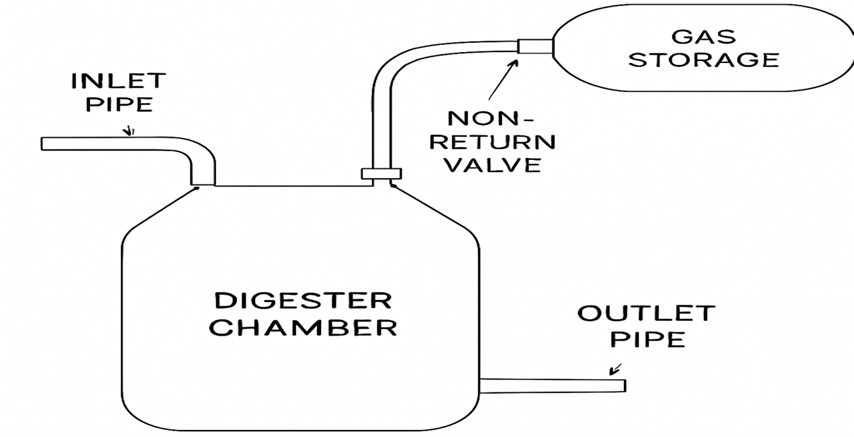
The rising demand for sustainable energy solutions has accelerated the search for low-cost, renewable, and eco-friendly cooking fuels. This study evaluated the performance of biogas derived from cow dung as a potential domestic energy source using a laboratory-scale batch anaerobic digestion system. Fresh cow dung was homogenized with water at a ratio of 4.5:20 (w/v) and introduced into a 25-liter high-density polyethylene (HDPE) digester fitted with inlet and outlet valves and linked to a gas storage unit. The system operated under mesophilic conditions for eight days, during which ambient temperature and daily gas yield were monitored. Biogas generation was negligible during the initial three days (0.00–0.018 kg), representing a lag phase in microbial activity. From Day 4 onward, production increased steadily, peaking at 9.09 kg on Day 8. Regression analysis demonstrated a strong positive correlation between retention time and biogas yield (R² = 0.94, p < 0.001), whereas temperature exhibited no significant influence (r = –0.08, p = 0.86). These results indicate that cow dung serves as a reliable substrate, capable of sustaining biogas production even under natural temperature variations. The findings confirm the viability of cow dung-derived biogas as a sustainable cooking fuel, particularly for rural households. Adoption of this technology can reduce dependence on firewood and kerosene, mitigate environmental degradation, and improve household air quality. Moreover, the use of inexpensive, locally available materials for digester construction highlights its practicality for widespread application in resource-limited communities.
References
Abubakar, B. S. U., & Ismail, N. (2012). Anaerobic digestion of cow dung for biogas production. ARPN Journal of Engineering and Applied Sciences, 7(2), 169–172.
Business Standard. (2025, July 15). UP rolls out Gram-Urja model to cut LPG use by 70% in rural homes. Business Standard. https://www.business-standard.com/india-news/up-rolls-out-gram-urja-model-to-cut-lpg-use-by-70-in-rural-homes-125071500811_1.html
Chen, Y., Cheng, J. J., & Creamer, K. S. (2008). Inhibition of anaerobic digestion process: A review. Bioresource Technology, 99(10), 4044–4064. https://doi.org/10.1016/j.biortech.2007.01.057
Circle Economy. (2021). Kenya biogas program: Developing a sustainable, domestic biodigester sector in Kenya. Circle Economy Knowledge Hub. https://knowledge-hub.circle-economy.com/nations24/article/10728
Eze, I. S., Ofoefule, A. U., Uzodinma, E. O. U., Okoroigwe, E. C., Oparaku, N. F., Eze, J. I., & Oparaku, O. U. (2011). Characterization and performance evaluation of 11 m³ biogas plant constructed at National Center for Energy Research and Development, University of Nigeria, Nsukka. Continental Journal of Renewable Energy, 2(1), 1–8.
Food and Agriculture Organization [FAO]. (2018). The state of the world’s forests 2018 – Forest pathways to sustainable development. FAO. https://www.fao.org/state-of-forests/en/
Food and Agriculture Organization [FAO]. (2023). Can Africa make charcoal more sustainable? FAO. https://www.fao.org/forestry/newsroom/en/item/1652350/icode/
Food and Agriculture Organization [FAO]. (2025, May 27). How biogas cooking fuel is transforming lives in Tanzania. FAO. https://www.fao.org/forest-farm-facility/news/news-detail/ru/c/1738307
Gana, H. A. & Sa’id, A. I. (2022). Impacts of deforestation on some selected communities in Damaturu, Yobe State Nigeria. FUDMA Journal of Sciences, 6(1), 402–407. https://doi.org/10.33003/fjs-2022-0601-911
Gashaw, A., Getachew, T., & Gebre, B. (2014). Production of biogas from cow dung and its purification using chemical absorption method. International Journal of Renewable and Sustainable Energy, 3(5), 92–97. https://doi.org/10.11648/j.ijrse.20140305.13
International Energy Agency [IEA]. (2023). A vision for clean cooking access for all. IEA. https://www.iea.org/reports/a-vision-for-clean-cooking-access-for-all
International Energy Agency [IEA]. (2024). SDG7: Data and projections. IEA. https://www.iea.org/reports/sdg7-data-and-projections
Itodo, I. N., Awulu, J. O., & Agyo, G. E. (2007). Performance evaluation of a biogas stove for cooking in Nigeria. Journal of Energy in Southern Africa, 18(3), 10–15.
Jeremiah, K. (2025, February 12). Rising costs, weak policy undermining LPG adoption in Africa. The Guardian (Nigeria). https://guardian.ng/energy/rising-costs-weak-policy-undermining-lpg-adoption-in-africa/
Kumar, J. P., Ranjeet, K. M., Sampath, C., Prakash, B., & Naveen, D. (2024). A comprehensive study on anaerobic digestion of organic solid waste: A review on configurations, operating parameters, techno-economic analysis and current trends. Biotechnology Notes, 5, 35–49.
Mattocks, R., Farrell, J. B., Haugh, C. G., Ingold, D., & Vita. (1984). Understanding biogas generation. Volunteers in Technical Assistance (VITA).
Mittal, S., Ahlgren, E. O., & Shukla, P. R. (2018). Barriers to biogas dissemination in India: A review. Energy Policy, 112, 361–370. https://doi.org/10.1016/j.enpol.2017.10.027
Moses, J. B. K., & Oludolapo, A. O. (2022). Biogas production and applications in the sustainable energy transition. Journal of Energy, 2022, Article 8750221, 1–43. https://doi.org/10.1155/2022/8750221
National Population Commission [NPC]. (2006). Official result for 2006 house and population census figures. Bureau for National Statistics. https://nationalpopulation.gov.ng/
Njogu, P., Ochieng, F. X., Ogembo, B., Ondimu, S., Kanali, C., Ronoh, E., & Ndiritu, H. (2022). Mesophilic process and kinetics studies of selected biomolecules as potential enhancers of biomethanization of cow dung in an anaerobic tubular batch reactor. Energy and Power Engineering, 14(3), 147–155.
Nopharatana, A., Pullammanappallil, P. C., & Clarke, W. P. (2007). Kinetics and dynamic modelling of batch anaerobic digestion of municipal solid waste in a stirred reactor. Waste Management, 27(5), 595–603. https://doi.org/10.1016/j.wasman.2006.02.021
Rabah, A. B., Garba, B., Hassan, L. G., & Musa, M. (2008). Production of biogas using abattoir waste at different retention time. Science World Journal, 3(4), 23–26.
Rilwanu, O. A., Nwokolo-Ojo, J. O., Ivogbe, O. R., & Adadu, A. C. (2025). The impact of proximate composition of cow dung on the rate of methane production in Akwanga Local Government Area of Nasarawa State. Journal of Science Innovation and Technology Research, 7(9). https://doi.org/10.70382/ajsitr.v7i9.023
Sadaka, S. S., & Engler, C. R. (2000). Effect of mixing on anaerobic digestion of beef manure. Applied Engineering in Agriculture, 16(4), 367–375. https://doi.org/10.13031/2013.5369
Saleh, A., & Sillah, I. U. (2022). Development and performance evaluation of bio-digester using cow dung and elephant grass (Pennisetum purpureum Schumach). Nigerian Journal of Engineering Science Research, 5(1), 55–64.
Sawyer, C. N., McCarty, P. L., & Parkin, G. F. (2003). Chemistry for environmental engineering and science (5th ed.). McGraw-Hill Education.
Surendra, K. C., Takara, D., Hashimoto, A. G., & Khanal, S. K. (2020). Biogas as a sustainable energy source for developing countries: Opportunities and challenges. Renewable and Sustainable Energy Reviews, 31, 846–859. https://doi.org/10.1016/j.rser.2013.12.015
Tyagi, V. V., & Lo, S. L. (2010). Application of biogas technology in India: Performance and policy perspectives. Renewable and Sustainable Energy Reviews, 14(2), 933–944. https://doi.org/10.1016/j.rser.2009.10.003
Ukpai, P. A., & Nnabuchi, M. N. (2012). Comparative study of biogas production from cow dung, cowpea and cassava peeling using 45 litre biogas digesters. Advances in Applied Science Research, 3(3), 1864–1869.
United Nations Children’s Fund [UNICEF]. (2021). Child injuries and violence: The facts. UNICEF. https://www.unicef.org/media/102551/file/Child-Injury-Fact-Sheet-2021.pdf
World Bank. (2023). State of access to modern energy cooking services 2022. https://documents.worldbank.org/en/publication/documents-reports/documentdetail/099200306072327242/p1727280f4c9f70e50aa6c05da4e546f1df
World Health Organization [WHO]. (2022). Household air pollution and health. https://www.who.int/news-room/fact-sheets/detail/household-air-pollution-and-health
Downloads
Published
Issue
Section
Categories
License
Copyright (c) 2025 Abdullahi Hassan Gana, Idris A. Sa’id

This work is licensed under a Creative Commons Attribution 4.0 International License.


