
STABILIZATION OF EMULSIONS BY Monodora myristica SEED PROTEIN HYDROLYSATE: EFFECT OF MOLECULAR WEIGHT DISTRIBUTIONS ON SURFACE, EMULSIFYING AND FOAMING PROPERTIES
DOI:
https://doi.org/10.33003/fjs-2025-0912-4462Keywords:
Polypetides, Monodora myristica, Emulsifier, Molecular weight, Functional propertiesAbstract
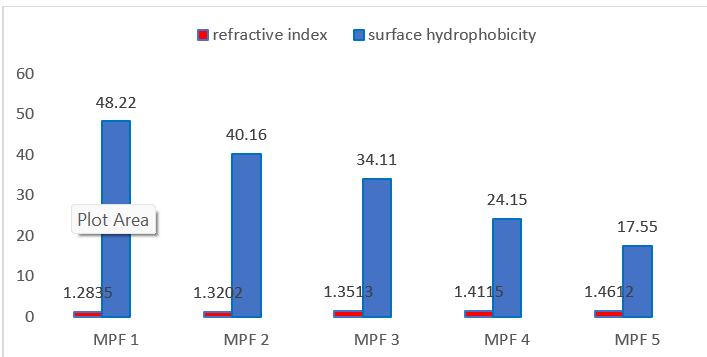
Development of sustainable benign emulsifiers from bioresource for industrial applications has continued to dominate research frontiers. Therefore, this research aimed to investigate the effect of varied molecular weights of Monodora myristica seed protein on the surface, emulsifying and foaming properties of emulsion systems. M. myristica seed protein was extracted via dialysis and fluxed into > 12, 000 kDa (MPF1), 12, 000-10, 000 kDa (MPF2), 10, 000-8, 000 kDa (MPF3), 8, 000-4, 000 kDa (MPF4) and < 4, 000 kDa (MPF5) molecular weights distributions. The results showed that the lower molecular weights M. myristica seed polypeptides fluxes were more distributed with aliphatic, hydrophilic and polar amino acids, whereas aromatic, hydrophobic, non-polar and sulphur-based amino acids residues were inherently found in the higher molecular weights variant. The surface tension of the amphoteric polypeptides increased with molecular weights, but decreased with protein flux concentration, consistent with their refractive index (1.2835-1.4612) and surface hydrophobicity index (17.55-48.22). The interfacial protein concentration and adsorbed protein, increased with molecular weight distributions of the protein fluxes. The emulsifying stability index (55.38-78.44 min.), average particle size of droplets (63.92-188.50 µm) and protein solubility (58.48-78.44 %), revealed that the higher molecular weights M. myristica seed protein fluxes has a greater tendency to form viscous stable emulsion with reduced foaming properties. The physicochemical properties exhibited by M. myristica seed polypeptide fluxes, were largely influenced by their amino acids residues and molecular weight distributions and present these specialty biopolymers with auspicious potential as suitable emulsifiers in food, pharmaceutical and chemical formulations
References
Adewole, E., Ajiboye, B.O., Idris O.O., Ojo, O.A., Onikan, A., Ogunmodede, O.T. and Adewumi, D.F. (2013). Phytochemical, Antimicrobial and GC-MS of African Nutmeg (Monodora Myristica). International Journal of Pharmaceutical Sciences and Invention 2 (5), 25-32.
Adewumi, O.O., Felix-Minnaar, J.V. and Jideani, V.A. (2022). Functional properties and amino acid Profile of Bambara groundnut and Moringa oleifera leaf protein complex. Processes, 10, 205-220. http://doi.org,/10.3390/pr10020205.
Boonlao, N., Ruktanonchai, U.R. and Anal, A.K. (2022). Enhancing Bioacessibility and Bioavailability of Caroteniods using Emulsion-based Delivery System. Colloids Surface and Biointerfaces, 209 (2), 112211. https://doi.org/10.1016/j.colsurfb.2021.112211.
Cao, W., Shi, L., Hao, G., Chen, J. and Weng, W. (2021). Effect of Molecular Weight on the Emulsion Properties of Microfluidized Gelation Hydrolysates. Food Hydrocolloid, 111 (106), 267. https://doi.org/10.1016/j.foodhyd.2020.106267.
Deotale, S., Dutta, S., Moses, J.A., Balasubramanian, V.M. and Anandharanakrishnan, C. (2020). Foaming Characteristics of Beverages and its relevance to food processing. Food Engineering Reviews, 12, 229-250.
Gabriela, V.M., Marmie-Pierre, B.S.L. and Mirian, D.H. (2021). Membrane fractionation of protein Hydrolysates from by-products: Recovery of valuable compounds from spent yeast. Membrane 11, 23. https://dx.doi.org/10.3390/membranes11010023.
Gite, A.N., Neither, N., Sharifah, K.S.M., Nortiasnida, Z., Nor, A.M. and Rosilina, K. (2022). Physicochemical and functional properties of carbohydrate-protein gum extract from kenaf (Hibiscus cannabinus L) Seed. International Journal of Food Science and Technology, 57, 258-267.
Igartus, D.E., Dichano, M.C., Ferrari, S.B., Palazolo, G.G. and Cabezas, D.M. (2024). Combination of pH-Shifting, Ultrasound and Heat Treatment to enhance Solubility and Emulsifying Stability of Rice Protein Isolate. Food Chemistry, 433, 137319. https://doi.org/10.1016/j.foodchem.2023.137319.
Kutzli, L., Weiss, J. and Gibbs, M. (2021). Glycation of Plant Proteins via Maillard Reaction Chemistry, Technofunctional Properties and Potential Food Applications. Foods 10, 376. https://doi.org/10.3390/foods10020376
Lin, D., Sun, L.C., Chen, Y.L., Liu, G.M., Maio, S. and Cao, M.J. (2022). Peptide/Protein Hydrolysate and their Derivative: their role as emulsifying agents for Enhancement of Physical and Oxidative Stability of Emulsions. Trends in Food Science and Technology, 129, 11-24. https://doi.org/10.1016/j.tifs.2022.08.012.
McClements, D.J., Bai, L., and Chung, C. (2017). Recent Advances in the Utilization of Natural Emulsifiers to form and Stabilize Emulsions. Annual Review in Food Science and Technology, 8, 205-236.
Ndagana, S.F., Umar, D.R., Barminas, J.T. and Saddiq, H.A. (2015). Surface Properties and Emulsifying Stability of Konkoli (Maesopsis eminii) Seed Gum. International Journal of Engineering Research and Technology, 4(6), 1193-1198.
Downloads
Published
Issue
Section
Categories
License
Copyright (c) 2025 Adeiza Emmanuel Samuel, Aishatu Abubakar Usman, Bwala Yusuf Hyeladzira, Babajide Michael Odejobi

This work is licensed under a Creative Commons Attribution 4.0 International License.


