
DIETARY DIVERSITY AND SELECTED MICRONUTRIENTS STATUS OF PRIMARY SCHOOL PUPILS IN MAKURDI LOCAL GOVERNMENT AREA OF BENUE STATE
DOI:
https://doi.org/10.33003/fjs-2025-0912-4447Keywords:
dietary diversity, nutritional status, primary pupils, makurdi, Benue stateAbstract
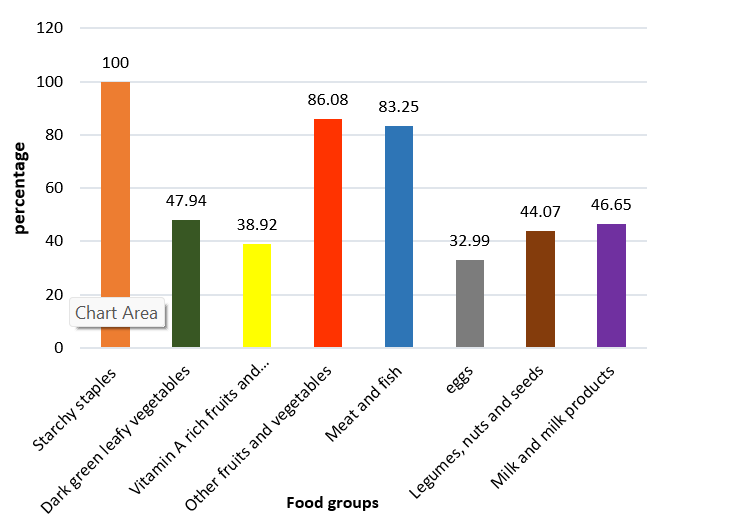
Dietary diversity is influenced by accessibility to food, the more food groups included in a daily diet, the greater the likelihood of meeting nutrient requirements. Hence, the study was conducted to investigate the association between dietary diversity scores (DDS) and the nutritional status of 388 preschool children in Makurdi, Benue state, Nigeria. A 24 hour dietary recall questionnaires and dietary diversity scores (DDS) were calculated based on 7 food groups (starchy staples, leafy vegetables, Vitamin A rich fruits and vegetables, other fruits and vegetables, meat and fish, eggs, legumes and seeds/nuts, milk and milk products). The results revealed cereals and cereal products (51.0%) are mostly consumed daily, followed by roots and tubers (19.5%). The consumption of fruits and vegetables was low with 6.3% of the pupils consuming fruits daily and 10.9% consuming vegetables daily. This highlights potential gaps in the consumption of essential food groups contributing to dietary diversity, hence, this study reinforce the importance of continued nutrition education of mothers, caregivers and preschool staff on the need to ensure consumption of diverse food sources in order to improve the nutritional status of children. Further studies are recommended on factors associated with low dietary diversity among preschool children.
References
Adebukola, C. O., Ugwunna, U. M., & Ekerette, N. N. (2017). Dietary diversity and nutrient intake adequacy among women in Iwo Local Government Area, Osun State Nigeria. African Journal of Food, Agriculture, Nutrition and Development, 17(4), 12641–12656. https://doi.org/10.18697/ajfand.80.16280
Arimond, M., & Ruel, M. T. (2004). Dietary diversity is associated with child nutritional status: evidence from 11 demographic and health surveys. The Journal of Nutrition, 134(10), 2579–2585. https://doi.org/10.1093/JN/134.10.2579
Ayogu, R. (2019). Energy and nutrient intakes of rural Nigerian schoolchildren: relationship with dietary diversity. Food and Nutrition Bulletin, 40(2): 241–253.
Bhandari, S., Sayami, J. T., Thapa, P., Sayami, M., Kandel, M. R. and Banjara, B. P. (2016). Dietary intake patterns and nutritional status of women of reproductive age in Nepal: Findings from a health survry. Arch public Health. 74(20: 1-11.
Black, R.E., Victora, C.G., Walker, S.P., Bhutta, Z.A., Christian, P., de Onis, M., Ezzati, M., Grantham-McGregor, S., Katz, J., Martorell, R. and Uauy, R. (2013). Maternal and child undernutrition and overweight in low-income and middle-income countries. Lancet, 382 (9890): 427–451.
BSMOE (2019). Number of registered primary schools with population distribution across Makurdi LGA of Benue State.
Clap, J., Moseley, W. G., Burlingame, B. and Termine, P. (2022). The case for a six-dimensional food security framework. Food Policy, 106(102164):1-10.
El-Sabely, A.A, Tork, H.M.M and Hussien, Y.E.(2013) Comparative study of nutritional status and dietary habits of children from public and private primary schools in Zagazig City, Egypt. IOSR-JNHS 3(1): 47-52.
FAO. (2004). Fruit and Vegetables for Health -Report of a Joint FAO/WHO Workshop, 1–3 September 2004, Kobe, Japan, Kobe, Japan.
Food and Agriculture Organization of the United Nations. (2011). The State of Food Insecurity in the World. Accessed 7 August 2012. Available:http://www.fao.org/docrep/013/i1683e/i1683epdf.
Food and Agriculture Organization of the United Nations. (2011). The State of Food Insecurity in the World. Accessed 7 August 2012. Available:http://www.fao.org/docrep/013/i1683e/i1683epdf.
Givens, D. I. (2020). MILK Symposium review: The importance of milk and dairy foods in the diets of infants, adolescents, pregnant women, adults, and the elderly. Journal of Dairy Science, 103(11), 9681–9699. https://doi.org/10.3168/JDS.2020-18296
Hunger Notes. (2011). World hunger and poverty facts and statistics. World Hunger Education Service, Washington D.C. Accessed 12 May 2011. Available:http://www.worldhunger.org/learn/worldhungerfacts2002.htm.
Igbokwe, O., Addimorah, G., Ikefuna, A., Ibeziako, N., Ubesie, A., Ekeh, C. and Iloh, K. (2017). Soco-demographic determinants of malnutrition among primary school aged children in Enugu, Nigeria. Pan African Medical Journal, 28:248p.
Ijarotimi, O. S. (2013). Determinants of Childhood Malnutrition and Consequences in Developing 2013 2:3, 2(3), 129–133. https://doi.org/10.1007/S13668-013-0051-5
International Food Policy Research Institute. (2011). Value chain for nutrition. Leveraging agriculture for improving nutrition and health. Brief 4. |IFPRI| 2020 International conference, New Delhi, India.
Kamath, S. M., Venkatappa, K. G. and Sparshadeep, E. M. (2017). Impact of nutritional status on cognition in institutionalized orphans: A pilot study. Journal of Clinical and Diagnostic Research, 11(3): CC01-CC04.
Karya Kate Nanbol, & Otsanjugu Aku Timothy Namo. (2019).The Contribution of Root and Tuber Crops to Food Security: A Review. Journal of Agricultural Science and Technology B, 9(4). https://doi.org/10.17265/2161-6264/2019.04.001
Khamis, A. G., Mwanri, A. W., Ntwenya, J. E. and Kreppel, K. (2019). The influence of dietary diversity on the nutritional status of children between 6 and 23 months of age in Tanzania. BMC Pediatrics, 19(1): 518.
Labadarios, D., Steyn, N. P. and Nel, J. (2011). “How diverse is the diet of adult South African?”. Nutrition Journal, Vol. 10, No.33.
Lozoff, B., Jimenez, E. and Wolf, A. W. (2013). Long-term developmental outcome of infants with iron deficiency. N Engl Journal of Medcine, 325: 687–694.
Modjadji, P., Molokwane, D., & Ukegbu, P. O. (2020). Dietary diversity and nutritional status of preschool children in northwest province, South Africa: A cross sectional study. Children, 7(10). https://doi.org/10.3390/CHILDREN7100174
Momodu, A. S., Akinbami, C. A. O. and Obisanya, J. F. (2011). Achieving food security and climate change mitigation through entrepreneurship development in rural Nigeria: Gender perspective. Africa Journal of Enviromental Science and Technology, 5(10): 834-854.
Mrimi, E. C., Palmeirim, M. S., Minja, E. G., Long, K. Z. and Keiser, J. (2022). Malnutrition, anemia, micronutrient deficiency and parasitic infections among schoolchildren in rural Tanzania. PLoS Neglected Tropical Diseases, 16(3): 0010261.
Nicholson, C. F., Kopainsky, B., Stephens, E. C., Parsons, D., Jones, A. D. and Garrett, J. (2020). Conceptual frameworks linking agriculture and food security. Nature Food, 1(9): 541-551.
NIPOST (2014). Post offices with map of Nigeria. Retrieved from https://en.wikipedia.org/wiki/Makurdi
Okafor, A.M., Odo, E.O. and Onodigbo, E.O. (2020). Dietary diversity: association with academic performance and anthropometric indices of rural Nigerian school children. Pakistan Journal of Nutrition, 19: 61-67. doi: 10.3923/pjn.2020.61.67
Olumakaiye, M.F (2013). Dietary diversity as a correlate of under-nutrition among school age. Annual Nutrition Metabolism 63: 569-569.
Opoola, F., Adebisi, S.S. and Ibegbu, A.O. (2016). The study of nutritional status and academic performance of primary school children in Zaria, Kaduna State, Nigeria. Annals of Bioanthropology, 4 (2):96. doi: 10.4103/2315-7992.204680
Owusu, S.J. (2013). Assessment of dietary intakes and nutritional status of school age children participating in school feeding programmes at Otinibi and Danfa. [Dissertation on the Internet] Ghana: University of Ghana. Available from: http://ugspace.ug.edu.gh/. Accessed 13/06/17.
Patsa, M. K. and Mukherjee, S. S. (2021). Relationship between Nutritional Status and Academic performance of Primary School Children in Rural Bankura Region of West Bengal, India. Bioscience Biotechnology Research Communications, 14(2): 686-691.
Ritchie, H. and Roser, M. (2017). Micronutrient deficiency. Our world in data. Retrieved from https://ourworldindata.org/micronutrient-deficiency.
Soto, C. J. and Tackett, J. L. (2015). Personality traits in childhood and adolescence: structure, development and outcomes. Current Directions in Psychological Sciences, 24(5): 358-362.
Steyn, P, Villiers, A, Gwebushe, N, Draper, C.E, Hill, J, Waal, M (2015). HealthKick, a randomised controlled trial primary school nutrition intervention improve dietary quality of children in low-income settings in South Africa? BMC Public Health, 15(1): 1- 11.
Torheim, L. E., Ouattara, F., Diarra, M. M., Thiam, F. D., Barikmo, I., Hatløy, A., & Oshaug, A. (2004). Nutrient adequacy and dietary diversity in rural Mali: Association and determinants. European Journal of Clinical Nutrition, 58(4), 594–604. https://doi.org/10.1038/sj.ejcn.1601853
UNICEF. (2020). NUTRITION, FOR EVERY CHILD. www.unicef.org
UNICEF/Food Fortification Initiative. (2012). “Monitoring of Flour Fortification: The Case of South Africa.” New York. Retrieved from www.ffinetwork.org/monitor/Documents/SouthAfricaCS.pdf
Weininger, J., Truswell, A., Carpenter, K., Kent and Douglas, W. (2023). Human Nutrition.Encyclopedia Britannica. Available at https://www.britannica.com/science/human-nutrition. Accessed 16 July 2023
WHO (2013). Guidance Note: Integrating the Right to Adequate Food into Food and Nutrition Security Programmes. [Online] Retrieved from: World Nutrition Note. (Accessed on 12th May, 2019).
Downloads
Published
Issue
Section
Categories
License
Copyright (c) 2025 M Tsa Erdoo, T Iombor Theophilus, E Okonkwo Lovina

This work is licensed under a Creative Commons Attribution 4.0 International License.


