
AN EVALUATION OF FERTILITY CAPABILITY CLASSIFICATION OF MBAMBA SOILS IN YOLA SOUTH LOCAL GOVERNMENT AREA NORTH-EASTERN NIGERIA
DOI:
https://doi.org/10.33003/fjs-2025-0912-4433Keywords:
Capability, Classification, Evaluation, Fertility, SoilAbstract
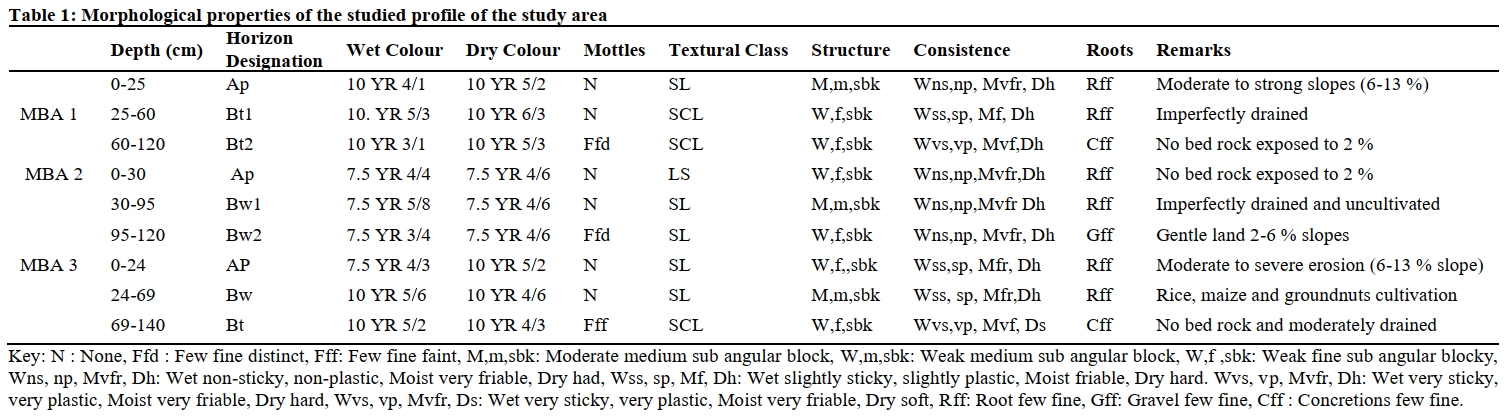
Understanding soil fertility capability status is considered as one of the most important tool towards improving and managing soil nutrients for profitable and sustainable farming. This study aimed to evaluates fertility capability classification of Mbamba soils in Yola South Local Government Area North-eastern Nigeria. Three (3) profile pits were dug based on the topo-sequence variation where core soils samples of the soils were collected from the identified distinct horizons. The results revealed that fertility capability classification (FCC) of the soils at profile 1 and 3 was classified as LLdn-km dominated with loamy soil developed under ustic moisture regime having 6-15 % Na saturation, low nutrient reserve and organic matter. In addition, at profile 3 site of the area it was classified as SLdn-km characterized as soil dominated with sandy texture at surface and loamy at subsurface horizons with low nutrient reserve, low exchangeable cation exchange capacity and organic matter content. Generally, the soils were classified as low fertility capability soils to support effective crop growth and development. Therefore, there is ardent need for the farmers in the area to employ integrated nutrients management techniques with the aim of improving and sustaining the soil nutrients for sustainable food production in the area.
References
Adisa, K. F., Ojetada, J. O., Muda, S. A. and Amusan A. A. (2016). Characterization and fertility capability classification of the soils of Shasha River Floodplain, Osun State Nigeria. Ife journal of Agriculture. Vol. 28 (1) pp20-34.
Agboola, A. A. and Shittu, O. S. (2002). Farming systems in Nigeria. In: Agboola, A. A. (ed) Essentials of Agricultural Production in Nigeria, 1st edition. Green Line Publishers, Ado-Ekiti pp 240.
Ahukaemere, C. M., Onweremadu, E.U., Akamigbo, F. O. R., and Ndukwu, B. N.(2016). Suitability evaluation of soils of the Coastal plain Sands for rain fed maiz production in acid Sands of South Eastern Nigeria. Nigerian journal of soil science 26, 138-145
Anne N. K, Charles K. K. G, Balthazar M. M, Peter W. M, Nyambilila A and Patrick T. G. (2015). Soil Morphology, Physico - Chemical Properties and Classification of Typical Soils of Mwala District, Kenya. International Journal of Plant & Soil Science4 (2): 156 170, 2015; Article no. IJPSS.2015.017ISSN: 2320-7035 SCIENCEDOMAINinternational www.sciencedomain.org
Amalu, U. C. (1998). Evaluation of properties of selected soils of Cross River Area and their management for increase cassava yield. Global Journal of Pure and Applied Sciences, 4 (3): 243-249
Ashenafi Ali, Abayneh, E, and Sheleme, B. (2010). Characterizing soils of DelboWegene watershed, Wolaita zone, Southern Ethiopia for planning appropriate land management. Journal of Soil Science and Environmental Management. 1(8), 184-199.
Azooz, A.H. and Arshad, M.A. (1996). Soil infiltration and hydraulic conductivity underlong-term no-tillage and conventional tillage systems. Can. J. Soil Sci. 76: 143-152.
Beyene, D. (2019). Fertility Evaluation of Soil For Cereal Production.Global Scienctific Journals. GSJ: Volume 7, Issue 3, March 2019, Online: ISSN 2320-9186 . PP. 1007-1037 www.globalscientificjournal.com
Boskina, Y, Michael, C.G., Mamman A, Kefas, P.K., Manga, A.B. and Habila, R.A. (2025). effects of organo-mineral fertilizers on growth and yield of four upland rice cultivars in two locations in Taraba State, Nigeria. FUDMA Journal of Sciences (FJS). Vol. 9 No. 7, July, 2025, pp 201 – 206 https://doi.org/10.33003/fjs-2025-0907-3325. ISSN online: 2616-1370 . ISSN print: 2645 - 2944
Bremner, J. M. (1965). Total nitrogen in Methods of soil analysis part 2, 1149 – 1178, Madison, WC. American Society of Agronomy.
Buol SW, Sanchez PA, Cate Jr RB, Granger M (1975). Soil Fertility Capability Classification: A technical soil classification system for fertility management. In: E. Bornemisza and Alvarado, A. (eds) Soil management in Tropical America. North Carolina State University, Raleigh, North Carolina.
Debela, H., Jesse, T.N., Zemede, A., and Nyangito, M.M. (2011). Physico-chemical soil properties of semiarid Ethiopia in two land use systems: Implications to crop production. International Journal of Agricultural Research. 6:12: 840-847.
Gachene, C.K.K. and Kimaru, G. (Eds.) (2003). Soil fertility and Land productivity: A guide for extension workers in the Eastern Africa Region. RELMA Technical Handout Series 30. Nairobi, Kenya: Regional Land Management Unit (RELMA), Swedish International Development Cooperation Agency (SIDA). Pp.164.
Hillel, D. (1980). Fundamentals of Soil Physics. Academic Press, Inc., London.
Hussain, M.M. (2004). Characterization and Classification of some Intensively Cultivated soil from the Ganges River Floodplain of Bangladesh. Dhaka Univ. Journal of Biological Science, 20:71-80
Igboekwe, M. U. and Adindu, R. U. (2011). Groundwater Recharge through Infiltration Process: A case study of Umudike, Southeasern Nigeria. Journal of Water Resource and Protection, 3: 295 – 299.
Jonh, L. H., Samuel, L. T. James, B. D., and Werner, L. N. (2006). Soil fertility and fertilizers: An introduction to nutrient management. 7th by Prentice Hall publishing co-Ltd. New-Delhi 110, 017 India Pp. ix, 98, 102, 164, 203, 293-360, 412-414, 447, 448 and 456.
Jaiswal, P.C. (2003). Soil, Plant and Water Analysis.Kalyani Publishers, Ludhiana, New Delhi, Norda Hyderabab, India. Pp.1-399.
Landon, J.R. (1991). Booker Tropical Soil Manual. A hand book for survey and agricultural land evaluation in the tropics and sub-tropics. 1st edition. N.Y, John Wiley and Sons Inc. 605 Third Avenue. New York. USA. P. 474.
Liu, M., Guilin H. and Qian Z.(2019). Effects of Soil Aggregate Stability on Soil Organic Carbon and Nitrogen under Land Use Change in an Erodible Region in Southwest China.International Journal of Environmental Research and Public Health 16 (20):3809.
Liu, M., Han, G.L., Li, Z.C., Liu, T.Z., Yang, X.M., Wu, Y.T., and Song, Z.L. (2017). Effects of slope position and land useon the stability of aggregate-associated organic carbon in calcareous soils. Acta Geochim. 36, 456–461.
Mahajan, S. and Billore, D. (2014). Assessment of Physico-chemical characteristics of the soil of Nagchoon Pond Khandwa, MP, India. Research Journal of Chemical Sciences. 4(1), 26-30.
Moraru, S.S., Ene, A., and Badila, A. (2020). Physical and Hydro-Physical Characteristics of Soil in the Context of Climate Change. A Case Study in Danube River Basin, SE Romania Sustainability. www.mdpi.com/journal/sustainability PP 1.26.
Mulugeta, D. and Sheleme, B. (2011). Characterization and classification of soils along the toposequence of Kindo Koye watershed in southern Ethiopia. MoA. Addis Ababa, Ethiopia. East Africa Journal of Science. 4 (2):65-77.
Msanya, B.M., Kaaya, A.K., Araki, S., Otsuka, H., and Nyadzi, G. I. (2003). Pedological characteristics, general fertility and classification of some benchmark soils of Morogoro District, Tanzania. African Journal of Science and Technology, Science and Engineering Series. 4(2):101-112.
Nwite, J. C. and Okolo, C. C. (2020). Enhancing rice productivity through soil fertility management in South-Eastern Nigeria. International Journal of Agriculture and Rural Development, 23(1), 5123–5130.
Nsor, M. E. And Ibanga, I. J. (2008). Morphological Characteristics and classification of soils derived from diverse parent materials in Central Cross River State, Nigeria.Global Journal of Pure and Applied Sciences Vol. 14, No. 3, 2008: 271 - 277 Copyright (C) Bachudo Sciences Co. Ltd. Printed In Nigeria. ISSN 1118-0579
Oklo, A.D., Armstrong, I.A., Idoko, O.M., Iningev, T.S., Emmanuel, A.A. and Oklo, R.O. (2021) Assessment of Soil Fertility in Terms of Essential Nutrients Contents in the Lower Benue River Basin Development Authority Project Sites, Benue State, Nigeria. Open Access Library Journal 8: e7222. https://doi.org/10.4236/oalib.1107222
Palm, C.A., Gachengo, C.N., Delve, R.J., Cadisch, G, and Giller, K.E., (2001). Organic inputs for soil fertility management in tropical agroecosystems: application of an organic resource database. Agriculture, Ecosystems and Environment 83, 27-42.
Petters, S. N., (1995). South-Eastern Benue Trough and Ikom - Mamfe Embayment. In: Geological Excursion Guide Book to Oban Massif, Calabar Flank and Manfe Embayment, Southern Nigeria, Dec Ford Publisher’s Limited, Calabar.
Patil, A.H., Kumbhar, A.V ., Nale, V.N (2017). GIS-GPS Based Soil Fertility Maps of Agriculture College Farm, Kadegaon District Sangli: Maharashtra. International Journal of Engineering Science and Computing, November 2017 http://ijesc.org/. pp 15426-15430.
Quansah, G. W. (2010). Effect of Organic and Organic Fertilizers and their combinations on the Growth and Yield of Maize in the Semi-deciduous Forest Zone of Ghana. M.Sc Thesis submitted to the department of Crop and Soil Sciences, College of Agriculture and Natural Resources, Kwame Nkrumah University of Science and Technology, Kumasi, Ghaja.
Rao, D.V.K.N. and Jose, A.I. (2003). Fertility capability classification of some soils under rubber in Kerala. Journal of the Indian Society of Soil Science 51,183-188.
Reichert, J.M, Luis, E.A., Sanches, S, Dalvan, J R., Rainer, H. and Inge, H. (2009). Reference bulk densityand critical degree of compactness for no-till crop production in subtropical highly weathered soils. Soil and Tillage Research. Vol 102 pp 242-254
Sadiq A.A and Shuwa S.A (2019). An appraisal of substantive soil and water conservation techniques adopted on different farm locations in Yola South LGA, Adamawa State, Nigeria. International Journal of Scientific Research Engineering & Technology (IJSRET), ISSN 2278 – 0882 (8):3:164-173.
Sadiq, A.A., Abdullahi, M., and Ardo. A.U. (2019). An overview of soil fertility degradation in Mubi area, North- eastern part of Nigeria. International Journal of Scientific and Research Publications, vol. 9 (2) Feb. 2019. 692-697. ISSN 2250-3153. http://dx.doi.org/10.29322/IJSRP.9.02.2019.p8685
Sadiq, A.A. and Tekwa, I.J. (2022).Soil Fertility and Management Practices in Mubi Region. Published by Abti Printing Press, Yola. ISBN. 978-978-959-589-1. Sponssored by Tetfund.
Sadiq, A.A and Vahyala I.E (2023). Characterization of physical and hydraulic properties of some selected arable lands in Yola South Local Government Area, Adamawa state. Published by Ahmadu Bello University, Zaria Printing Press. ISBN:978-978-792-494-5. Pp.18-20
Sanchez, P.A. and R.R.B. Leakey, (1997). Land-use transformation in Africa: Three determinants for balancing food security with natural resource utilization. European Journal of Agronomy. 7: 15-23.
Sanchez, P.A., Palm, C.A. and Buol, S.W. (2003). Fertility capability soil classification: a tool to help assess soil quality in the tropics. Geoderma 114, 157-185.
Singh, B., Chanasyk, D. S., McGill, W. B., and Nyborgo, M. P. K. (1994). Residue and tillage management effects on soil properties ofa Typic Cryoboroll under continuous barley. Soil Tillage Res. 32: 1 17-133.
Suharta, N. (2010). Characteristics and problems of marginal soil from acid sedimentary rocks in Kalimantan. Journal of Agricultural Research and Development. 29 (4), 139-146
Downloads
Published
Issue
Section
Categories
License
Copyright (c) 2025 Muhammed Bashir Jungudo, Abubakar Sadiq Abdulqadir

This work is licensed under a Creative Commons Attribution 4.0 International License.


