
EFFICACY OF SYNTHESIZED SILVER NANO-PARTICLES USING Picralima nitida CRUDE SEED EXTRACT (ABEERE) ON Plasmodium berghei INFECTED MICE
DOI:
https://doi.org/10.33003/fjs-2025-0912-4421Keywords:
Extract, Malaria treatment, medicinal plants, Mice, Plasmodium berghei, parasiteAbstract
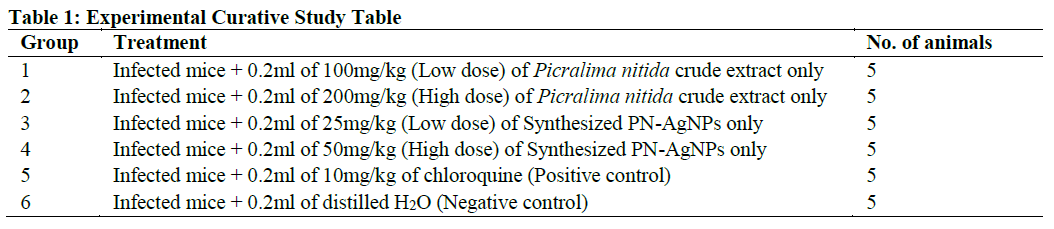
Malaria is a potentially fatal disease caused by Plasmodium parasites. The synthesis of silver nano-particles using plant extracts is getting more attention, due to their application in biomedical sciences such as anti-parasitic, anti-malarial, bactericidal and fungicidal activity. This study was designed to evaluate the efficacy of synthesized silver nano-particles using crude seed extract of Picralima nitida on Plasmodium berghei infected mice focusing on weight, percentage parasitemia, packed cell volume (PCV) and white blood cell (WBC) count. Thirty mice were randomly divided into six groups of five animals each. Infection was established using Plasmodium berghei, and treatment was administered following a 4-day curative protocol. The infected groups received 25 mg/kg and 50 mg/kg of P. nitida-synthesized silver nanoparticles, while comparison groups received 100 mg/kg and 200 mg/kg of P. nitida crude extract. Changes in weight, parasitemia, PCV, and WBC count were determined using standard hematological and microscopic techniques. Mice treated with 50mg/kg of Picralima nitida synthesized silver nano-particles showed significant improvement in weight, increased packed cell volume, decreased percentage parasitemia and white blood cell count at the post infection period. The findings demonstrated that Picralima nitida synthesized silver nano-particles is more effective as an antimalarial agent and preserves red blood cell integrity than Picralima nitida crude extract and hence can be used as an antimalarial drug.
References
Charan, J., and Kantharia, N. D. (2013). How to calculate sample size in animal studies?. Journal of pharmacology and pharmacotherapeutics, 4(4), 303-306.
Adebayo, J. O., Orire, A. B., Gyebi, G. A., Olorundare, O. E., & Babatunde, A. S. (2022). Effects of 3-O-[6-deoxy-3-O-methyl-β-D-allopyranosyl-(1 4)-β-D-canaropyranosyl]-17β-marsdenin on selected indices of cardiovascular diseases in mouse. Comparative Clinical Pathology, 31(1), 155-168.
Alcover, C. F., Bernadat, G., Kabran, F. A., Le Pogam, P., Leblanc, K., Fox Ramos, A. E., and Beniddir, M. A. (2020). Molecular networking reveals serpentinine-related bisindole alkaloids from Picralima nitida, a previously well-investigated species. Journal of Natural Products, 83(4), 1207-1216.
Ali, A., Zafar, H., Zia, M., ul Haq, I., Phull, A. R., Ali, J. S., and Hussain, A. (2016). Synthesis, characterization, applications, and challenges of iron oxide nanoparticles. Nanotechnology, Science and Applications, 9, 49.
Amaeze, O. U., Aderemi-Williams, R. I., Ayo-Vaughan, M. A., Ogundemuren, D. A., Ogunmola, D. S., and Anyika, E. N. (2018). Herbal medicine use among type 2 diabetes mellitus patients in Nigeria: understanding the magnitude and predictors of use. International Journal of Clinical Pharmacy, 40(3), 580-588.
Ansa, A.R., Kapadia, G. J., Lloyd, H. A., and Sokoloski, E. A. (1990). Picratidine, a new indole alkaloid from Picralima nitida seeds. Journal of Natural Products, 53(4), 975-977.
Chowdhury, A., Kunjiappan, S., Panneerselvam, T., Somasundaram, B., and Bhattacharjee, C. (2017). Nanotechnology and nanocarrier-based approaches on treatment of degenerative diseases. International nano letters, 7(2), 91-122.
Dacie JV, Lewis SM (1991) Practical hematology, 7th edn. ELBS, England, pp 37–85
David, F. A., Rosenthal, P. J., Croft, S. L., Brun, R., and Nwaka, S. (2004). Antimalarial drug discovery: efficacy models for compound screening. Nature reviews Drug discovery, 3(6), 509-520.
Erharuyi, O., Falodun, A., and Langer, P. (2014). Medicinal uses, phytochemistry and pharmacology of Picralima nitida (Apocynaceae) in tropical diseases: A review. Asian Pacific journal of tropical medicine, 7(1), 1-8.
Folarin, R. O., Omirinde, J. O., Bejide, R., Isola, T. O., Usende, L. I., & Basiru, A. (2014). Comparative hepatoprotective activity of ethanolic extracts of Cuscuta australis against acetaminophen intoxication in wistar rats. International scholarly research notices, 2014(1), 730516.
Gedda, M. R., Madhukar, P., Vishwakarma, A. K., Verma, V., Kushwaha, A. K., Yadagiri, G. and Sundar, S. (2020). Evaluation of safety and Antileishmanial efficacy of amine functionalized carbon-based composite nanoparticle appended with amphotericin B: An in vitro and preclinical study. Frontiers in chemistry, 8, 510.
Iwalewa, E.O.; Lege-Oguntoye, L.; Rai, P.P., Iyaniwura, T.T. (1997). In vivo and In vitro antimalarial activity two crude extracts of cassia occidentalis leaf. Niger. J. Pharm. Sci. 5: 23-28.
Jain NC (1986) Schalm's veterinary hematology, 4th edn. Lea and Fabiger, Philadelphia, pp 564–572
Jain, K., Gowthamarajan, K., Sood, S., Elango, K., and Suresh, B. (2012). Olfactory drug delivery of artemether-curcumin combination for management of cerebral malaria. Malaria Journal, 11(1), 1-1.
Jiotsa, T. B., Gounoue K. R., Tsakem N., Jaurès M., Ngueguim T. F., Djouwoug N. C., Ndelo J.t, Tekam J. M., Kouamouo J., and Dimo T. (2022). Journal of Medicinal Plants Studies, 10(3): 24-30.
Kabiru, Y. A., Okolie, N. L., Muhammad, H. L., and Ogbadoyi, E. O. (2012). Preliminary studies on the antiplasmodial potential of aqueous and methanol extracts of Eucalyptus camadulensis leaf. Asian Pacific Journal of Tropical Disease, 2, S809-S814.
Khan, M. E., Amupitan, J. O., Oyewale, A. O., and Ndukwe, I. G. (2015). Evaluation of the in vivo antimalarial activity of the methanolic leaf extract of Nepata cateria. Research in Pharmaceutical Biotechnology, 6(2), 8-15.
Kooij, T. W., Janse, C. J., and Waters, A. P. (2006). Plasmodium post-genomics: better the bug you know? Nature Reviews Microbiology, 4(5), 344-357.
Lateef, A., Folarin, B. I., Oladejo, S. M., Akinola, P. O., Beukes, L. S., and Gueguim-Kana, E. B. (2018). Characterization, antimicrobial, antioxidant, and anticoagulant activities of silver nanoparticles synthesized from Petiveria alliacea L. leaf extract. Preparative Biochemistry and Biotechnology, 48(7), 646-652.
Laurent, S., Forge, D., Port, M., Roch, A., Robic, C., Vander Elst, L., and Muller, R. N. (2010). Magnetic iron oxide nanoparticles: synthesis, stabilization, vectorization, physicochemical characterizations, and biological applications. Chemical reviews, 108(6), 2064-2110.
Lohitha, G., Kalani, H., Pindiprolu, S. K., Arakareddy, B. P., and Yadagiri, G. (2022). Current challenges and nanotechnology-based pharmaceutical strategies for the treatment and control of malaria. Parasite Epidemiology and Control, e00244.
Lorke, D. (1983). A new approach to practical acute toxicity testing. Archives of toxicology, 54(4), 275-287.
Masri, A., Anwar, A., Rao, K., Rajendran, K., Khan, N. A., Shah, M. R., and Siddiqui, R. (2019). Antimicrobial activities of green synthesized gums-stabilized nanoparticles loaded with flavonoids. Scientific reports, 9(1), 1-12.
Murray, V., Wardlaw, J. M., Berge, E., and Del Zoppo, G. J. (2014). Thrombolysis for acute ischaemic stroke. Cochrane database of systematic reviews, (7).
Naseri, N., Valizadeh, H., and Zakeri-Milani, P. (2015). Solid lipid nanoparticles and nanostructured lipid carriers: structure, preparation and application. Advanced pharmaceutical bulletin, 5(3), 305.
Nwankwo, N. E., Egbuonu, A. C. C., Nduka, F. O., and Nwodo, O. F. C. (2017). Effect of seed extract of Picralima nitida on haematological parameters of malaria-infected albino mice and its interference with the serum electrolyte levels. Ife Journal of Science, 19(2), 379-388.
Ogbeide, O. K., Sajere, O., Omorefe, N., Aghedo, O. N., Isibor, J. I., Osarinmwian, O., and Iyekowa, O. (2025). Selected Preclinical Studies on Picralima nitida Stem Bark Extract. Tropical Journal of Drug Research, 2(2), 29-37.
Okokon, J. E., Antia, B. S., Igboasoiyi, A. C., Essien, E. E., and Mbagwu, H. O. C. (2007). Evaluation of antiplasmodial activity of ethanolic seed extract of Picralima nitida. Journal of Ethnopharmacology, 111(3), 464-467.
Okpe, O., Habila, N., Ikwebe, J., Upev, V. A., Okoduwa, S. I., & Isaac, O. T. (2016). Antimalarial potential of Carica papaya and Vernonia amygdalina in mice infected with Plasmodium berghei. Journal of tropical medicine, 2016(1), 8738972.
Patra, D. K., Pradhan, C., and Patra, H. K. (2018). Chelate based phytoremediation study for attenuation of chromium toxicity stress using lemongrass: Cymbopogon flexuosus (nees ex steud.) W. Watson. International journal of phytoremediation, 20(13), 1324-1329.
Penna-Coutinho, J., Cortopassi, W. A., Oliveira, A. A., França, T. C. C., and Krettli, A. U. (2011). Antimalarial activity of potential inhibitors of Plasmodium falciparum lactate dehydrogenase enzyme selected by docking studies. PloS one, 6(7), e21237.
Peter, I.T. and Antoli, V.K. (1998). The current global malaria situation. Malaria parasite biology, pathogenesis and protection. ASM press, W.D.C, p11-22.
Phillips, M.A., Burrows, J.N., Manyando, C., Van Huijsduijnen, R.H., Van Voorhis, W.C., and Wells, T.N.C. (2017). Malaria. Natural Review Discussion Prime 3.
Rizvi, S. A., and Saleh, A. M. (2018). Applications of nanoparticle systems in drug delivery technology. Saudi pharmaceutical journal, 26(1), 64-70.
Saganuwan, S. A. (2005). In vitro antimicrobial activities testing of Abrus precatorius cold water leaf extract on Salmonella typhimurium, Escherichia coli and Klebsiella pneumoniae. Journal of Technology Resolution, 4(3), 70-3.
Saganuwan, S., Onyeyili, P. A., and Suleiman, A. O. (2011). Comparative toxicological effects of orally and intraperitoneally administered aqueous extracts of Abrus precatorius leaf in Mus musculus. Herba polonica, 57(3).
Shittu, H., Gray, A., Furman, B., and Young, L. (2010). Glucose uptake stimulatory effect of akuammicine from Picralima nitida (Apocynaceae). Phytochemistry Letters, 3(1), 53-55.
W.H.O. (1980). The Biology of malaria parasites: Report of a WHO Scientific Group WHO Technical Report Series: 2.
World malaria report. (2019). 2020, 4–7.
Zhu, Z., Chen, C., Kang, Y., Huo, Z., Huang, W., Xin, H. L., ... and Stamenkovic, V. R. (2014). Highly crystalline multimetallic nanoframes with three-dimensional electrocatalytic surfaces. Science, 343(6177), 1339-1343.
Downloads
Published
Issue
Section
Categories
License
Copyright (c) 2025 Ahmmed Bayo Opalekunde, Nuhu Abdulrazaq Abdulrazaq, Nassar Sulaiman Adebayo, Aminat Ahmed, Aishat Bolanle Ahmed, Halimat Opeyemi Akanbi, Abdulmumeen Bolakale Shuaib, Mashood Bolaji, Sanda Idiat Modupe

This work is licensed under a Creative Commons Attribution 4.0 International License.


