
COMPARATIVE STUDY ON THE HEALTH EFFECT ASSOCIATED WITH RADON CONCENTRATION FOR BOREHOLE AND WELL WATER SAMPLES ACROSS DUTSE L.G.A, JIGAWA STATE, NIGERIA
DOI:
https://doi.org/10.33003/fjs-2026-1001-4413Keywords:
Annual effective dose, Borehole water, Excess lifetime cancer risk, Radon-222Abstract
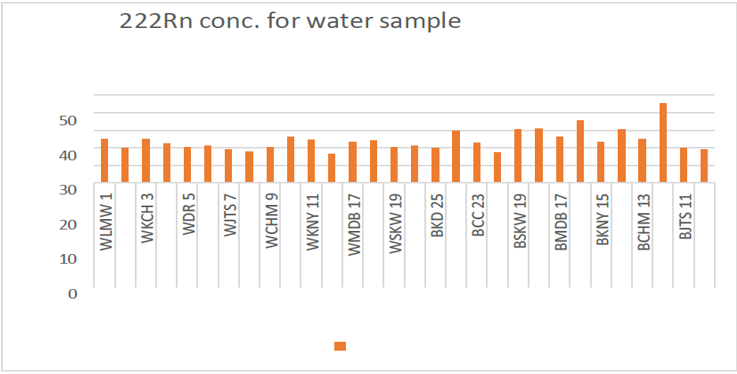
Groundwater contamination with naturally occurring radionuclides, poses significant environmental and health risks. This study assessed Radon-222 (^222Rn) concentrations in borehole water sources from Dutse Local Government Area (LGA), Jigawa State, Nigeria. Twenty borehole water samples were analyzed using a liquid scintillation counter. Radon concentrations ranged from 18.93 to 45.38 Bq/L, with a mean value of 28.59 Bq/L, exceeding the maximum contaminant levels (MCL) of 11.1 Bq/L (USEPA) and 10 Bq/L (WHO). The annual effective doses from ingestion for adults, children, and infants were 0.21, 0.31, and 0.34 mSv/y, respectively, all above the WHO permissible limit of 0.1 mSv/y. Excess lifetime cancer risks (ELCR) due to ingestion were 0.00073, 0.001096, and 0.001278 for adults, children, and infants, respectively, surpassing the recommended limit of 0.00029. These findings indicate that borehole water in Dutse LGA is not radiologically safe for consumption and requires treatment and routine monitoring.
References
1. Abdulrasheed, M., et al. (2024). Assessment of excess life cancer risk from radon concentration in borehole water samples, Katagum LGA, Bauchi State, Nigeria. Journal of Environmental Radioactivity, 258, 106–115.
2. Abed, S., et al. (2024). Indoor radon exposure and lung cancer risk: Global perspectives. Environmental Health Perspectives, 132(1), 015004.
3. Ajiboye, A., et al. (2022). Radon in Nigerian groundwater: A review of occurrence and mitigation. Groundwater for Sustainable Development, 17, 100732.
4. ATSDR/CDC (2010). Toxicological profile for radon. Agency for Toxic Substances and Disease Registry, Atlanta.
5. Bako, A., et al. (2023). Toxicity of radon-222 in groundwater across Keana, Nassarawa State, Nigeria. Applied Radiation and Isotopes, 197, 110672.
6. Bashir, U., et al. (2023). Natural radioactivity in water and health risks. Journal of Water and Health, 21(2), 158–170.
7. Becker, K. (2003). Radon risk and remediation in Europe. Radiation Protection Dosimetry, 107(1–3), 75–83.
8. Belete, A., & Anteneh, Y. (2021). Radon isotopes and their environmental health impacts. Radiation Physics and Chemistry, 180, 109307.
9. Dankawu, B., et al. (2022). Estimation of excess lifetime cancer risk and annual effective dose for borehole water in Dutse, Nigeria. Radiation Protection Dosimetry, 190(3), 330–338.
10. Esan, O., et al. (2020). Radon in Nigerian groundwater sources: Health risk assessment. Environmental Monitoring and Assessment, 192, 730.
11. Freiler, M., et al. (2016). Uranium and radon in Portuguese granite aquifers. Science of the Total Environment, 569–570, 927–937.
12. Grzywa-Celińska, A., et al. (2020). Radon in water and lung cancer epidemiology. International Journal of Environmental Research and Public Health, 17(6), 2130.
13. IAEA (2018). Radiation protection and safety of radiation sources: International basic safety standards. International Atomic Energy Agency, Vienna.
14. Jidele, O., et al. (2021). Measurement of radon and toxic elements in Ogun State groundwater. Environmental Earth Sciences, 80, 221.
15. Kolo, A., et al. (2023). Annual effective dose and ELCR of radon in groundwater of Bosso community, Minna, Nigeria. Journal of Radiation Research and Applied Sciences, 16(1), 14–23.
16. Makumbi, R., et al. (2024). Gastrointestinal cancers and radon ingestion: A global assessment. Cancer Epidemiology, 88, 102178.
17. Moujaess, N., et al. (2020). Radon and lung cancer risk among miners. Lung Cancer, 139, 45–52.
18. Regenauer, D., et al. (2022). Radon and uranium in soils: Geological controls. Applied Geochemistry, 141, 105283.
19. Riudavets, M., et al. (2022). Global burden of radon-induced lung cancer. Lancet Oncology, 23(2), 245–256.
20. Shuaibu, H. Y., et al. (2024). Radon concentrations in groundwater of Kiyawa LGA, Jigawa State. Radiation Physics and Chemistry, 205, 110721.
21. Syahnita, M. (2021). Assessment of radon in groundwater from Sabon Gari LGA, Kaduna State. Environmental Science and Pollution Research, 28, 34792–34804.
22. UNSCEAR (1993, 2000). Sources and effects of ionizing radiation. United Nations Scientific Committee on the Effects of Atomic Radiation, New York.
23. USEPA (1999). National primary drinking water regulations: Radon rule. U.S. Environmental Protection Agency, Washington, DC.
24. WHO (2003). Guidelines for drinking-water quality, 3rd edition. World Health Organization, Geneva.
25. WHO (2009). Handbook on indoor radon: A public health perspective. World Health Organization, Geneva.
Downloads
Published
Issue
Section
Categories
License
Copyright (c) 2026 Ibrahim Murtala Musa, Musbahu Maryam, Jinjiri Khadija, Sagir Muhammad Ameera, Hassan Samaila, Uba Khalid, Sulaiman Yakubu Maimuna, Dalha Imam Mukhtar, Lawan Abubakar Ahmad, Zanna Maaji Muhammad, Haruna Masama Muhammad, Abdullahi Bello Abubakar, Musa Kabir Muhammad, Ahmad Sani Abubakar, Muhammad Dankawu Umar, Kafadi David Gaima, Yushau Shuaibu Haruna, Zakari Rabiu, Abubakar Zainab, Abubakar Siddiqa, Yusuf Yahaya, Imam Mustapha, Zubir Usman

This work is licensed under a Creative Commons Attribution 4.0 International License.