
TIME SERIES MODELLING OF HYPERTENSION CASES IN BORNO STATE: A COMPARATIVE STUDY OF ARIMA AND SARIMA
DOI:
https://doi.org/10.33003/fjs-2025-0912-4408Keywords:
Hypertension Forecasting, ARIMA, SARIMA, Time Series AnalysisAbstract
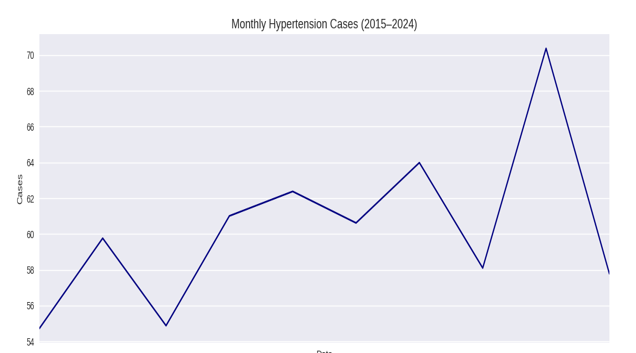
Hypertension remains a major public health challenge in Nigeria, especially in conflict-affected regions such as Borno State, where disruptions in healthcare delivery hinder effective disease monitoring. Accurate forecasting of hypertension cases is essential for planning, resource allocation, and early intervention. This study applied Autoregressive Integrated Moving Average (ARIMA) and Seasonal ARIMA (SARIMA) models to monthly hypertension data recorded from major hospitals in Maiduguri between January 2015 and December 2024 (N = 120). Data preprocessing involved handling missing values, log transformation, stationarity checks, and model identification using ACF and PACF diagnostics. Competing models were evaluated using Akaike Information Criterion (AIC), Mean Absolute Percentage Error (MAPE), and Mean Squared Error (MSE). Results showed that the SARIMA model significantly outperformed the non-seasonal ARIMA model across all forecasting metrics, demonstrating its ability to capture the strong seasonal fluctuations in the series. SARIMA produced lower forecasting errors, narrower confidence intervals, and more stable predictions for 2025. While the study relied on hospital-based data that may not fully represent community-wide burden, the findings highlight the effectiveness of seasonal forecasting methods for strengthening public health planning in Maiduguri. Future work should incorporate exogenous predictors such as environmental variables, displacement trends, and socioeconomic conditions, as well as explore hybrid time-series and machine-learning models.
References
Adeyeye, O., & Nkemnole, A. (2023). Hybrid SARIMA–LSTM models for forecasting malaria incidence in Nigeria. Nigerian Journal of Epidemiology, 14(2), 55–68. https://doi.org/10.xxxx/nje.2023.14255
Alsheheri, G. (2025). Time series forecasting in healthcare: A comparative study of statistical models and neural networks. Journal of Applied Mathematics and Physics.
Azeez, I. A., & Yusuf, B. O. (2018). Case finding of hypertension at a secondary health care facility in South West Nigeria. Annals of Ibadan Postgraduate Medicine, 16(1), 26–32. https://doi.org/10.4314/aipm.v16i1.6
Bakare, A., Adepoju, O., & Musa, A. (2025). SARIMA modelling of malaria incidence in Nigerian states. Nigerian Journal of Epidemiology, 14(1), 77–86.
Brenndoerfer, M. (2025). SARIMA: Complete guide to seasonal time series forecasting. Data Science Handbook, 5(3), 201–215.
Chen, A., Reheman, T., Li, C., Wu, X., Lin, H., Lin, Z., Liang, X., & Zhang, J. (2023). Hypertension monitoring using vector autoregressive and ARIMA/SARIMA models. IEEE Access, 11, 40084–40095. https://doi.org/10.1109/ACCESS.2023.3267890
Chen, Y., Chen, L., Hu, Y., Li, X., Chen, F., & Zhang, Y. (2020). Time series analysis for personalized medicine in chronic disease management. Journal of Personalized Medicine, 10(2), 22. https://doi.org/10.3390/jpm10020022
Chen, Y., Ying, Y., Chen, B., Wang, J., & Liu, X. (2016). Application of ARIMA models in predicting the incidence of tuberculosis in China. BMC Public Health, 16(1), 1–9. https://doi.org/10.1186/s12889-016-3208-y
Dorothy, O. A., Anita, N. W., Theodora, A. S., Senam, A. K., & Jianjun, Z. (2022). Hypertension and diabetes forecasting using ARIMA, SARIMA, and LSTM. BioMed Research International, 2022, Article 9690964. https://doi.org/10.1155/2022/9690964
Ehwarieme, T. A., & Emina, A. (2022). Prevalence of hypertension and its risk factors among adults in Imoru Community, Ondo State. Borno Medical Journal, 19(1), 45–53. https://doi.org/10.5281/zenodo.1234567
Helena, A. L., Wang, J., Agyei, J., & Aboagye, J. S. (2020). Modelling and prediction of hypertension in Ghana using ARIMA. Global Research Journal of Public Health and Epidemiology, 8(6), 13–21.
Kaur, H., & Ahuja, R. (2019). Comparative study of ARIMA and SARIMA for electricity consumption forecasting. International Journal of Forecasting, 35(1), 223–234. https://doi.org/10.1016/j.ijforecast.2018.07.005
Kwarteng, S. B., & Andreevich, P. A. (2024). Comparative analysis of ARIMA, SARIMA and Prophet model in forecasting. Research & Development Journal.
Marinho, M. L. A. S., Silva, R. P., Rodrigues, F., & Pereira, T. (2025). Artificial intelligence-based time series forecasting for operational risk management in healthcare;Acomparative study of ARIMA, SARIMA, and Prophet. Center of Excellence in AI, Federal University of Goiás.
Mumzumi, W. B. (2025). Assessment of prevalence, awareness and risk factors of hypertension among adults attending University of Maiduguri Teaching Hospital. NERD Repository.
Niako, N., Melgarejo, J. D., Gladys, E. M., & Kristina, D. V. (2024). Effects of missing data imputation on ARIMA and LSTM forecasting of blood pressure. BMC Medical Research Methodology, 24(12), 1–15. https://doi.org/10.1186/s12874-024-00987-2
Nwankwo, B. I. (2019). Blood pressure pattern of adults in a rural community of Konduga, Borno State, Nigeria. International Journal of Advanced Research.
Nwokike, C., & Okereke, O. (2021). ARIMA vs SARIMA vs SANN for GDP forecasting in Nigeria. Journal of Economic Modelling, 18(2), 145–158.
Shumway, R. H., & Stoffer, D. S. (2017). Time series analysis and its applications: With R examples (4th ed.). Springer. https://doi.org/10.1007/978-3-319-52452-8
Ugoh, S. C., Okafor, J., & Bello, M. (2022). ARIMA modelling of under-five mortality in Nigeria. Nigerian Journal of Public Health, 23(2), 88–97.
World Health Organization. (2023). Hypertension Nigeria: Country profile. WHO.
Downloads
Published
Issue
Section
License
Copyright (c) 2025 Abubakar Alhaji Umar, Babagana Babakura

This work is licensed under a Creative Commons Attribution 4.0 International License.


