
CONTROL OF SORGHUM ANTHRACNOSE CAUSED BY colletotrichum sublineolum WITH moringa oleifera LEAF EXTRACT
DOI:
https://doi.org/10.33003/fjs-2025-0912-4399Keywords:
Sorghum, Moringa oleifera leaf extract, Sorghum anthracnose, Colletotrichum sublineolum, BiostimulantAbstract
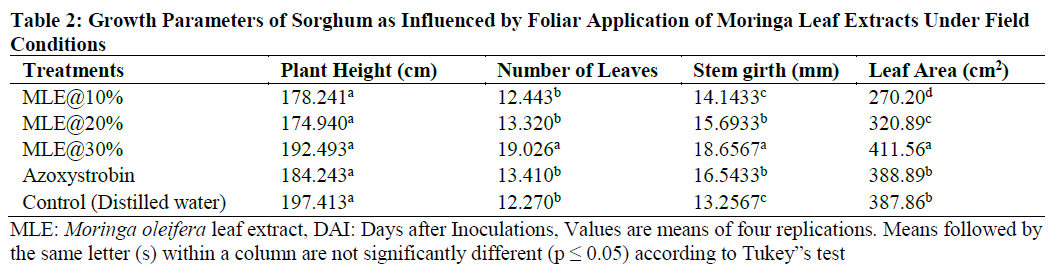
Sorghum anthracnose, caused by Colletotrichum sublineolum, is a serious disease causing substantial yield losses in Nigeria. The overdependence on chemical fungicides necessitates the need for sustainable alternatives. This study evaluated the bio-fungicidal and growth-promoting efficacy of Moringa oleifera leaf extract (MLE) on sorghum under field conditions. A randomized complete block design was used with five treatments: MLE at 10%, 20%, and 30% (v/v), a synthetic fungicide (Azoxystrobin) as a positive control, and a distilled water control. Disease incidence and severity were assessed at 15-day intervals beginning from 40 days after sowing, while growth and yield parameters were recorded at physiological maturity. Results showed that MLE application significantly reduced anthracnose incidence and severity in a concentration-dependent manner. The 30% (v/v) of MLE treatment was the most effective, showing results statistically similar to Azoxystrobin at final assessment. Furthermore, MLE at 30% significantly enhanced key growth parameters, including leaf area, stem girth, and number of leaves, and improved yield components such as panicle length and number of spikes per panicle. Consequently, grain yield from the 30% MLE treatment (2.92 ton/ha) was statistically on par with the synthetic fungicide (3.40 ton/ha). The study concluded that 30% (v/v) MLE is a potent bio-fungicide and biostimulant, offering a sustainable and effective strategy for integrated management of sorghum anthracnose and yield enhancement.
References
Abiy, T., Girma, A., & Terefe, H. (2024). Epidemiological assessment and yield loss due to sorghum anthracnose in major growing regions of Ethiopia. Crop Protection, 175, 106–118.
Afzal, S., Khan, M. R., & Siddiqui, Z. A. (2023). Antifungal potential of Moringa oleifera leaf extract against Puccinia triticina, the causal agent of wheat leaf rust. Journal of Plant Pathology, 105(2), 487–495.
Agyenim-Boateng, K. G., Zhang, S., Shaibu, A. S., Li, J., & Li, B. (2021). Bioactive compounds and therapeutic potential of Moringa oleifera: A review. South African Journal of Botany, 139, 383–393.
Ajeigbe, H. A., Akinseye, F. M., & Kamara, A. Y. (2018). Sorghum production in Nigeria: A review. International Crops Research Institute for the Semi-Arid Tropics.
Ajeigbe, H. A., Kamara, A. Y., & Omotayo, A. O. (2021). Sorghum anthracnose management in the Nigerian Savanna: Current status and future perspectives. Journal of Crop Improvement, 35(4), 512–530.
Ali, H., Iqbal, N., & Shahzad, A. N. (2023). Plant biostimulants: A sustainable approach to enhance nutrient use efficiency and crop productivity. Frontiers in Plant Science, 14, 1128563.
Araújo, K., Mahajan, D., Kerr, R., & da Silva, M. (2017). Global biofuels at the crossroads: An overview of technical, policy, and investment complexities in the sustainability of biofuel development. Agriculture, 7(4), 32.
Aremu, A. O., Plačková, L., Gruz, J., Bairu, M. W., & Doležal, K. (2020). Endogenous cytokinin profiles in Moringa oleifera across different tissues and developmental stages: Implications for plant growth promotion. Plant Physiology and Biochemistry, 155, 581–589.
Arouna, A., Lokossou, J. C., Wopereis, M. C. S., & Lançon, F. (2020). Contribution of improved rice varieties to poverty reduction and food security in sub-Saharan Africa. Global Food Security, 27, 100442.
Busta, L., Jetter, R., & Cahoon, E. B. (2021). Maize and sorghum: Genetic diversity, environmental adaptability, and value for biotechnological applications. Annual Review of Plant Biology, 72, 285–310.
du Jardin, P. (2015). Plant biostimulants: Definition, concept, main categories and regulation. Scientia Horticulturae, 196, 3–14.
El-Mageed, T. A. A., Shaaban, A., Abd El-Mageed, S. A., & Rady, M. M. (2021). Moringa leaf extract as a biostimulant improves water use efficiency, physio-biochemical attributes of squash plants under deficit irrigation. Agricultural Water Management, 244, 106466.
El-Mohamedy, R. S. R., & Aboelfetoh, M. A. (2014). Antifungal activity of Moringa oleifera leaf extract against some phytopathogenic fungi and its effect on growth and yield of potato plants. Journal of Agricultural Technology, 10(4), 963–982.
Elsayed, A. I., Rafudeen, M. S., & Ganie, S. A. (2020). Biostimulants and their role in improving plant growth under abiotic stresses. In M. M. Azooz & P. Ahmad (Eds.), Plant metabolites and regulation under environmental stress (pp. 313–333). Academic Press.
Food and Agriculture Organization. (2012). Sorghum: Post-harvest operations. FAO.
Food and Agriculture Organization. (2022). FAOSTAT statistical database. http://www.fao.org/faostat/
Ferranti, P., & Caruso, G. (2015). Cereal-based foodstuffs: The backstage of a long and still ongoing evolution. Food Research International, 76, 200–205.
Gwary, D. M., Cardwell, K. F., & Esele, J. P. (2009). Sorghum anthracnose: Progress of research on management strategies. Journal of Sustainable Agriculture, 33(2), 193–210.
Isyaku, M. S., Yahaya, S. M., & Abdullahi, A. (2024). Characterization of soil physicochemical properties at the Federal University Dutse research farm, Sudan Savanna, Nigeria. Nigerian Journal of Soil Science, 34(1), 45–56.
Khalid, M., Rahman, S. U., & Bilal, M. (2022). Sorghum polyphenols: Bioavailability and health benefits. Food Chemistry, 373(Pt B), 131593.
Lohani, S., Trivedi, P. K., & Nath, P. (2009). Changes in activities of cell wall hydrolases during ethylene-induced ripening in banana: Effect of 1-MCP, ABA and IAA. Postharvest Biology and Technology, 51(1), 43–50.
Maqsood, M., Hussain, S., & Azam, M. (2021). Induction of systemic resistance in plants by plant growth-promoting rhizobacteria and other biological agents. Journal of Plant Growth Regulation, 40(4), 1561–1574.
Masi, M., Cimmino, A., & Evidente, A. (2022). A review on the antifungal activity of plant extracts against phytopathogenic fungi. Plants, 11(19), 2638.
Mofunanya, A. A. J., Ekpo, E. J. A., & Nkang, A. E. (2023). Mechanisms of induced systemic resistance by plant extracts against fungal pathogens. Physiological and Molecular Plant Pathology, 124, 101963.
Mosa, W. F. A., El-Bially, M. A., El-Mahdy, S. M., & Youssef, M. A. (2021). Biostimulants and their role in regulating plant growth and development under environmental stress: A review. Egyptian Journal of Agronomy, 43(1), 1–18.
Mouafi, A. B., Abdel-Aziz, S. M., & Bashandy, S. R. (2024). Phytochemical analysis and antifungal efficacy of Moringa oleifera leaf extract against Fusarium oxysporum. Journal of Applied Microbiology, 136(1), lxad275.
Oke, D. G., Ogunkunle, C. O., & Adetunji, C. O. (2025). Emerging trends in sustainable plant protection: Biopesticides and plant resistance inducers. Crop Protection, 185, 106782.
Rouphael, Y., & Colla, G. (2020). Biostimulants in agriculture. Frontiers in Plant Science, 11, 40.
Sher, A., Sarwar, B., & Sattar, A. (2022). Dose-response relationship of plant-based biostimulants: A critical review. Journal of Plant Nutrition, 45(7), 1015–1032.
Shoemaker, C. E., Grant, D., & Tesso, T. (2010). Genetic variation for stress tolerance in sorghum. In M. P. Reynolds (Ed.), Climate change and crop production (pp. 173–190). CABI.
Tesso, T., Perumal, R., & Little, C. R. (2012). Sorghum anthracnose: A review of the disease and its management. Plant Disease, 96(6), 796–808.
Thakur, R. P., Reddy, B. V. S., & Mathur, K. (2007). Screening techniques for sorghum diseases. International Crops Research Institute for the Semi-Arid Tropics.
Xin, Z., Wang, M., & Burow, G. (2016). Sweet sorghum as a biofuel crop: Where are we now? Biofuels, 7(5), 495–504.
Xu, Y., Li, P., Zou, C., Lu, Y., & Xie, C. (2017). Enhancing genetic gain in the era of molecular breeding. Journal of Experimental Botany, 68(11), 2641–2666.
Xu, Y., Li, P., & Yang, Z. (2021). Genetic improvement of grain yield and adaptation in sorghum. Theoretical and Applied Genetics, 134(11), 3699–3714.
Yadav, R., Kumar, S., & Singh, V. K. (2023). Efficacy of Moringa oleifera leaf extract as a seed treatment against seed-borne fungi of wheat. Journal of Plant Diseases and Protection, 130(1), 187–195.
Yahaya, S. M., Isyaku, M. S., & Bello, T. T. (2022). Prevalence and severity of sorghum anthracnose in the Northern Guinea and Sudan Savannah zones of Nigeria. Tropical Plant Pathology, 47(3), 412–422.
Yakhin, O. I., Lubyanov, A. A., & Brown, P. H. (2024). Biostimulant science: Understanding mechanisms and optimizing applications. Journal of Agricultural and Food Chemistry, 72(1), 3–16.
Zhang, H., Li, Y., & Zhu, J. K. (2020). Developing naturally stress-resistant crops for a sustainable agriculture. Nature Plants, 6(12), 1412–1425.
Zulfiqar, F., Casadesús, A., Brockman, H., & Munné-Bosch, S. (2020). An overview of plant-based natural biostimulants for sustainable horticulture with a particular focus on Moringa oleifera extracts. Plant Science, 295,
Downloads
Published
Issue
Section
Categories
License
Copyright (c) 2025 Musa Habu, Yakubu Haruna

This work is licensed under a Creative Commons Attribution 4.0 International License.


