
SURFACE CHARACTERIZATION AND POINT OF ZERO CHARGE OF A CU²+ BASED COORDINATION COMPOUND AND ITS POTENTIAL FOR ADSORPTION OF POLLUTANTS
DOI:
https://doi.org/10.33003/fjs-2025-0912-4398Keywords:
Adsorption, Coordination Compound, Copper, Pollutants, PZC, Surface ChemistryAbstract
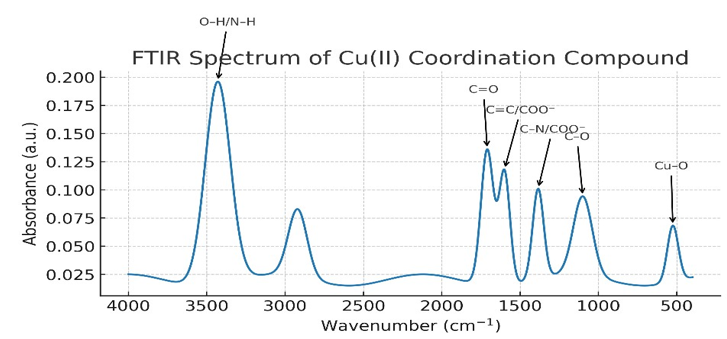
Coordination polymers or compounds have been used as multifaceted materials for different application due to their porosity and high surface area, availability of multicomponent organic ligands and the possibility of using different inorganic metal atoms in their fabrication. Thus, in this study, a Cu²+ based coordination compound was synthesized from 1,2,4,5–benzenetetracarboxylic acid, 4–aminomethylbenzoic acid, NaOH and copper (II) acetate monohydrate by refluxing and characterized for its potential application in the removal of pollutants. Characterization techniques studied includes Fourier Transform Infrared (FTIR) spectroscopy, Transmission Electron Microscopy (TEM), Brunauer–Emmett–Teller (BET) surface area analysis, and X-ray Photoelectron Spectroscopy (XPS). FTIR confirmed successful metal–ligand coordination through O–H, C=O, and Cu–O vibrations, while TEM revealed a porous and heterogeneous morphology, the BET analysis gave a surface area of 72.20 m²g-¹. XPS spectra showed the coexistence of Cu²+ and Cu+ oxidation states. The point of zero charge (PZC) determined by the pH drift method was 5.7, suggesting selective adsorption of anionic pollutants below this pH and cationic pollutants above it. These results demonstrate that the Cu2+ based coordination compound exhibits typical characteristics that favours adsorption of pollutants.
References
Adimula, V. O., Anifowose, R. A., Adeniyi, E. O., Obafemi, A. D., Elaigwu, S. E., Owalude, S., & Tella, A. C. (2025). Adsorptive Removal of Congo Red Dye by a Synthesized Dual Ligand (Carboxylate and N-donor) Coordination Compound. The Chemist, 96, 60.
Baruah, J.B. (2022). Coordination Polymers in Adsorptive Remediation of Environmental Contaminants. Coordination Chemistry Reviews, 470: 214694. https://doi.org/10.1016/j.ccr.2022.214694
Bonthula, S., Bonthula, S. R., Pothu, R., Srivastava, R. K., Boddula, R., Radwan, A. B., & Al-Qahtani, N. (2023). Recent Advances in Copper-Based Materials for Sustainable Environmental Applications. Sustainable Chemistry, 4, 246-271. https://doi.org/10.3390/suschem4030019
Fu, F., & Wang, Q. (2011). Removal of heavy metal ions from wastewater: A review. Journal of Environmental Management, 92: 407–418. https://doi.org/10.1016/j.jenvman.2010.11.011
Gupta, V. K., & Suhas. (2009). Application of low-cost adsorbents for dye removal – A review. Journal of Environmental Management, 90: 2313–2342. https://doi.org/10.1016/j.jenvman.2008.11.017
Kosmulski, M. (2009). Surface Charging and Points of Zero Charge; CRC Press: Boca Raton.
Lei, L., Huang, D., Zhou, C., Chen, S., et al. (2020). Demystifying the active roles of NiFe-based oxides/(oxy)hydroxides for electrochemical water splitting under alkaline conditions. Coordination Chemistry Reviews, 408, 213177. https://doi.org/10.1016/j.ccr.2019.213177
Mane, P. V., Rego, R. M., Yap, P. L., Losic, D., & Kurkuri, M.D. (2024). Unveiling cutting-edge advances in high surface area porous materials for the efficient removal of toxic metal ions from water. Progress in Materials Science, 146, 101314. https://doi.org/10.1016/j.pmatsci.2024.101314
Nazari-Arshad, S., & Mohammadikish, M. (2022). Copper-based coordination polymer as a fast and efficient dye adsorbent from aqueous solutions. Journal of Coordination Chemistry, 75, 2214–2227. https://doi.org/10.1080/00958972.2022.2122452
Sposito, G. (1998). On points of zero charge. Environmental Science & Technology, 32: 2815–2819. https://doi.org/10.1021/es9802347
Wang, S., & Peng, Y. (2010). Natural zeolites as effective adsorbents in water and wastewater treatment. Chemical Engineering Journal, 156: 11–24. https://doi.org/10.1016/j.cej.2009.10.029
Downloads
Published
Issue
Section
Categories
License
Copyright (c) 2025 Elaigwu Sunday E., Adimula Vincent O., Rasheed Olanrewaju A., Efunwole Bisola R., Tella Adedibu C.

This work is licensed under a Creative Commons Attribution 4.0 International License.


