
PARASITIC CONTAMINATION: PREVALENCE AND LOAD IN RELATION TO WATER QUALITY OF AHI RIVER IN UMUAHIA, ABIA STATE
DOI:
https://doi.org/10.33003/fjs-2026-1001-4392Keywords:
River, Contamination, Parasite, Physicochemical parameters, Rainfall, Public HealthAbstract
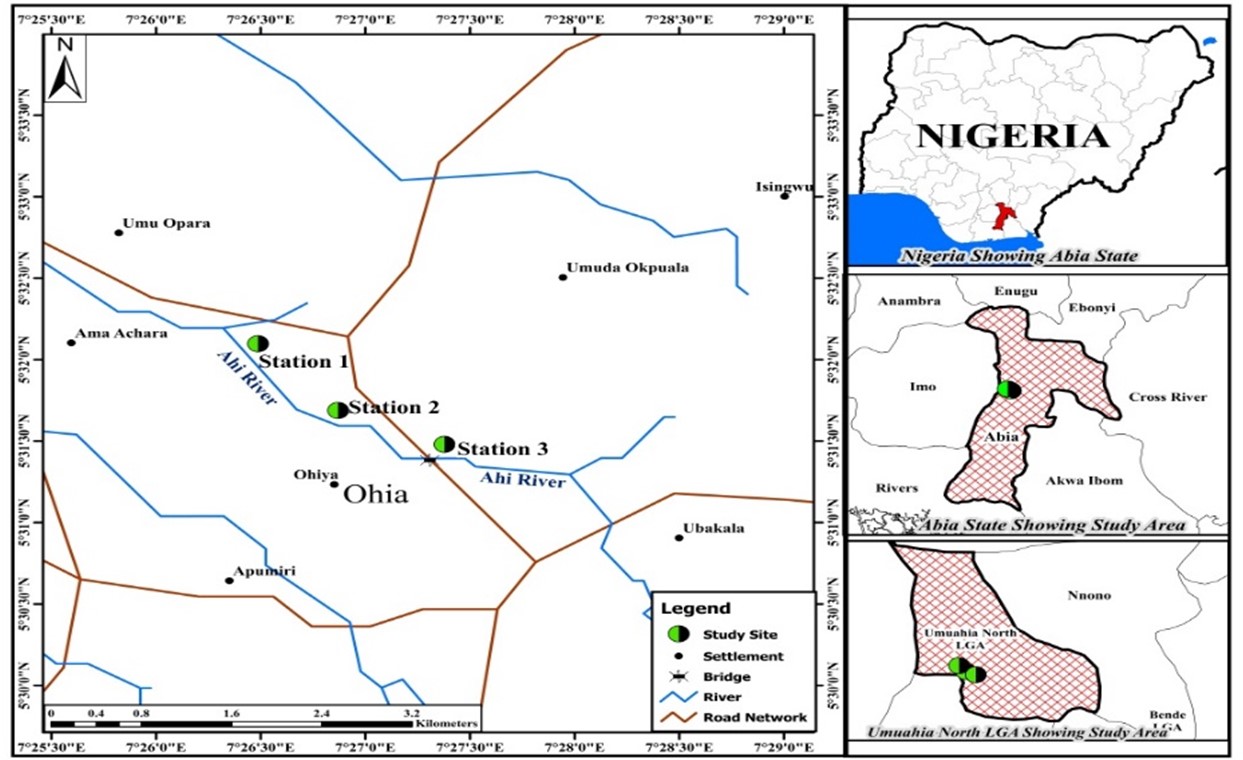
Water is an essential resource needed by humans for most of their activities. However, human activities have resulted in the contamination of surface water bodies with chemical and biological agents. Prevalence, parasitic load and some physicochemical parameters of a rural water source in Ohiya Community, Umuahia, Abia State was assessed. The parameters were determined with standard analytical procedures. Grab and composite filtration methods were used for parasite sample collection and sedimentation method for the analysis. Some pH (33.3%) and dissolved oxygen (94.4%) values did not conform to regulatory limits out of nine (9) parameters evaluated. The study recorded 8 parasites (including helminths and protozoa) of public health significance. The overall parasitic contamination prevalence was 75.0%, 77.8% (grab method) and 72.2% (composite filtration method). The most prevalent parasite was Entamoeba coli (41.7%) and the least was Balantidium coli (2.8%). Station 2 had the maximum prevalence (91.7%) and parasitic load (84) while station 3 had the least prevalence (58.3%) and load (22). May and June 2023 had the maximum prevalence (100%) while the maximum parasitic load (74) was recorded in May 2023. On the other hand, July and August 2023 had the minimum prevalence (50.0%) while the minimum parasitic load (6) was recorded in July 2023. The composition, prevalence and parasitic load were highly influenced by physicochemical parameters, sampling method, anthropogenic-related stressors and rainfall. Based on the findings of this study, treatment of the water is required before usage. Solid wastes disposal and discharge of effluents around the river should be prohibited.
References
Abba, A. M., Abdulkarim, B., Omenesa, R. L., Abdulhamid, Y., & Mudassir, I. (2018). Study on Physico-Chemical Parameters and Prevalence of Fish Parasites in Jibia Reservoir, Katsina State, Nigeria. UMYU Journal of Microbiology Research, 3(2), 1 – 6. https://doi.org/10.47430/ujmr.1832.001
Aghaindum, A. G., & Landry, F. K. A. (2019). Dissemination of the resistant forms of intestinal worms in the marshy areas of the city of Yaounde (Cameroon): importance of some abiotic factors of the medium. Applied Water Science, 9, 19. https://doi.org/10.1007/s13201-019-0895-y
Al-Tameemi, K., & Kabakli, R. (2020). Ascaris lumbricoides: Epidemiology, Diagnosis, Treatment, and Control. Asian Journal of Pharmaceutical and Clinical Research, 13(4), 8 – 11. https://doi.org/10.22159/ajpcr.2020.v13i4.36930
Amadi, A. N. C., Chukwuemeka, B. C., & Obeten, P. I. (2020). Prevalence of Human Intestinal Parasites, It's Detection on Dumpsite and Relationship with the Environmental Factors in Ogbor Hill, Aba, Eastern Nigeria. ASUU Journal of Science, 7(1 & 2),73 – 100.
Ames, H. (2022). Factors Affecting a River's Velocity. Sciencing.com. https://sciencing.com/factors-affecting-rivers-velocity-8223150.html
Ani, O. C., & Itiba, O. L. (2015). Evaluation of the Parasitic Contamination of Local Sources of Drinking Water in Abakaliki, Ebonyi State, Nigeria. IOSR Journal of Medical and Dental Sciences,14(9 Ver. I), 30-34. https://doi.org/10.9790/0853-14913034
Anyanwu, E. D., & Umeham, S. N. (2020). Identification of waterbody status using predictive index assessment tools - A Case Study of Eme River, Umuahia, Nigeria. International Journal of Energy and Water Resources, 4(3), 271-279. https://doi.org/10.1007/s42108-020-00066-5
Anyanwu, E. D., Irole-Eze, O. P., Adetunji, O. G., & Nnadi, O. F. (2024). Hydro-parasitological Assessment of Ikwu River, Umuahia, Southeast Nigeria. BIU Journal of Basic and Applied Sciences, 9(1), 115 – 129.
Anyanwu, E. D., Lawrence, Q. O., & Onyele, O. G. (2018). Parasitological Assessment of a Drinking Water Source in Umuahia, Southeast Nigeria. African Journal of Biology and Medical Research, 1(1): 55 – 62.
Anyanwu, E. D., Nwoke, O. B., Adetunji, O. G., & Paul, O. C. (2022). Assessing the water quality of a rural multipurpose stream, Southeast, Nigeria. Journal of Material and Environmental Science, 13(12), 1414- 1424.
APHA (2017). Standard Methods for the Analysis of Water and Wastewater. 23rd Edition. Washington D.C.: American Public Health Association.
Bayhan, İ., Yeşilnacar, M. İ., Demir Yetiş, A., & Tutkun, E. (2020). An evaluation of drinking-usage water quality in terms of environmental health: A case study of Siverek (Sanliurfa), Turkey. Turkish Bulletin of Hygiene and Experimental Biology, 77(EK4 Su ve Saglik): 107-120.
Berkhout, B. W., Borregaard, M. K., Brandl, R., Brandle, M., Dehling, D. M., Hof, C., Poulin, R., & Thieltges, D. W. (2019). Host assemblage and environment shape β-diversity of freshwater parasites across diverse taxa at a continental scale. Global Ecology and Biogeography, 29: 38–49. https://doi.org/10.1111/geb.13005
Bolaji, O. S., Adekunle, O. C., Ajayi, A. A., Adeyemo, A. T., Ojewuyi, A. R., Ibrahim, A. A., Adeyemo, A. T., Ajayi, A. O., Akindele, A. I., & Adeyeba, O. A. (2023). Prevalence of Pathogenic Intestinal Parasites and Enteropathogenic Bacteria in Faecal Samples Obtained from Abattoirs in Ogbomoso, Oyo State, Nigeria. Alexandria Journal of Veterinary Sciences, 77(2), 17-28. http://dx.doi.org/10.5455/ajvs.148234
Budria, A., & Candolin, U. (2014). How does human-induced environmental change influence host-parasite interactions? Parasitology, 141(4), 462-474. https://doi.org/10.1017/S0031182013001881
Cao, S. T., Tran, H. P., Le, H. T. T., Bui, H. P. K., Nguyen, G. T. H., Nguyen, L. T., Nguyen, B. T., &Luong, A. D. (2021). Impacts of effluent from different livestock farm types (pig, cow, and poultry) on surrounding water quality: a comprehensive assessment using individual parameter evaluation method and water quality indices. Environmental Science and Pollution Research, 28(36):1-14. https://doi.org/10.1007/s11356-021-14284-9
Cheesbrough, M. (2010). District laboratory practice in Tropical Countries. Second Edition. Cambridge, England: Cambridge University Press.
Chowfin, A., Gluvakovic, N., & Gayh, U. (2024). Effect of Rainfall on Water Parameters in Recreational Lakes in Heidelberg, Germany. Igmin Research, 2(2), 121-126.
Couso-Perez, S., Abeledo-Lameiro, M. J., Vidal-Varela, A.I., & Gomez-Couso, H. (2023). Removal of the waterborne parasite Cryptosporidium parvum from drinking water using granular activated carbon. Journal of Environmental Chemical Engineering, 11, 111185. https://doi.org/10.1016/j.jece.2023.111185
Dinç, G. (2021). Some Foodborne and Waterborne Protozoa. Journal of Istanbul Veterinary Sciences, 5(2), 107- 112. https://doi.org/10.30704/http-www-jivs-net.948361
EEA (2024). Biochemical oxygen demand in rivers (sdg_06_30). ESMS Indicator Profile (ESMS-IP). European Environment Agency. https://ec.europa.eu/eurostat/cache/metadata/en/sdg_06_30_esmsip2.htm.
Ejike, B. U., Ohaeri, C. C., & Amaechi, E. C. (2021). Parasitic Contamination of Local Drinking Water Sources in Aba Metropolis, Abia State, Nigeria. Sultan Qaboos University Journal For Science, 26(1), 1-7. https://doi.org/10.53539/squjs.vol26iss1pp1-7
Elmonir, W., Remela, E. M. A., & Alwakil, Y. (2020). Diversity, virulence and antibiogram traits of Escherichia coli recovered from potable water sources in Gharbia, Egypt. Journal of Water and Health, 18(3): 430-438. https://doi.org/10.2166/wh.2020.239
Emelie, C. I. N. (2019). Nigeria’s Multi-Religious Practice: A Challenge to Sustainable Environmental Protection. African Journal Law and Human Rights, 3(2), 115 – 119.
Fenta, L., & Kebede, A. (2019). Effect of Climate Change on Food and Water Borne Diseases Outbreak: A Mini Review. Food Science and Quality Management, 88, 11 – 23. https://doi.org/10.7176/FSQM/88-02
Gboeloh, L. B. (2021). Evaluation of Gastrointestinal Parasites in Major Dumpsites and Health Risk Behaviour of Scavengers in Port Harcourt Metropolis. EAS Journal of Parasitology and Infectious Diseases,3(4), 44 – 53. https://doi.org/10.36349/easjpid.2021.v03i04.001
Gordy, M. A., Koprivnikar, J., Mcphail, B., & Hanington, P. C. (2020). Environmental and ecological factors driving trematode parasite community assembly in central Alberta lakes. International Journal for Parasitology: Parasites and Wildlife, 13, 283–291. https://doi.org/10.1016/j.ijppaw.2020.11.008
Huang, G. Z., Hsu, T. C., Yu, C. K., Huang, J.-C., &Lin, T.-C. (2020). Dilution and precipitation dominated regulation of stream water chemistry of a volcanic watershed. Journal of Hydrology, 583,124564. https://doi.org/10.1016/j.jhydrol.2020.124564
Indirani, P., Sekar, R. R. J., & Ponmurugaraj, N. (2022). Impact of Solid Waste Disposal on Water Quality in the selected stations of Thamiraparani River Basin at Kanyakumari District, Tamilnadu. International Journal of Food and Nutritional Sciences, 11(8), 2255 – 2266.
Islam, M. M. M., & Islam, M. A. (2020). Quantifying public health risks from exposure to waterborne pathogens during river bathing as a basis for reduction of disease burden. Journal of Water and Health, 18(3), 292–305. https://doi.org/10.2166/wh.2020.045
Iyaji, F. O., Abuh, A., Yaro, C. A., Mohammed, D. (2018). Evaluation of Parasitic Contamination of Drinking Water Sources in the Rural Areas of Dekina Local Government Area, Kogi State, Nigeria. American Journal of Public Health Research, 6(1), 1-3. https://doi.org/10.12691/ajphr-6-1-1
Izah, S. C., Bassey, S. E., & Ohimain, E. I. (2018). Impacts of Cassava Mill Effluents in Nigeria. Journal of Plant and Animal Ecology, 1(1), 14 - 42. https://doi.org/10.14302/issn.2637-6075.jpae-17-1890
Junaidi, J., Cahyaningsih, U., Purnawarman, T., Latif, H., Sudarnika, E., Hayati, Z., & Muslima, M. (2020). Entamoeba histolytica Neglected Tropical Diseases (NTDS) Agents that Infect Humans and Some Other Mammals: A Review. E3S Web of Conference, 151, 01019. https://doi.org/10.1051/e3sconf/202015101019
Kiliç, Z. (2020). The importance of water and conscious use of water. International Journal of Hydrology, 4(5), 239‒241. https://doi.org/10.15406/ijh.2020.04.00250
Kirk, D., O'Connor, M. I., & Mordecai, E. A. (2022). Scaling effects of temperature on parasitism from individuals to populations. Journal of Animal Ecology, 91(10), 2087–2102. https://doi.org/10.1111/1365-2656.13786
Lokman, N. A., Ithnin, A. M., Yahya, W. J., &Yuzir, M. A. (2021). A brief review on biochemical oxygen demand (BOD) treatment methods for palm oil mill effluents (POME). Environmental Technology and Innovation, 21, 101258. https://doi.org/10.1016/j.eti.2020.101258
Manetu, W. M., & Karanja, A. M. (2021). Waterborne Disease Risk Factors and Intervention Practices: A Review. Open Access Library Journal, 8, 1-11. https://doi.org/10.4236/oalib.1107401
Mueller, J. S., Grabowski, T. B., Brewer, S. K., & Worthington, T. A. (2017). Effects of Temperature, Total Dissolved Solids, and Total Suspended Solids on Survival and Development Rate of Larval Arkansas River Shiner. Journal of Fish and Wildlife Management, 8, 79–88. https://doi.org/10.3996/112015-JFWM-111
Mujawar, S., Halakeri, B., & Nadaf, A. (2019). Impact of religious activities on water quality: A significant assessment at Kudala Sangama. International Research Journal of Engineering and Technology,6(7), 1406 – 1409.
Nemati, S., Shalileh, F., Mirjalali, H., & Omidfar, K. (2023). Toward waterborne protozoa detection using sensing technologies. Frontiers in Microbiology, 14, 1118164. https://doi.org/10.3389/fmicb.2023.1118164
NESREA (2011). National Environmental (Surface and Groundwater Quality Control) Regulations. Abuja, Nigeria: Federal Ministry of Environment.
Ngowi, H. A. (2020). Prevalence and pattern of waterborne parasitic infections in eastern Africa: A systematic scoping review. Food Waterborne Parasitology, 20, e00089. https://doi.org/10.1016/j.fawpar.2020.e00089
Nwankwo, C., & Nwankwoala, H. O. (2018). Gully Erosion Susceptibility Mapping in Ikwuano Local Government Area of Abia State using GIS Techniques. Earth Sciences Malaysia, 2(1), 08-15. https://doi.org/10.26480/esmy.01.2018.08.15
Ogunbode, T.O., & Oyekan, F.E. (2023). Religious Practices and Its Impacts on a Sustainable Urban Environment in Nigeria: The Way Forward. Scientific World Journal, 2023, 1 – 8. https://doi.org/10.1155/2023/8080235
Ojok, W., Wasswa, J., & Ntambi, E. (2017). Assessment of Seasonal Variation in Water Quality in River Rwizi Using Multivariate Statistical Techniques, Mbarara Municipality, Uganda. Journal of Water Resource and Protection, 9, 83-97. https://doi.org/10.4236/jwarp.2017.91007
Okere, S. G., Nduka, F. O., & Otokunefor, K. (2024). Molecular detection of water protozoan parasites from selected rivers in Rivers State, Nigeria. FUDMA Journal of Sciences, 8(1), 190-194. https://doi.org/10.33003/fjs-2024-0801-2262
Omer, N. H. (2019). Water Quality Parameters. IntechOpen. https://doi.org/10.5772/intechopen.89657.
Park, J. H., Inam, E., Abdullah, M. H., Agustiyani, D., Duan, L., Hoang, T. T., Kim, K.-W., Kim, S. D., Nguyen, M. H., Pekthong, T., Sao, V., Sarjiya, A., Savathvong, S., Sthiannopkao, S., Syers J. K., & Wirojanagud, W. (2011).Implications of rainfall variability for seasonality and climate-induced risks concerning surface water quality in East Asia. Journal of Hydrology, 400(3-4), 323–332. https://doi.org/10.1016/j.jhydrol.2011.01.050
Poulin, R. (2020). Meta-analysis of seasonal dynamics of parasite infections in aquatic ecosystems. International Journal for Parasitology, 50, 501–510. https://doi.org/10.1016/j.ijpara.2020.03.006.
Sente, C., Onyuth, H., Tamale, A., Mali, B., Namara, B. G., Mugoya, J. G., & Omara AR. Waterborne parasites in Uganda: A survey in Queen Elizabeth Protected Area. Public Health Challenges, 2(4), e142. https://doi.org/10.1002/puh2.142.
Sha-Amu, H. D., Ibrahim, K., & Gimba, U. N. (2024). Physicochemical Parameters and Abundance of Pathogenic Protozoans and Helminths in Abattoirs within Minna Metropolis, Niger State, Nigeria. Journal of Applied Sciences and Environmental Management, 28(1), 275- 290. https://dx.doi.org/10.4314/jasem.v28i1.32
Shou, C. Y., Tian, Y., Zhou, B., Fu, X.-J., Zhu, Y.-J., & Yue, F.-J, (2022). The Effect of Rainfall on Aquatic Nitrogen and Phosphorus in a Semi-Humid Area Catchment, Northern China. International Journal of Environmental Research and Public Health; Basel,19(17), 10962. https://doi.org/10.3390/ijerph191710962
Simon-Oke, I. A., Afolabi, O, J., & Obimakinde, E T. (2020). Parasitic contamination of water sources inAkure, Ondo State, Nigeria. Journal of Basic and Applied Zoology, 81, 50. https://doi.org/10.1186/s41936-020-00187-7
Titcomb, G., Mantas, J. N., Hulke, J., Rodriguez, I., Branch, D., & Young, H. (2021). Water sources aggregate parasites with increasing effects in more arid conditions. Nature Communications, 12, 7066. https://doi.org/10.1038/s41467-021-27352-y.
Tula, M. Y., Enabulele, O. I., & Ophori, E. A. (2023). Parasitological contamination of two water sources in Adamawa-North Senatorial zone, Adamawa State, Nigeria. Arid Zone Journal of Basic and Applied Research, 2(1), 203-212. https://doi.org/10.55639/607.0293
USEPA (2022). Water Quality Topics: Pathogens. United States Environmental Protection Agency, Washington, DC. https://www.epa.gov/wqclr/water-quality-topics-pathogens.
Villar-Torres, M., Monterojuan, F. E., Raga, A., & Repullés-Albelda, A. (2023). The influence of water temperature on the life-cycle of Sparicotyle chrysophrii (Monogenea: Microcotylidae), a common parasite in gilthead seabream aquaculture. Aquaculture, 565, 739103. https://doi.org/10.1016/j.aquaculture.2022.739103
Vonshak, A., Laorawat, S., Bunnag, B., & Tanticharoen, M. (2014). The effect of light availability on the photosynthetic activity and productivity of outdoor cultures of Arthrospira platensis (Spirulina). Journal of Applied Phycology, 26, 1309–1315. https://doi.org/10.1007/s10811-013-0133-1
Waruiru, R. M., Mbuthia, P. G., Wanja, D. W., & Mwadime, J. M. (2020). Prevalence, intensity and influence of water quality on parasites of farmed fish in Kirinyaga County, Kenya. Livestock Research for Rural Development, 32: Article #164. http://www.lrrd.org/lrrd32/10/rmwar32164.html.
WHO (2019). Results of Round II of the WHO International Scheme to Evaluate Household Water Treatment Technologies. Geneva, Switzerland: World Health Organization. https://iris.who.int/bitstream/handle/10665/325896/9789241516037-eng.pdf.
WHO (2023). Burden of disease attributable to unsafe drinking water, sanitation and hygiene, 2019 update. Geneva: World Health Organization. https://apps.who.int/iris/handle/10665/370026
Wolf, J., Johnston, R. B., Ambelu, A., Arnold, B. F., Bain, R., Brauer, M., Brown, J., Caruso, B. A., Clasen, T., Colford, J. M. Jr, Mills, J. E., Evans, B., Freeman, M. C., Gordon, B., Kang, G., Lanata, C. F., Medlicott, K. O., Prüss-Ustün, A., Troeger, C., Boisson, S., & Cumming, O. (2023). Burden of disease attributable to unsafe drinking water, sanitation, and hygiene in domestic settings: a global analysis for selected adverse health outcomes. Lancet,401(10393), 2060–2071. https://doi.org/10.1016/S0140-6736(23)00458-0
Yang, L., Li, J., Zhou, K., Feng, P., & Dong, L. (2021). The effects of surface pollution on urban river water quality under rainfall events in Wuqing District, Tianjin, China. Journal of Cleaner Production, 293, 126136. https://doi.org/10.1016/j.jclepro.2021.126136
Downloads
Published
Issue
Section
Categories
License
Copyright (c) 2026 Emeka Donald Anyanwu, Ozioma Prisca Irole-Eze, Chioma Ada Ihemanma, Ananda Chisom Hilary, Amarachi Grace Stephen

This work is licensed under a Creative Commons Attribution 4.0 International License.


