
GRAIN SIZE AND PEBBLE MORPHOMETRY OF BIDA FORMATION SANDSTONES (NORTHERN BIDA BASIN): IMPLICATIONS FOR SEDIMENTARY PROCESSES
DOI:
https://doi.org/10.33003/fjs-2025-0912-4388Keywords:
Bida, Fluvial, Sandstone, PaleoenvironmentAbstract
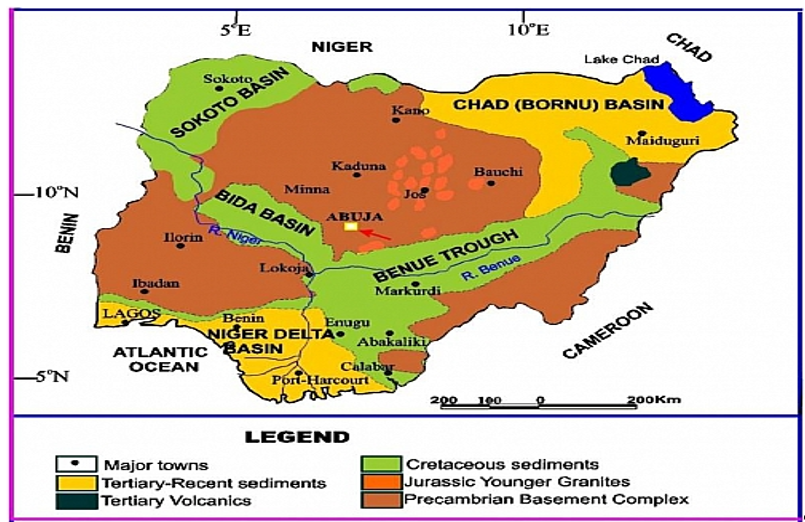
The intracratonic Bida Basin is one of the inland sedimentary basin in Nigeria with clastic deposition. This study investigates the transportation history, maturity, and paleodepositional environments of the Cretaceous sandstones from the Bida Formation exposed at Gbugbu, Ndeji, Maganiko, and Lafiagi within the Northern Bida Basin. A sedimentological approach was employed, comprising grain size analysis (n=26) and pebble morphometry (n=149). The inclusive graphic standard deviation (sorting) values range from (1.00-1.19, 1.28-1.98, 1.04-1.28, and 0.89-1.42) respectively, indicating most of the sandstones are poorly sorted. The sandstones, especially at Gbugbu, Maganiko, and Lafiagi, are fine-skewed to near-symmetrical, while the sandstones at Ndeji are coarse-skewed. The majority of the sandstones are platykurtic with values ranging from (0.75-0.94). These variations in the sorting, skewness, and kurtosis indicate fluctuating depositional energy, mixed sources, short transportation, and environments ranging from fluvial dominance over beach settings. Morphometry indices such as the mean, flatness ratio, elongation ratio, oblate-prolate index, and maximum projection sphericity index support these environmental interpretations, with sphericity values ≥ 0.65 suggesting fluvial dominance. The roundness and sphericity of the pebbles suggest short transportation. The occurrence of beach pebbles in the Bida Formation is an indication that the sediments were deposited in an environment shared between a river and beach tidal zone since the majority of pebbles showed a bladed form in the sphericity-form diagram. The majority of the pebbles yielded a bladed compact shape with a dominating sphericity index symptomatic of fluvial sediments. .
References
Adeleye D.R 1974: Sedimentology of the fluvial Bida sandstone (cretaceous) Nigeria.
Sedimentary geology. 12, Pg1-24
Agyingi, C.M., (1993). Palynological evidence for a Late Cretaceous age for Patti Formation,
eastern Bida Basin, Nigeria. Journal of African Earth sciences.17, 512–522.
Akande, S. O., Ojo, O. J., Erdtmann, B. D., et al. (2005). Paleoenvironments, Organic Petrology
and Rock Eval
Akande, S. O., Ojo, O. J., Erdtmann, B. D., et al. (2005). Paleoenvironments, organic petrology
and Rock-Eval studies on source rock facies of the Campanian to Maastrichtian Patti
Formation, southern Bida basin, Nigeria. Journal of African Earth Sciences, 41, 394-406.
http://dx.doi.org/10.1016/j.jafrearsci.2005.07.006
Amajor, L. C. & Ngerebara, O. D. (1990). Significance of Compositional and textural properties
of sands from western Andoni Beach and flanking rivers (Andoni and Imo), eastern Niger
Delta, Nigeria. Journal of Mining Geology, 26, 269-277.
Ayuba, . R., Baba, . Y., Adamu, . L. M., Ochu, . G. D., Ebe, . A., & Emmanuel, . A. U. (2024).
Geochemical, Mineralogical, and Petrographical studies of ironstones around Mount Patti,
Southern Bida Basin, Nigeria: Implications for quality assessment, provenance and
environment of deposition. Fudma Journal of Sciences, 8(1), 45-
55. https://doi.org/10.33003/fjs-2024-0801-2251
33
Bamidele, T.E., Ojo, O.J., (2025). Geochemical, diagenetic, and depositional characteristics of
the Maastrichtian Agbaja Formation ironstone exposed at Enegbaki, southern Bida Basin,
Nigeria. Results in Earth Sciences. 3, 100118. https://doi.org/10.1016/j.rines.2025.100118 .
Braide, S. P. (1992a). Geological development, origin, and energy mineral resources potential of
the Lokoja Formation in the southern Bida Basin. Journal of Mining and Geology, 28, 33-
44.
Braide, S. P. (1992b). Syntectonic fluvial sedimentation in the central Bida Basin. Journal of
Mining and Geology, 28, 55-64.
Dobkins, J. E. & Folk, R. L. (1970). Shape development on Tahiti – Nui. Journal of Sedimentary
Petrology, 40, 1167-1203.
Folk, R. L. & Ward, W. C. (1957). Brazo River bar: A study in the significance of grain size
parameters. Journal of Sedimentary Petrology, 27, 3-26
Freidman, G. M. (1979). Differences in size distribution of populations of particles among sands
of various origin. Sedimentology, 20, 3-32.
http://dx.doi.org/10.1111/j.13653091.1979.tb00336.x
Friedman, G. M. (1967). Dynamic processes and statistical parameters compared for size
frequency distribution of beach and river sands. Journal of sedimentary Petrology, 37, 327-
354.
Idowu, J. O., & Enu, E. I. (1992). Petroleum geochemistry of some late Cretaceous shale from
the LokojaSandstone of Middle Niger Basin, Nigeria. Journal of African Earth Sciences, 14,
443-455.http://dx.doi.org/10.1016/0899-5362(92)90047-G
34
Luttig, G. (1962). The shape of pebbles in the continental fluviatile and marine facies. Int. assoc.
Scientific hydrology pub. 59, 235-258.
Madi, K., Ndlazi, N.Z. (2020). Pebble morphometric analysis as signatures of the fluvial
depositional environment of the Katberg Formation near Kwerela River around East
London, Eastern Cape Province, South Africa. Arabian Journal of Geosciences 13, 235.
https://doi.org/10.1007/s12517-020-5189-z
Nwajide, C. S. & Hoque, M. (1982). Pebble morphometry as an aid in environmental diagnosis:
an example from the middle BenueTrough Nigeria. Journal of Mining and Geology, 19,
114-120.
Obaje, N. G., Wehner, H., Scheeder, G., et al. (2004). Hydrocarbon prospectivity of Nigeria’s
inland basins from the viewpoint of organic geochemistry and organic petrology. American
Association of Petroleum Geologists Bulletin, 88, 325-353.
Ojo, O. J & Akande, S. O. (2009). Sedimentology and depositional environments of the
Maastrichtian Patti Formation, southeastern Bida Basin, Nigeria. Cretaceous Research, 30,
1415-1425. http://dx.doi.org/10.1016/j.cretres.2009.08.006
Ojo, O. J. & Akande, S. O. (2003). Facies Relationships and Depositional Environments of the
Upper Cretaceous Lokoja Formation in the Bida Basin, Nigeria. Journal of Mining and
Geology, 39, 39-48. http://dx.doi.org/10.4314/jmg.v39i1.18789
Ojo, O.J, Adepoju, S.A, Awe, A, Adeoye, M.O, Olumayade, E.G, Ndukwe, O.S, Abdulraman,
S.O, Haruna, K.A and Jimoh, A.Y (2026). Uncovering the Late Cretaceous
paleoenvironment and paleoclimate of the Agbaja Plateau, Bida Basin, Nigeria: An
35
inorganic geochemical analysis of shales and implications for organic matter enrichment.
Geosystems and Geoenvironment. 5(1). 100452, ISSN 2772-8838,
https://doi.org/10.1016/j.geogeo.2025.100452 .
Ojo, O.J, Jimoh, A.Y., Umelo, J.C., Akande, S.O. (2020). Organic geochemical and
palynological studies of the Maastrichtian source rock intervals in Bida Basin, Nigeria:
Implications for hydrocarbon prospectivity. Journal of Petroleum Exploration and
Production Technology 10, 3191–3206. https://doi.org/10.1007/s13202- 020- 00989- z.
Ojo, O.J., (2012). Depositional Environments and Petrographic Characteristics of Bida
Formation around Share-Pategi, Northern Bida Basin, Nigeria. Journal of Geography and
Geology. 4(1), 224-241.
Ojo, O.J., and Akande, S.O., (2006). Sedimentological and palynological studies of the Patti
Formation, Southeastern Bida Basin, Nigeria: Implications for paleoenvironments and
paleogeography. Nig. Ass. Pet. Expl. Bull. 19(1), 61–77.
Ojo, O.J., Bamidele, T.E., Adepoju, S.A., Akande, S.O. (2021). Genesis and paleoenvironmental
analysis of the ironstone facies of the Maastrichtian Patti Formation, Bida Basin,
Nigeria. Journal of African Earth Sciences, 174.
104058pp. doi:10.1016/j.jafrearsci.2020.104058 .
Ojoma, P. E., Martins, O. A., Ayinla, H. A., Obasi, I. A., & Simon, D. C. (2024). Field
occurrence and compositional characteristics of the clay horizon in the Patti Formation,
Southern Bida Basin North-Central Nigeria. Fudma Journal of Sciences, 8(5), 79-
88. https://doi.org/10.33003/fjs-2024-0805-2696
36
Olaniyan, O., & Olabaniyi, S. B. (1996). Facies analysis of the Bida Sandstone Formation
around Kajita, Nupe Basin, Nigeria. Journal of African Earth Sciences, 23, 253-256.
http://dx.doi.org/10.1016/S0899-5362(96)00066-8
Olugbemiro, R. & Nwajide, C. S. (1997). Grain size distribution and particle morphogenesis as
signatures of depositional environments of Cretaceous (non-ferruginous) facies in the Bida
Basin, Nigeria. Journal of Mining and Geology, 33, 89-101.
Selley, R. C. (1985). Ancient Sedimentary Environment, third ed. Cornell University Press,
Ithaca, NY, 317p.
Sneed, E. D. & Folk, R. L. (1958). Pebbles in the lower Colorado River, Texas: a study in
particles morphogenesis. Journal of Sedimentary Petrology, 66, 114-150.
Stratten, J. (1973). Notes on the application of shape parameters to differentiate between beach
and river deposits in southern Africa. Trans Geolo. Soc. S. Africa, 76, 59-64.
Tucker, M. E. (1988). Sedimentary Petrology, Blackswell ScientificPublication, Great Britain,
235p.
Udensi, E. E. & Osasuwa, I. B. (2004). Spectra determination of depths to magnetic rocks under
the Nupe Basin, Nigeria. Nigeria Association of Petroleum Explorationists Bulletin, 17, 22-
37.
Downloads
Published
Issue
Section
Categories
License
Copyright (c) 2025 Yusuf Jimoh, A., Victoria Arinde, A., Olusola Ojo, J., Abdulrazaq Haruna, K., Olasunkanmi Nurudeen, K.

This work is licensed under a Creative Commons Attribution 4.0 International License.


