
CHITOSAN ENCAPSULATED CLOVE OIL MITIGATES NUTRIENT DETERIORATION AND PRESERVES PHYSIOCHEMICAL ATTRIBUTES OF Cucumis Sativa and Musa Acuminate
DOI:
https://doi.org/10.33003/fjs-2026-1001-4330Keywords:
Chitosan, Clove Oil, Plantain, Shelf-LifeAbstract
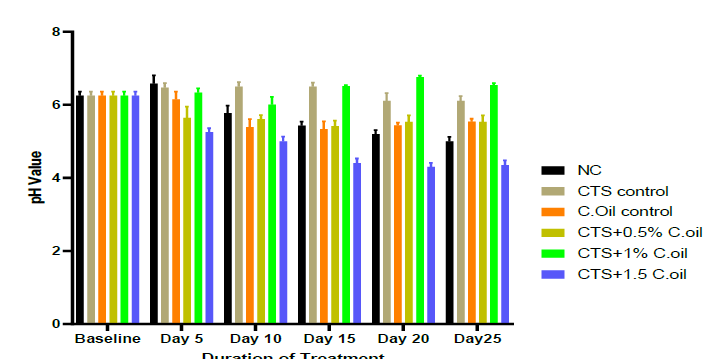
This research evaluated the use of chitosan loaded with clove oil to prevent nutrient deterioration, quality and extend the shelf-life of cucumbers and plantains. The study involved the synthesis as well as characterisation of chitosan (CTS) from crab shells and afterward loaded with clove oil (C.oil) synthesised from clove seed. The process yielded 45.7% CTs and 14.0% C.oil. The synthesised CTS was 60% pure and had a 78% deacetylation level. The chitosan-loaded clove oil was applied to cucumbers and plantains to assess their efficacy in preservation and shelf life extension. Application of chitosan-loaded clove oil reduced weight loss in cucumbers from 30.14% to 17.54% and in plantains from 48.89% to 28.63%. The untreated normal control (NC) samples had a significant increase in pH and a decrease in total titratable acidity (TTA), while a slight change in pH and TTA was observed in the cucumbers and plantain treated with chitosan-loaded clove oil. Cucumbers and plantains treated with chitosan-loaded clove oil show no significant reduction in the total antioxidant capacity when in comparison to the control group. Also, there is the retention of the epicarp green colouration for a longer period in the fruits coated with CTS +1% C.oil and CTS solution than in untreated samples. In conclusion, chitosan-loaded clove oil demonstrated significant potential in extending the shelf-life and preserving the quality of cucumbers by an additional 15 days and plantains by an additional 4 days.
References
Aguilar-González, A. E., Palou, E., & López-Malo, A. (2015). Antifungal Activity of Essential Oils of Clove (Syzygium aromaticum) and/or Mustard (Brassica nigra) in Vapour Phase Against Gray Mold (Botrytis cinerea) in Strawberries. Innovative Food Science & Emerging Technologies, 32, 181–185. https://doi.org/10.1016/j.ifset.2015.09.003
Ajibola, O. O., Thomas, R., & Bakare, B. F. (2023). Selected fermented indigenous vegetables and fruits from Malaysia as potential sources of natural probiotics for improving gut health. Food science and human wellness, 12(5), 1493-1509. https://doi.org/10.1016/j.fshw.2023.02.011
AOAC., (2010). Official Methods of Analysis of Association of Official Analytical Chemists. 18th Edition, Washington, DC.
Apak, R., Güçlü, K., Özyürek, M., Bektas¸ Oğlu, B., & Bener, M. (2008). Cupric ion reducing antioxidant capacity assay for food antioxidants: vitamins, polyphenolics, and flavonoids in food extracts. Advanced protocols in oxidative stress I, 163-193. https://doi.org/10.1007/978-1-60327-517-0_14
Atarés, L. & Chiralt, A. (2016). Essential Oils as Additives in Biodegradable Films and Coatings for Active Food Packaging. Trends in Food Science & Technology, 48, 51-62. https://doi.org/10.1016/j.tifs.2015.12.001
Adeniyi, O. R. & Ayandiji, A. (2014). Economic analysis of post-harvest losses in plantain (and banana): a case study of south western Nigeria. https://doi.org/10.9734/BJAST/2014/11969
Beckles, D. M. (2012). Factors affecting the postharvest soluble solids and sugar content of tomato (Solanum lycopersicum L.) fruit. Postharvest biology and technology, 63(1), 129-140. https://doi.org/10.1016/j.postharvbio.2011.05.016
Bhardwaj, A., Alam, T., & Talwar, N. (2019). Recent advances in active packaging of agri-food products: a review. Journal of Postharvest Technology, 7(1), 33-62. https://acspublisher.com/journals/index.php/jpht/article/view/15377
Burrows, F., Louime, C., Abazinge, M., & Onokpise, O. (2007). Extraction and evaluation of chitosan from crab exoskeleton as a seed fungicide and plant growth enhancer. American-Eurasian Journal of Agricultural & Environmental Sciences, 2(2), 103-111.
Chaudhary, S., Kumar, S., Kumar, V., & Sharma, R. (2020). Chitosan nanoemulsions as advanced edible coatings for fruits and vegetables: Composition, fabrication and developments in last decade. International Journal of Biological Macromolecules, 152, 154-170. https://doi.org/10.1016/j.ijbiomac.2020.02.276
Czechowska-Biskup, R., Jarosińska, D., Rokita, B., Ulański, P. & Rosiak, J. M. (2012). Determination of degree of deacetylation of chitosan-comparision of methods. Progress on Chemistry and Application of Chitin and its Derivatives, (17), 5-20.
Dos Santos, S. N. A., Kluczkovski, A. M., de Souza, T. P., Pinto, S. D. C. B., da Silva, A. C. P., Lemos, H. B., & Teixeira, I. D., (2023). Monitoring sugar content in infant foods. Brazilian Journal of Health Review, 6(2), 6829-6840. https://doi.org/10.34119/bjhrv6n2-187
Fawole, O. A., & Opara, U. L. (2013). Changes in physical properties, chemical and elemental composition and antioxidant capacity of pomegranate (cv. Ruby) fruit at five maturities stages. Scientia Horticulturae, 150, 37-46. https://doi.org/10.1016/j.scienta.2012.10.026
Ghasemnezhad, M., Zareh, S., Shiri, M. A., & Javdani, Z. (2015). The arils characterization of five different pomegranates (Punica granatum) genotypes stored after minimal processing technology. Journal of food science and technology, 52, 2023-2032. https://doi.org/10.1007/s13197-013-1213-6
Graça, A., Santo, D., Esteves, E., Nunes, C., Abadias, M., & Quintas, C. (2015). Evaluation of microbial quality and yeast diversity in fresh-cut apple. Food Microbiology, 51, 179-185. https://doi.org/10.1016/j.fm.2015.06.003
Guan, W., Li, S., Yan, R., Tang, S. & Quan, C. (2007). Comparison of Essential Oils of Clove Buds Extracted with Supercritical Carbon dioxide and Other Three Traditional Extraction Methods. Food Chemistry, 101(4), 1558–1564. https://doi.org/10.1016/j.foodchem.2006.04.009
Hasheminejad, N., Khodaiyan, F. & Safari, M. (2019). Improving the antifungal activity of clove essential oil encapsulated by chitosan nanoparticles. Food chemistry, 275, 113-122. https://doi.org/10.1016/j.foodchem.2018.09.085
Hasheminejad, N. & Khodaiyan, F. (2020). The effect of clove essential oil loaded chitosan nanoparticles on the shelf life and quality of pomegranate arils. Food chemistry, 309, 125520. https://doi.org/10.1016/j.foodchem.2019.125520
Hussain, M. R., Iman, M., Maji, & T. K. (2013). Determination of degree of deacetylation of chitosan and their effect on the release behavior of essential oil from chitosan and chitosan-gelatin complex microcapsules. International Journal of Advanced Engineering Applications, 6(4), 4-12.
He, Z., Bao, B., Fan, J., Wang, W. & Yu, D. (2020). Photochromic Cotton Fabric Based on Microcapsule Technology with Anti-Fouling Properties. Colloids and Surfaces A: Physicochemical and Engineering Aspects, 594, 124661. https://doi.org/10.1016/j.colsurfa.2020.124661
Kumar, S., Mukherjee, A. & Dutta, J. (2020). Chitosan based nanocomposite films and coatings: Emerging antimicrobial food packaging alternatives. Trends in Food Science & Technology, 97, 196-209. https://doi.org/10.1016/j.tifs.2020.01.002
Negi, A., & Kesari, K. K. (2022). Chitosan nanoparticle encapsulation of antibacterial essential oils. Micromachines, 13(8), 1265. https://doi.org/10.3390/mi13081265
Núñez, L., D'aquino, M., & Chirife, J. (2001). Antifungal Properties of Clove Oil (Eugenia caryophylata) in Sugar Solution. Brazilian Journal of Microbiology, 32, 123-126. https://doi.org/10.1590/S1517-83822001000200010
Ogungbemi, K., Ugbaja, R. N., Ilesanmi, F. F., Ilori, A. O., Odeniyi, T. A., Adeniyi, B. M., Balogun, D.A., & Ajisafe, S. S. (2020). Effect of dietary chitosan on the feed efficiency and weight performance of high fat diet induced hyperlipidemia in male wistar rat. International Journal of Scientific Reports, 6, 90-94. https://doi.org/10.18203/issn.2454-2156.IntJSciRep20200645
Oyewole, O.S., Ogungbemi, K., Ilori, A.O., Ibitoye, O. & Ayangbemi, B.T. (2023). Evaluation of synergistic effect of evaporative cooling system and potassium permanganate on extending the shelf life and quality of plantain. Innovare Journal of Agricultural Science, 2(11), 1-5
Pereira dos Santos, E., Nicácio, P. H. M., Coêlho Barbosa, F., Nunes da Silva, H., Andrade, A. L. S., Lia Fook, M. V., de Lima Silva, S.M., & Farias Leite, I. (2019). Chitosan/essential oils formulations for potential use as wound dressing: Physical and antimicrobial properties. Materials, 12(14), 2223. https://doi.org/10.3390/ma12142223
Perumal, A. B., Huang, L., Nambiar, R. B., He, Y., Li, X., & Sellamuthu, P. S. (2022). Application of essential oils in packaging films for the preservation of fruits and vegetables: A review. Food chemistry, 375,131810. https://doi.org/10.1016/j.foodchem.2021.131810
Rahman, M. S. (Ed.), 2020. Handbook of food preservation. CRC press.
Silvennoinen, K., Katajajuuri, J.M., Hartikainen, H., Heikkilä, L., & Reinikainen, A. (2014). Food Waste Volume and Composition in Finnish Households. British Food Journal, 116(6), 1058–1068. https://doi.org/10.1108/BFJ-12-2012-0311
Yousuf, B., Wu, S., Siddiqui, & M. W. (2021). Incorporating essential oils or compounds derived thereof into edible coatings: Effect on quality and shelf life of fresh/fresh-cut produce. Trends in Food Science &Technology, 108,245-257. https://doi.org/10.1016/j.tifs.2021.01.016
Yu, D., Xu, Y., Jiang, Q., Xia, W. (2017). Effects of chitosan coating combined with essential oils on quality and antioxidant enzyme activities of grass carp (Ctenopharyngodon idellus) fillets stored at 4 C. International Journal of Food Science & Technology, 52(2), 404-412. https://doi.org/10.1111/ijfs.13295
Yuan, G., Chen, X., & Li, D. (2016). Chitosan films and coatings containing essential oils: The antioxidant and antimicrobial activity, and application in food systems. Food Research International, 89, 117-128. https://doi.org/10.1016/j.foodres.2016.10.004
Downloads
Published
Issue
Section
Categories
License
Copyright (c) 2026 Kunle Ogungbemi, Adewale Ayodeji Afolabi, Odunola Victoria Ajala, Babawale Matthew Akeju, Oluwakemi Mobolade Solomon Ibuwunwa, Daniel Balogun, Samuel Taiwo Popoola, Boluwaji Matthew Adeniyi, Olubukola Ademilola Ogundare, Shuaeeb Niyi Oyewole

This work is licensed under a Creative Commons Attribution 4.0 International License.


