
ASSESSMENT OF SOME PHYSICOCHEMICAL PROPERTIES AND HEAVY METALS IN WATER FROM FARMLANDS AROUND MAHANGA LAKE, BALI LOCAL GOVERNMENT AREA OF TARABA STATE, NIGERIA
DOI:
https://doi.org/10.33003/fjs-2025-0912-4307Keywords:
Heavy metals, Physicochemical properties, Mahanga lake, Water quality, Environmental toxicityAbstract
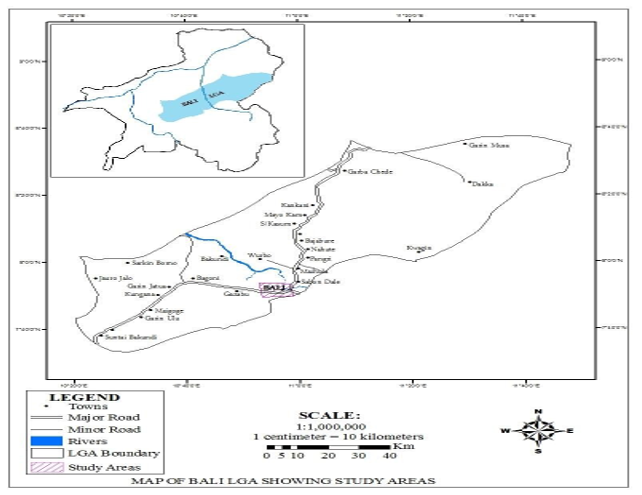
Water quality in agricultural landscapes is increasingly threatened by physicochemical pollutants and heavy metals arising from farming practices and anthropogenic activities. These contaminants pose serious risks to ecosystem health and human safety, particularly in rural communities that rely directly on natural water bodies for drinking, irrigation, and domestic use. This study assessed the physicochemical properties and heavy metal concentrations in water from farmlands around Mahanga Lake, Bali Local Government Area, Taraba State, Nigeria. Water samples were collected from four cardinal points (North, South, East, West) and analyzed using standard methods. Physicochemical parameters (pH, Temperature, Electrical Conductivity, Total Suspended Solids, Total Dissolved Solids, Turbidity) were measured with appropriate meters, while heavy metals (Cd, Cr, Cu, Ni, Pb) were determined using Atomic Absorption Spectroscopy. Results revealed that pH (5.7–6.8), TSS (190–210 mg/L), and turbidity (32–38 NTU) did not meet WHO drinking water standards. Heavy metal analysis showed that Cr (0.063–0.085 mg/L) and Pb (0.048–0.071 mg/L) concentrations exceeded permissible WHO limits, while Cd (0.015–0.028 mg/L), Cu (0.13–0.18 mg/L), and Ni (0.0008–0.001 mg/L) were within acceptable ranges. Pearson’s correlation analysis indicated a strong positive relationship between TSS and turbidity (r = 0.996), and between Cr and Pb (r = 0.955), suggesting common pollution sources. The study concludes that the lake water is unsuitable for drinking and recommends continuous monitoring, public awareness on water safety, and implementation of remediation strategies to reduce pollutant influx from agricultural and anthropogenic activities.
References
Abd Elnabi, H., El-Sayed, M., & Hassan, R. (2023). Toxicological impacts of heavy metals on children’s health: A global perspective. Environmental Health Perspectives, 131(4), 450–462. https://doi.org/10.1289/ehp.2023.450
APHA. (2022). Standard methods for the examination of water and wastewater (23rd ed.). Washington, DC: American Public Health Association.
Chunhabundit, R. (2022). Cadmium toxicity and renal dysfunction: Mechanisms and health implications. Toxicology Reports, 9, 123–134. https://doi.org/10.1016/j.toxrep.2022.01.012
De Ronda, A., Khalid, S., & Yusuf, M. (2023). Lead exposure in children from traditional cosmetics: Neurological and behavioral outcomes. Journal of Pediatric Toxicology, 12(2), 89–101. https://doi.org/10.1016/j.jptox.2023.02.005
Egbueri, J. C. (2020). Human health risk assessment of heavy metals in drinking water sources. Environmental Nanotechnology, Monitoring & Management, 14, 100–112. https://doi.org/10.1016/j.enmm.2020.100312
Flannery, B., O’Connor, J., & Smith, L. (2022). Cadmium exposure and adverse birth outcomes: A systematic review. Environmental Research, 210, 112–120. https://doi.org/10.1016/j.envres.2022.112120
Igbokwe, O. I., Nwankwo, C., & Okeke, J. (2021). Electrical conductivity of drinking water sources in Nigeria: Implications for public health. African Journal of Environmental Science and Technology, 15(6), 234–242. https://doi.org/10.5897/AJEST2021.3021
Jebreen, H. (2019). Temperature variations in freshwater ecosystems: Case studies from Africa. Journal of Environmental Hydrology, 27(3), 45–53.
Khan, M. A., Singh, R., & Zhang, Y. (2024). Environmental persistence and human health risks of priority heavy metals in aquatic ecosystems. Environmental Science and Pollution Research, 31(12), 17845–17862. https://doi.org/10.1007/s11356-023-30567-2
Malik, A., Khan, R., & Hussain, S. (2023). Agricultural sources of heavy metal pollution: Fertilizers, pesticides, and wastewater. Chemosphere, 320, 137–148. https://doi.org/10.1016/j.chemosphere.2023.137148
MASIME. (2022). Laboratory protocols for suspended solids analysis in water. International Journal of Environmental Analytical Chemistry, 102(5), 567–574. https://doi.org/10.1080/03067319.2022.102574
Mohammed, A., Suleiman, M., & Musa, Y. (2019). Physicochemical properties of surface waters in Taraba State, Nigeria. Nigerian Journal of Environmental Sciences, 13(2), 77–85.
Musa, I. (2021). Turbidity and transparency of surface waters: Agricultural impacts in Nigeria. African Journal of Water Resources, 8(1), 33–41.
National Population Commission (NPC). (2006). Population and housing census of the Federal Republic of Nigeria: Priority tables. Abuja: NPC.
Ogoko, E., & Sylvester, C. (2020). Electrical conductivity and dissolved salts in Nigerian freshwater systems. Journal of Water Quality Research, 56(4), 345–352. https://doi.org/10.2166/wqrj.2020.056
Vidican, R., Popa, D., & Stan, M. (2020). Environmental and health impacts of cadmium, lead, copper, and zinc. Ecotoxicology and Environmental Safety, 196, 110–118. https://doi.org/10.1016/j.ecoenv.2020.110118
Downloads
Published
Issue
Section
Categories
License
Copyright (c) 2025 Farimani Dowell Bartimaeus, Modibbo U.U, Wasinda Malgwi Daniel, Abubakar Umar Mohammed

This work is licensed under a Creative Commons Attribution 4.0 International License.


