
GROWTH PERFORMANCE AND FEED UTILIZATION OF Clarias gariepinus JUVENILE FED GRADED LEVEL OF BLOOD MEAL
DOI:
https://doi.org/10.33003/fjs-2025-0912-4282Keywords:
Bloodmeal, Clarias gariepinus, FCR, Fishmeal, Growth performanceAbstract
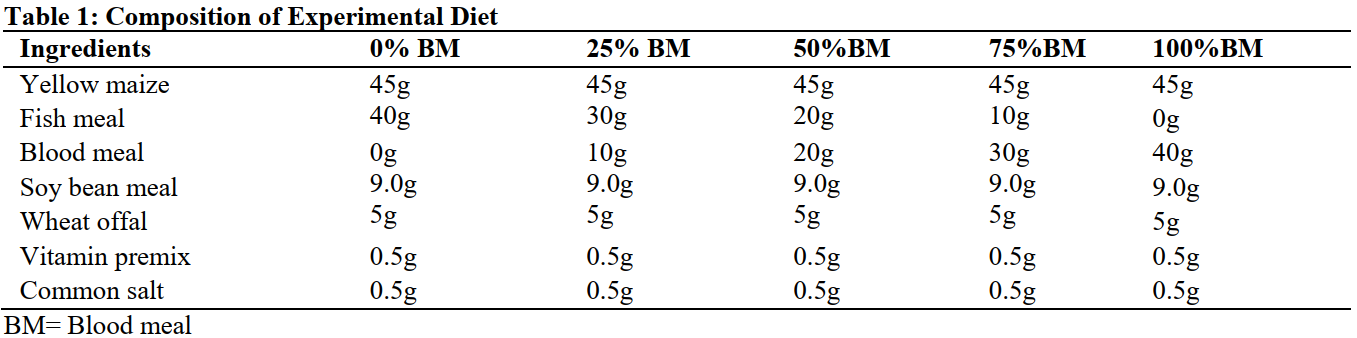
This study investigated the growth performance and feed utilization of Clarias gariepinus juvenile (African catfish) fed graded levels of blood meal. The experiment was conducted at the Zoology Laboratory, Nasarawa State University, Keffi, over a 12-week period from september to november 2024. Juvenile C. gariepinus (mean initial weight: 8 g) were acclimated and randomly stocked (10 fish per 20liters aquarium) in triplicate groups, totaling 150 fish across 15 aquaria. Five isonitrogenous and isocaloric diets were formulated with graded blood meal inclusion levels of (0%, 25%, 50%, 75%, and 100%). Diet composition included yellow maize, fish meal, blood meal, soybean meal, wheat offal, vitamin premix, and common salt. Growth performance varied among treatments; the highest weight gain was observed in fish fed 25% and 50% blood meal, whereas lower gains were recorded at 0% and 100% inclusion levels. Differences in weight gain across treatments were not statistically significant (p > 0.05). Water quality parameters recorded were within optimal ranges: temperature (24–26 °C), pH (6.5–7.0) and dissolved oxygen (4.7–5.6 mg/L). The study demonstrates that blood meal can partially replace fish meal in C. gariepinus diets, with 25–50% inclusion levels yielding optimal growth performance. Based on the findings of this study, it is recommended that blood meal be included at 25–50% levels in the diets of Clarias gariepinus juveniles, as these inclusion rates produced the best growth performance and feed utilization. Fish farmers and feed formulators should therefore adopt partial replacement of fish meal with blood meal within this range to reduce feed...
References
Adewole, A., & Olaleye, V. (2020). Growth performance in Clarias gariepinus. Institute for Freshwater Fisheries Research, New Bussa, 5, 73–82.
Adewumi, A. A. (2021). Bovine blood and rumen digesta in catfish diet. European Journal of Scientific Research, 83(2), 167–172.
Agbebi, O. T. (2019). Effect of different levels of substitution of fish meal with blood meal in pelleted feeds on catfish culture. European Journal of Scientific Research, 31(1), 6–10.
Akirotimi, C., & Costell, M. (2020). Artificial reproduction and pond rearing of African catfish in Sub-Saharan Africa: A handbook. FAO Fisheries Technical Paper No. 362.
Aliu, B. S. (2020). Replacement of fish meal with poultry/hatchery waste meal supplemented with blood meal in catfish fingerlings. Journal of Scientific and Engineering Research, 3(6), 125–130.
American Public Health Association (APHA). (2021). Standard methods for the examination of water and wastewater. Washington, DC: APHA.
Brink, R. (2021). Fish cultured in Central East Africa. Faulum Romapp, 158.
Cheng, H., Hardy, R., & Usry, J. (2019). Constant temperature growth performance of wild population Ictalurus punctatus. Aquaculture, 654.
Divakaran, S. (2019). Catfish nutrition. University Extension Service Publication 2412, 4 pp. Mississippi State University.
Dongmo, P. (2020). Fish growth. Kent Crockhelm Ltd. Retrieved May 2022.
Duwal, S. D., Onyia, L. U., Edward, A., Apollos, T. G., George, M., & Kwankwa, T. (2019). Partial replacement of fish meal with blood meal in diets of Clarias gariepinus fingerlings in Mubi, Nigeria: Effects on growth, survival and cost. Adamawa State University Journal of Scientific Research, 7(1).
El Sayeed, A. (2024). Catfish nutrition requirements. Mississippi State University Extension Service Publication 2412, 4 pp.
John Amadi, S. V., & Bob Manuel, F. G. (2019). Blood meal as fish meal replacers: The effect on growth and feed utilization in the African catfish (Clarias gariepinus) fingerlings. European Journal of Biotechnology and Bioscience, 7(4), 22–26.
Makinde, O. A., & Sonaiya, E. B. (2012). The potential of two vegetable-carried blood meals as protein sources in African catfish (Clarias gariepinus, Burchell) juvenile diets. Open Journal of Animal Sciences, 2(1). https://doi.org/10.4236/ojas.2012.21003
Mbagwu, B., Ibeawuchi, R. K., & Okorie, U. P. (2022). Effects of blood meal inclusion diet on growth performance, feed utilization and survival rate of Clarias gariepinus (Burchell 1822) in concrete pond. Asian Journal of Fisheries and Aquatic Research, 20(5), 12–22. https://doi.org/10.9734/ajfar/2022/v20i5505
Njieassam, E. S. (2016). Effects of using blood meal on the growth and mortality of catfish. Journal of Ecosystem & Ecography, 6. https://doi.org/10.4172/2157-7625.1000204
Noreen, S. (2020). Catfish requirements.
Otubusin, S. O. (2020). Economics of small-scale table-size fish production. Aquaculture Nutrition, 13, 462–470.
Page, J., & Andrew, T. (2020). Variable feed allowance with constant protein input for catfish cultures in ponds. Aquaculture, 204, 101–112.
Thongsanitkan, P., Worapussu, T., Sirirustananun, N., & Bangbai, P. (Year). Improvement of blood meal as an ingredient in hybrid catfish (Clarias macrocephalus × Clarias gariepinus) diet. Recent Science and Technology. 6(3), 813–825 https://li01.tci-thaijo.org/index.php/rmutsvrj/article/view/254256
Downloads
Published
Issue
Section
Categories
License
Copyright (c) 2025 Aisha Aminu Sada, Banyigyi A. Hassan, James K. Makpo, Hassan S. Chuntar

This work is licensed under a Creative Commons Attribution 4.0 International License.


