
INVESTIGATION OF RAIN-INDUCED SIGNAL ATTENUATION FOR SATELLITE COMMUNICATION IN ABUJA AND KADUNA, NIGERIA
DOI:
https://doi.org/10.33003/fjs-2025-0912-4263Keywords:
Rain attenuation, Horizontal, Ku-band, Lavergnat–Gole model, Satellite communicationAbstract
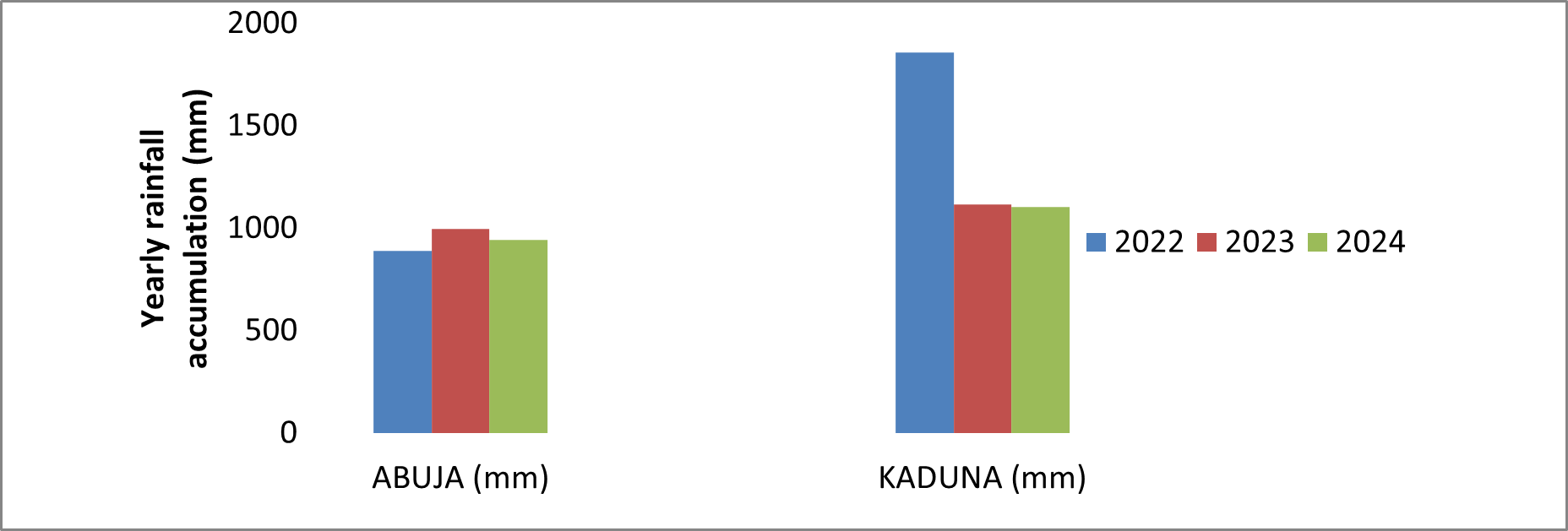
This paper examines rain-induced attenuation on Ku-band (12 GHz and 14 GHz) satellite communication links over Abuja and Kaduna, Nigeria, using three years (2022–2024) of rainfall data from the Nigerian Meteorological Agency (NiMet). The Lavergnat–Gole (LG) model was employed to derive 1-minute rain rates and corresponding attenuation for both horizontal and vertical polarisations. Results revealed rainfall rates of 95.90 mm/h in Abuja and 107.01 mm/h in Kaduna exceeded for 0.01% of the time, showing stronger rainfall intensity in Kaduna. Attenuation increased with frequencies, path length and horizontal polarisation, with Kaduna experiencing higher signal losses ranging from 15.36 dB to 152.86 dB compared to Abuja with values 13.56 dB to 134.82 dB and vertical polarization 11.95 dB to 118.89 dB in Kaduna compared to 10.63 db to 105.73 dB in Abuja at 14 GHz while horizontal polarisation for Kaduna values ranges from 11.99 dB to 119.36 dB compared to 10.54 dB to 104.79 dB in Abuja and vertical polarization for Kaduna values ranges from 8.21 dB to 92.43 dB compared to Abuja with values ranging from 8.21 dB to 81.69 dB at 12 GHz operational frequencies for path-length of 2 km, 5 km, 10 km, 15 km and 20 km link. The study concludes that rain attenuation critically limits Ku-band reliability in tropical regions, and recommends sufficient fade margin and adaptive power control to enhance system performance.
References
Adetan, O. E., & Afullo, T. J. (2013). Raindrop size distribution and rainfall attenuation modeling in Equatorial subtropical Africa, critical diameters. Annals of Telecommunications, 1-13.
Budalal, A. A., Shayea, I., Islam, M. R., Din, J., Yahya, A. E., Daradkeh, Y. I., & Azmi, M. H. (2025). Effective rain rate model for analysing overestimated rain fade in short millimetre-wave terrestrial links due to distance factor, Results in Engineering, 25, 104112.
Chebil, J. Zyoud, A. H., Habaebi, M. H., Rafiqul,, I. M., & Doa, H. (2020). Analysis of rain fade slope for terrestrial links. Indonesian Journal of Electrical Engineering and Computer Science, 18, 896 – 902.
Ezeh, G. N., Chukwuneke, N. S, Ogujiofor, N. C., & Diala, U. H. (2014). Effect of rain attenuation on satellite communication link. Advances in sciences and technology research journal, 8(22), 1-11.
Igwe, K. C., Oyedum, O. D, Ajewole, M. O, Aibinu, A. M, & Ezenwora, J. A. (2021). Performance evaluation of some rain rate conversion models for microwave propagation studies. Advances in space research, 67, 3098-3105.
ITU-R Recommendations (2017). Prediction methods required for the design of terrestrial line-of-sight systems, document ITU-R P. 530-17. International Telecommunication Union Radiocommunication Recommendations, Geneva, Switzerland.
Nweke, F. U. (2015). Lightening strike and thunder and its affection on television signal transmission, industrial physics department, Ebonyi State University, Abakaliki. Journal of Computer Engineering, 17(5).
Obiyemi, O. O., & Ibiyemi, T. S. (2014). Experimental investigation of rainfall effect on digital satellite television reception in Nigeria: Initial results. In Adaptive Science & Technology (ICAST). 6th International Conference on Institute of Electrical and Electronic Engineers.
Ojo, J. S., Ajewole, M.O., & Sarkar, S.K. (2018). Rain attenuation predictions at Ku-band in South-West Nigeria. Progress in electromagnetics research B.
Onaya, J. O. (2023). Modelling Rain Attenuation Prediction for Terrestrial Links at Centimeter and Millimeter Bands Over Kenya (Doctoral dissertation, University of Nairobi).
Semire, F. A., Mohd-Mokhtar, R., & Akanbi, I. A. (2019). Validation of New ITU-R Rain Attenuation Prediction Model over Malaysia Equatorial Region. MAPAN, 34, 71–77.
Shayea, I., Rahman, T., Hadri Azmi, M., & Islam, M. R. (2018). Real measurement study for rain rate and rain attenuation conducted over 26 GHz microwave 5G link system in Malaysia. IEEE access, 26, 19044–19064.
Tyabo, A. M., Oyedum, O. D., Ayantunji, G. B., Elemo, O. E., Muhammad, B. L., Jibrin, A. Y., & Ndanusa, B. (2022). Study of rain-induced signal degradation of terrestrial radio links within Minna and Lapai, North-Central, Nigeria. Journal of Physics and Emerging Technologies, 2756 – 3898
Downloads
Published
Issue
Section
Categories
License
Copyright (c) 2025 Aishat Al-Tine Modibbo, A. M. Tyabo, Philip Musa Gyuk, Muhammad Bello Ladan, Atsacha Ishaku Ndonya, M. A. Bashir, C. Usman

This work is licensed under a Creative Commons Attribution 4.0 International License.


