COMPARATIVE ANTI-DIABETIC ACTIVITIES OF Lawsonia inermis, Crysophyllum albidum, Allium sativum, And Mangifera indica USED IN AFRICAN TRADITIONAL SETTINGS
DOI:
https://doi.org/10.33003/fjs-2025-0912-4262Keywords:
Allium sativum, Chrysophyllum albidum, Diabetes, Keywords: Diabetes, Lawsonia inermis, Chrysophyllum albidum, Allium sativum, Mangifera indica, Wistar rats, Metformin, Mangifera indica, Metformin, Wistar ratsAbstract
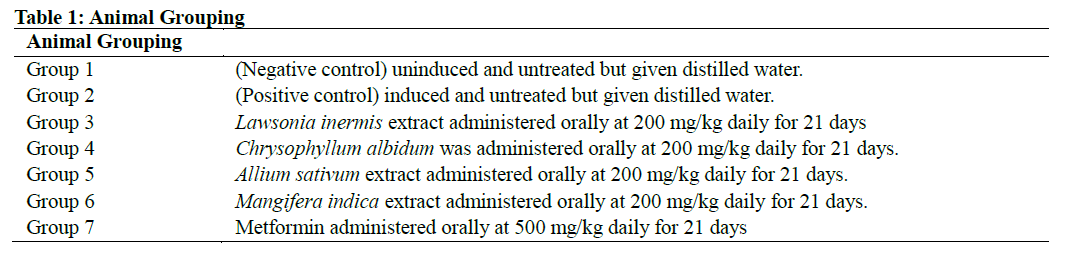
Diabetes mellitus is one of the major endocrine illnesses affecting over 100 million individuals worldwide. medicinal plants have been used for the treatment of diabetes with little incidence of toxicity. Aim is to compare the anti-diabetic activities of Lawsonia inermis, Chrysophyllum albidum, Allium sativum and Mangifera indica in Streptozotocin induced diabetic rats. Acute toxicity study was conducted using adult female Wistar rats (n=36). The comparative anti-diabetic study involved the use of male rats (n=35) grouped into (1-7) of five rats per groups. Group 1 (Negative control), 2 (Positive control), 3 (Lawsonia inermis at 200 mg/kg), 4 (Chrysophyllum albidum at 200 mg/kg), 5 (Allium sativum at 200 mg/kg), 6 (Mangifera Indica at 200 mg/kg), and 7 (Metformin at 500 mg/kg). Methanolic extract of L. inermis C. albidum, A. sativum and M. indica were not toxic at ≤5000 mg/kg. All the extracts exhibited anti-diabetic activities by significantly reducing the blood glucose in the order of L. inermis, A. sativum, C. albidum, and M. Indica. PCV decreased significantly in C. albidum, and M. indica. RBC increased significantly in L. inermis treated group while it reduced significantly in C. albidum and M. indica. Hb concentration followed similar trends increasing significantly in C. albidum, and M. indica. Lawsonia inermis possess significant anti-diabetic activities with significant modulatory effect on haematology and biochemistry when compared to other plants.
References
Adeneye, A. A., Awodele, O., Aiyeola, S. A., & Benebo, A. S. (2015). Modulatory potentials of the aqueous stem bark extract of Mangifera indica on carbon tetrachloride-induced hepatotoxicity in rats. Journal of Traditional and Complementary Medicine, 5(2), 106-115.
Agrawal, C., Khanam, B., Badtiya, V., & Juneja, S. (2024). Correlation Of Hba1c (Normal) In Early And Well Controlled Diabetes With Serum Creatinine and blood urea. International Journal of Medicine & Public Health, 14(4).
Ahmad, M. A., Bhat, S. H., Iqra, Z., Jan, I., Yousuf, S., Syeed, S., ... & Ganaie, A. A. (2024). Unveiling the Therapeutic Potential: Metabolomics Insights into Medicinal Plants and Their Antidiabetic Effects. Current Food Science and Technology Reports, 2(2), 91-109.
Akanji, O. C., Gabriel, B. O., Oshomoh, E. O., & Asuelimen, O. S. (2023). Antidiabetic property of Chrysophyllum albidum extract in Streptozotozin-induced diabetic rats.
Aladejana, E. B., Adelabu, O. A., Aladejana, A. E., & Ndlovu, S. I. (2024). Antimicrobial properties of alternative medicines used in the management of infections in diabetic patients: A comprehensive review. Pharmacological research-modern Chinese medicine, 11, 100432.
Alsuliam, S. M., Albadr, N. A., Alshammari, G. M., Almaiman, S. A., Yagoub, A. E. A., Saleh, A., & Yahya, M. A. (2023). Lepidium sativum alleviates diabetic nephropathy in a rat model by attenuating glucose levels, oxidative stress, and inflammation with concomitant suppression of TGF-β1. Saudi Journal of Biological Sciences, 30(8), 103720.
Ansari, S. (2021). Overview of traditional systems of medicine in different continents. In Preparation of Phytopharmaceuticals for the Management of Disorders (pp. 431-473). Academic Press.
Aremu, A., Oridupa, O. A., & Bashar, N. B. (2024). Effect of Different Fractions of Lawsonia inermis Linn on Haematobiochemical Changes, Osmotic Fragility and Lipid Profile in Streptozotocin-induced Diabetic Wistar Rats. Journal of Applied Veterinary Sciences, 9(3), 19-30.
Aremu, A., Oridupa, O. A., Akorede, G. J., Olatumji, A. O., Basiru, A., Ahmed, A. O., & Raufu, I. A. (2022). Safety evaluation of Lawsonia inermis on physiological, andrological and haematological parameters of male Wistar rats.
Aremu, A., Oridupa, O. A., Raufu, I. A., & Ahmed, A. O. (2022). In vivo antihyperglycaemic activities of different solvent partitioned extract of Lawsonia inermis leaves in streptozotocin-induced diabetic rat model. Romanian Journal of Diabetes Nutrition and Metabolic Diseases, 29(3), 323-334.
Aremu, A., Oridupa, O.A., Akorede, G.J., Basiru, A., & Ahmed O., A. (2022): In Vivo Bioactivity-Guided Fractions and Compounds Isolation of Antidiabetic Activities of Lawsonia Inermis Linn Leaves in Streptozocine Induced Diabetic Wistar Rats. Indiana Journal of Agriculture & Life Science: 2 :5 : 53-61.
Balogun, J. A. (2022). A Comparative Analysis of the Health System of Nigeria and Six Selected Nations Around the World. In The Nigerian Healthcare System: Pathway to Universal and High-Quality Health Care (pp. 299-344). Cham: Springer International Publishing.
Beura, S. K., Panigrahi, A. R., Yadav, P., Kulkarni, P. P., Lakhanpal, V., Singh, B., & Singh, S. K. (2025). Role of Thrombosis in Neurodegenerative Diseases: An Intricate Mechanism of Neurovascular Complications. Molecular Neurobiology, 62(4), 4802-4836.
Chike-Ekwughe, A., John-Africa, L. B., Adebayo, A. H., & Ogunlana, O. O. (2024). Antioxidative and anti-diabetic effects of Tapinanthus cordifolius leaf extract on high-fat diet and streptozotocin-induced type 2 diabetic rats. Biomedicine & Pharmacotherapy= Biomedecine & Pharmacotherapie, 176, 116774-116774.
Dangana, R. S., Abubakar, I. B., Shinkafi, T. S., Aja, P. M., & Nwozo, S. O. (2024). Ethnobotany, pharmacology and phytochemistry of medicinal plants used for management of Diabetes mellitus in Uganda, Kenya, Tanzania and the Democratic Republic of Congo. Discover Applied Sciences, 6(6), 312.
Dessie, G., Mulugeta, H., Amare, D., Negesse, A., Wagnew, F., Getaneh, T., ... & Lebu, S. (2020). A systematic analysis on prevalence and sub-regional distribution of undiagnosed diabetes mellitus among adults in African countries. Journal of Diabetes & Metabolic Disorders, 19(2), 1931-1941.
Dilworth, L., Facey, A., & Omoruyi, F. (2021). Diabetes mellitus and its metabolic complications: the role of adipose tissues. International journal of molecular sciences, 22(14), 7644.
Esan, C. O., Ratcliffe, C., Talabi, J. Y., Diaz-Martinez, R., & Enujiugha, V. N. (2024). Factors that influence the management of type 2 diabetes mellitus among adults in Nigeria: a systematic review and meta-analysis. IPS Journal of Public Health, 4(2), 118-142.
Goyal, Y., Verma, A. K., Bhatt, D., Rahmani, A. H., & Dev, K. (2020). Diabetes: perspective and challenges in modern era. Gene Reports, 20, 100759.
Hussein, R. A., & El-Anssary, A. A. (2019). Plants secondary metabolites: the key drivers of the pharmacological actions of medicinal plants. Herbal medicine, 1(3), 11-30.
Irinmwinuwa, O., Benard, G., Adolphus, M., Opute, R., Njoku, C., & Chinedu, J. (2023). A Critical Review On Ld50 Of Some Medicinal Plant. European Journal Pharmaceutical and Medical Research, 10, 735-746.
Izah, S. C., Ogidi, O. I., Ogwu, M. C., Salimon, S. S., Yusuf, Z. M., Akram, M., ... & Iyingiala, A. A. (2024). Historical perspectives and overview of the value of herbal medicine. In Herbal medicine phytochemistry: Applications and trends (pp. 3-35). Cham: Springer International Publishing.
Jugran, A. K., Rawat, S., Devkota, H. P., Bhatt, I. D., & Rawal, R. S. (2021). Diabetes and plant‐derived natural products: From ethnopharmacological approaches to their potential for modern drug discovery and development. Phytotherapy Research, 35(1), 223-245.
Khan, M. M., Khalilullah, H., Eid, E. E., Azam, F., Khan, M. A., Khan, A., ... & Anwar, M. J. (2022). A dig deep to scout the pharmacological and clinical facet of garlic (Allium sativum). Current Traditional Medicine, 8(1), 1-19.
Li, D. D., Yang, Y., Gao, Z. Y., Zhao, L. H., Yang, X., Xu, F., ... & Su, J. B. (2022). Sedentary lifestyle and body composition in type 2 diabetes. Diabetology & Metabolic Syndrome, 14(1), 8.
Liu, J., Ren, Z. H., Qiang, H., Wu, J., Shen, M., Zhang, L., & Lyu, J. (2020). Trends in the incidence of diabetes mellitus: results from the Global Burden of Disease Study 2017 and implications for diabetes mellitus prevention. BMC public health, 20(1), 1415.
Matalqah, S. M., & Al-Tawalbeh, D. M. (2025). Medicinal plants potential against diabetes mellitus. diabetes, 9(10), 11.
Mohajan, D., & Mohajan, H. K. (2023). Obesity and its related diseases: a new escalating alarming in global health. Journal of Innovations in Medical Research, 2(3), 12-23.
Naiff, P. F., Kuckelhaus, S. A., Couto, S., Oliveira, M., Santiago, L. M., Cascaes, A. C., ... & Guimarães, M. D. C. M. (2021). Phagocytic activity of monocytes and neutrophils in patients with periodontitis, whether or not associated to type 2 diabetes. Acta Odontológica Latinoamericana, 34(3), 201-213.
Owusu-Darko, P. G., Golly, M. K., & Owusu-Mensah, E. (2024). History of eating customs, food traditions, and dietary taboos across Western Africa: an overview on health implications, safety measures, and regulatory frameworks. Nutritional and Health Aspects of Food in Western Africa, 9-30.
OY, T., Salisu, T. F., Oladele, E. O., Yaro, C., Iliyazu, N., Tukur, A., ... & Yari, M. A. (2025). Toxicological Evaluation of the Leaves of Mangifera indica L.(Mango) on Albino Rats (Rattus norvegicus). Sultan Qaboos University Journal For Science, 28(1), 1-9.
Papachristoforou, E., Lambadiari, V., Maratou, E., & Makrilakis, K. (2020). Association of glycemic indices (hyperglycemia, glucose variability, and hypoglycemia) with oxidative stress and diabetic complications. Journal of diabetes research, 2020(1), 7489795.
Patil, S. R., Chavan, A. B., Patel, A. M., Chavan, P. D., & Bhopale, J. V. (2023). A review on diabetes mellitus its types, pathophysiology, epidermiology and its global burden. J Res Appl Sci Biotechnol, 2(4), 73-79.
Pereira, R. F., & Bartolo, P. J. (2016). Traditional therapies for skin wound healing. Advances in wound care, 5(5), 208-229.
Poznyak, A., Grechko, A. V., Poggio, P., Myasoedova, V. A., Alfieri, V., & Orekhov, A. N. (2020). The diabetes mellitus–atherosclerosis connection: The role of lipid and glucose metabolism and chronic inflammation. International journal of molecular sciences, 21(5), 1835.
Rodriguez, B. A., & Johnson, A. D. (2020). Platelet measurements and type 2 diabetes: investigations in two population-based cohorts. Frontiers in cardiovascular medicine, 7, 118.
Rudnicka, E., Suchta, K., Grymowicz, M., Calik-Ksepka, A., Smolarczyk, K., Duszewska, A. M., ... & Meczekalski, B. (2021). Chronic low grade inflammation in pathogenesis of PCOS. International journal of molecular sciences, 22(7), 3789.
Ruiz-Ortega, M., Rayego-Mateos, S., Lamas, S., Ortiz, A., & Rodrigues-Diez, R. R. (2020). Targeting the progression of chronic kidney disease. Nature Reviews Nephrology, 16(5), 269-288.
Saad, R. A., & Qutob, H. M. (2022). The relationship between anemia and obesity. Expert Review of Hematology, 15(10), 911-926.
Skalli, S., & Jordan, S. A. (2016). Herbal and traditional medicines, now and future. In Pharmacovigilance: critique and ways forward (pp. 145-159). Cham: Springer International Publishing.
Smith, J. C. (2019). Evaluation of Phytochemical Composition in Selected Medicinal Plants and Potential Application as Antimicrobial Agent. Delaware State University.
Ullah, F., Ayaz, M., Sadiq, A., Ullah, F., Hussain, I., Shahid, M., ... & Devkota, H. P. (2020). Potential role of plant extracts and phytochemicals against foodborne pathogens. Applied Sciences, 10(13), 4597.
Villas Boas, G. R., Rodrigues Lemos, J. M., de Oliveira, M. W., Dos Santos, R. C., Stefanello da Silveira, A. P., Barbieri Bacha, F., ... & Oesterreich, S. A. (2020). Aqueous extract from Mangifera indica Linn.(Anacardiaceae) leaves exerts long-term hypoglycemic effect, increases insulin sensitivity and plasma insulin levels on diabetic Wistar rats. Plos one, 15(1), e0227105.
Downloads
Published
Issue
Section
Categories
License
Copyright (c) 2025 Aremu Abdulfatai, Dr Boluwatife I AJaikaye, Dr Akorede G. J, Dr Olatunji A.O, Dr K.Y Suleiman, Dr Ahmed O.A

This work is licensed under a Creative Commons Attribution 4.0 International License.