
EFFECTS OF FUEL SUBSIDY REMOVAL ON ALLOCATIVE EFFICIENCY OF STAPLE CROP PRODUCTION IN GOMBE STATE, NIGERIA
DOI:
https://doi.org/10.33003/fjs-2025-0912-4250Keywords:
Allocative Efficiency, Fuel Subsidy Removal, Staple Crop ProductionAbstract
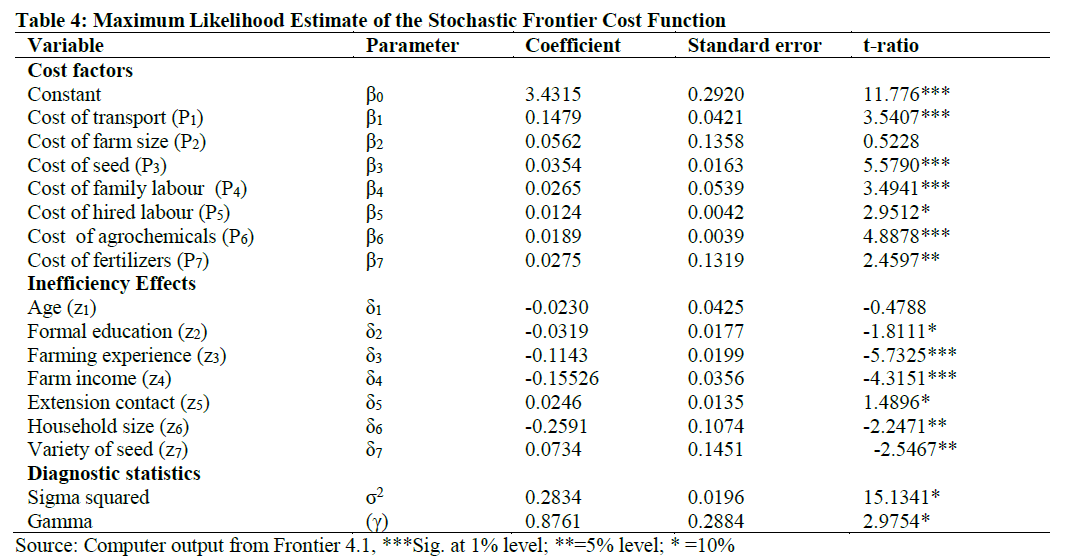
This study was carried out after fuel subsidy was removed, the aim is to examine effects of fuel subsidy removal on allocative efficiency (AE) of Staple Crop Production in Gombe State, Nigeria. Multistage, purposive and simple random sampling techniques were used to select 360 respondents. The data were analyzed using both descriptive statistics and inferential statistics. Results revealed that majority of the respondents were male (66.94%), adults with a mean age of 60 years, married (81.67%), having (54.44%) household size of 10 persons with a good literacy level of (89.73%). Coefficients of transportation cost, seeds, family labour and agrochemicals were all highly significant at 1%. Fertilizers weas at 5% while hired labour at 10% accordingly. The mean AE was 51%, sigma squared was significant at 10%, Gamma (γ) was 0.88 and significant at 10%. Constraints include but not limited to; high cost of petrol leading to inflation, high cost of transportation, labour, fertilizer, quality seeds. It was recommended that government should refine crude oil locally, exempt tax on agricultural inputs, establish mega agricultural store for subsidized inputs sale in the 774 local governments, revive extension services and also encourage farmers to join cooperatives.
References
Abayomi, A., Adam, S. O., & Alumbugu, A. (2015). Oil Exportation and Economic Growth in Nigeria. Developing Country Studies, 5(15), 83-92. https://core.ac.uk/download/pdf/234682516.pdf
Abdulkareem, A., & Abdulhakeem, K. A. (2016). Analysing Oil Price Macroeconomic Volatility in Nigeria. CBN Journal of Applied Statistics, 7(1), 1-22. https://dc.cbn.gov.ng/jas/vol7/iss1/1/
Adekoya, O. B. (2021). Revisiting Oil Consumption- Economic Growth Nexus: Resource-Curse and Scarcity Tales. Resources Policy, 70, 101-911. http://dx.doi.org
Adelabu, A. (2012). Food Security: A Threat to Human Security in Nigeria. Journal of Health and Social Issues, 7(2), 1-11.
Adikwu, O., Ochimana, G. A.1 and Babafemi, P. A. (2025). Economic Assessment of Yam Production before and after Fuel Subsidy Removal in Okpokwu Local Government Area of Benue State, Nigeria. Sahel Journal of Life Sciences FUDMA 3(1): 1-7, 2025
Agu, A. O., Ekwutosi, O. C. & Augustine, A. N. (2018). Effect of Subsidy Removal on Nigerian Economy. Advance Research Journal of Multi-Disciplinary Discoveries, 23(1), 06-12. http://www.journalresearchijf.com/wpcontent/uploads/EFFECT-OF-SUBSIDY-REMOVAL-ON-NIGERIAN-ECONOMIC.pdf
Agu, A. O., Ekwutosi, O. C. & Augustine, A. N. (2018). Effect of Subsidy Removal on Nigerian Economy. Advance Research Journal of Multi-Disciplinary Discoveries, 23 (1), 06-12. http://www.journalresearchijf.com/wpcontent/uploads/EFFECT-OF-SUBSIDY-REMOVAL-ONNIGERIAN-ECONOMIC.pd
Akinnibi, F. (2023). Fuel subsidy meaning: How to build wealth despite removal. https://cowrywise.com/blog/fuel-subsidy-andbuilding-wealth/utm
Akinyemi, O., Alege, P.O., Ajayi, O.O., Adediran, O.S & Urhie, E. (2017). A Simulation of the Removal of Fuel Subsidy and the Performance of the Agricultural Sector in Nigeria Using a Dynamic Computable General Equilibrium Approach. Covenant Journal of Business and Social Sciences, 8(1), 60-70. https://doi.org/10.20370/cjbss.v8i1.510
Anietie, U. (2023). Fuel Subsidy Removal and Hunger: Imperative of Food Banking Initiative. World Food Program. https://hungermap.wfp.org/
Ayinde, I. A., Otekunrin, O. A., and Akinbode, S. O. (2020). Food Security in Nigeria: Impetus for Growth and Development. Journal of Agricultural Economics 6(1); 808–820.
Balouga, J. (2012). Nigerian Local Content: Challenges and Prospects. International Association for Energy Economics, 4, 23-26.
Biye, S. U., Adamu, Y., Yidi, M. S., Danladi, B. B. and Sadiq, T. K. (2022). Determinants of Technical Efficiency and Profitability of Anchor Borrower Maize farmers in Gombe State, Nigeria. Journal of Agricultural Economics, Environment and Social Sciences. ISSN: 2476-8423 8(2): 18-33
BusinessDay, (2013). Increasing Nigeria’s oil refining capacity. Thursday, 14 February 2013. http://www.businessdayonline.com/NG/index.php/oil/51502-increasing-nigerias-oil-refiningcapacity. Accessed on July, 24th , 2024
Centre for Public Policy Alternatives (2012). Fuel Subsidy: A Lesson for Nigeria.
Coelli, T. J., Rao, D. S. P., and G. E. Battese (1998). An Introduction to Efficiency and Productivity Analysis. Kluwer Academic Publishers. Economics 21: 169-179.
Desai, M. (1976). Applied Econometrics, Philip Allan Publishers Ltd, Deggington, Oxford, pp52-60.
EIA, (2012). US Energy Information Administration report of Nigeria. October 16, 2012. http://www.eia.gov/countries/analysisbriefs/Nigeria/nigeria.pdf. Accessed on July 24, 2013.
Eneji, E. E. and Cajethan, U. U. (2024). Influence of furel subsidy removal onnfarmers’ access to inputs and agricultural production in Northern Cross River State, Nigeria. Journal of centre for Technical Vocation Education, Training and Research 6(1): 217-223
Erokhin, V., and Gao, T. (2020). Impacts of COVID-19 on Trade and Economic Aspects of Food Security: Evidence from45 Developing Countries. International Journal Environment Research Public Health 17, 57–75. doi: https://doi.org/10.3390/ijerph17165775
Evaans, O. Nwaogwugwwu, L., Vincent, O., Meagan, E. and Ojapinwa, T. (2023). The socioeconomics of the 2023 fuel subsidy removal in nigeria. BizEcons Quarterly, 17, 12-32
FAO (2012). Food and Agriculture Organization,www.foa.org./docrep/u8480e07.htm
FAO (2021). The State of Food and Agriculture 2021. Making Agrifood Systems More Resilient to Shocks and Stresses. Rome, FAO. https://doi.org/10.4060/cb4476en.
Grain de Sel (2010). Special Report. No. 51 — July – September 2010. Pp 11-13
Hamidu, B. M., S. G. Kuli, and I. Mohammed (2011). Profitability Analysis of Groundnut (Arachis hypogae L.) Processing among Women Enterprenuers in Bauchi Metropolis. A Paper Presented at 20th Annual National Conference of Farm Management Association of Nigeria held at Forestry Research Institute of Nigeria, Federal College of Forestry Jos, Plateau State 18th –21st September
Henderson, D. (2003). “The Measurement of Technical Efficiency Using Panel Data.” Mimeo, State University of New York at Binghamton, New York.
Ibanga, I. (2011). The Economics of Privatizing and Deregulating the Nigerian Downstream Oil Sector.https://www.oandoplc.com/wpcontent/uploads/The%20Economics%20of%20Privatizin g%20and%20Deregulating.pdf
Idrees, M. G., Rabi, T. A., Nura, M. B. (2024). Implications of Fuel Subsidy Removal on Nigeria’s Sustainable Development. Nigerian Journal of Management Sciences Vol. 25(1) pp23-25, February 2024
Jondrow, J., C. A. K. Lovell, I. S. Materov and P. Schmidt (1982). On Estimation of Technical Inefficiency in the Stochastic Frontier Production Function Model. Journal of Econometrics 19:233-238.
Khalid, S., Peter, M., Harald, G., Angel, A. and Terrie, W. (2015). Impacts on Poverty of Removing Fuel Import Subsidies in Nigeria. World Bank Policy Research Working Paper 7376. Public Disclosure Energy Policy, Vol 69, June 2014, Pages 165–178 http://www.sciencedirect.com/science/article/pii/S0301421514000950
Kilian, L. (2014). Oil Price Shocks: Causes and Consequences. Annual Review of Resource Economics, 6, 133-154. http://dx.doi.org/10.1146/annurev-resource083013-114701
Kumbhaker, S. C. and C. A. K. Lovell (2000). Stochastic Frontier Analysis, Cambridge: Cambridge University Press, United Kingdom.
Leadership Newspaper (2024). Effects of Fuel Subsidy Removal on Nigerian Masses. Tuesday, July 30th, 2024
Lorussoa, M., & Pieronib, L. (2018). Causes and Consequences of Oil Price Shocks on the UK Economy. Economic Modelling, 72, 223-236. https://doi.org/10.1016/j.econmod.2018.01.018
Mayomi, I., Wanah. B.B., & Mbaya, L. A. (2016). Geospatial Techniques for Terrain Analysis of Gombe State, Nigeria. Journal of Geography, Environment and Earth Science International 6(1) pp 3-18.
Meludu, N. T., Obidiebube, E. A., Chukwu, O., & Ikeogu, C. F. I. (2023). Sustainable agriculture, nature conservation and climate change response: Proceedings of the 1st Faculty of Agriculture International Conference, Nnamdi Azikiwe University, Awka, Nigeria. In Proceedings of the Faculty of Agriculture International Conference (pp. 1-477).
McCulloch, N., Tom, M. & Joonseok, Y. (2020). Fuel Subsidy Reform and the Social Contract in Nigeria: a Micro-economic Analysis’ 3(2020): https://www.ictd.ac/publication/fuel-subsidy social-contractmicroeconomic-analysis-nigeriarib/
Msheliza, D.S., & Bello.Y. (2016). Evidence of Climate Change and the Perceived Changes in Climate Parameters by Smallholder Farmers in Gombe State, Nigeria IOSR Journal of Humanities and Social Science (IOSR-JHSS) 21(11), pp 29-35
Mukaramah, H., Siti, H.,Che, M., Wan, R., Shazida, J., Mohd, S. (2018).The Effects of Fuel Subsidy Removal on Input Costs of Productions: Leontief Input-Output Price Model. International Journal of Supply Chain Management IJSCM, ISSN: 2050-7399 (Online), 2051-3771 (Print). Pp. 529-534
Narayanan, B. G., Aguiar, A., McDougall, R. Editors (2012). Global Trade, Assistance, and Production: The GTAP 8 Data Base, Center for Global Trade Analysis, Purdue University.
Nadoo, V. (2022). The impact of fuel subsidies on economic growth in Sub-Saharan Africa. Energy Economics, 112, 106223. http//imf.org/external/pubs/ft/dp/2013/afr1301.pdf. accessed on 24th July, 2024
National Population Commission. NPC (2006). Census Report.
Noiler (2025). Impact of fuel subsidy removal on Nigeria’s agricultural sector. https://noiler.net/blog/). Accessed November 19 2025.
Ocheni, S. I. (2015). Impact of Fuel Price Increase on the Nigerian Economy. Mediterranean Journal of Social Sciences, 6(1) S1, 560-569. http://dx.doi.org/10.5901/mjss.2015.v6n1s1p560
Okongwu & Imoisili (2022). Removal of Petrol Subsidy: Legal Implications for the Nigerian Economy. file:///C:/Users/NEWsky%20Computer%20Ware/Desktop/oil%20subsidy%201.pdf
Okwuanya, I., Ogbu, M. & Pristine, J. M. (2015). An Assessment of the Impact of Petroleum Subsidy on Consumer Price Index in Nigeria. Global Journal of Interdisciplinary Social Sciences, 4(1), 36-39. https://www.walshmedicalmedia.com/open-access/anassessment-of-the-impact-of-petroleum-subsidy-onconsumer-price-index-in-nigeria.pdf
Olaniyi, A.A. (2016). Effects of Fuel Subsidy on Transport Costs and Transport Rates in Nigeria. Journal of Energy Technologies and Policy, 6(11), 1-9. https://core.ac.uk/download/234668276.pdf
Omitogun, A., Olanrewaju, G. O., & Ogundipe, O. M. (2021). Fuel Subsidy Removal in Nigeria: Economic Implications and Polcy Framework. Journal of African Development, 24 (2), 127-142
Osabohien, R. O., Ohalete, M. P., and Osabuohien, E. (2020a). Population– Poverty– Inequality Nexus and Social Protection in Africa. Social Indicator Resources 151, 575–598. doi: 10.1007/s11205- 020-02381-0.
Ovaga, O. H., & Okechukwu, M. E. (2022). Subsidy in the Downstream Oil Sector and the Fate of the Masses in Nigeria. Kuwait Chapter of Arabian Journal of Business and Management Review, 1(6), 1-20.
Ozili P. K., & Obiora K., (2023). Implications of Fuel Subsidy Removal on the Nigerian Economy. “Public Policy’s Role in Achieving Sustainable Development Goals. IGI Global
Rice, X., (2012). Fuel Gamble Costs Jonathan his Standing. Nigeria’s President Miscalculated by Scrapping Subsidies Without Easing the Blow to The Poor. Financial Times, January 14/15, 2022, page 3.
Rimamsitse, N. (2023). Comparative Analysis of Fuel Subsidy Removal and the Diversification Policies for Agricultural Development in Nigeria. International Journal of Science, Engineering and Technology, 2023, 11:5 Pp2-18
Siddig, K., Aguiar, A., Grethe, H., Minor, P., & Walmsley, T. (2014). Impacts of Removing Fuel Import Subsidies in Nigeria on Poverty. Energy Policy, 69, 165-178.
The Nation Newspaper (2023). Domino Effect of Petrol Subsidy Removal on Food, Income Insecurity. The Nation, July 11, 2023
Udo, R.K.(1981). Geographical Regions of Nigeria. Heinemann Educational Books Ltd pp 156- 159
USDA (2024). International Production Assessment Division. Foreign Agricultural Service. U.S. Department of Agriculture. http//ipad.fas.usda.gov/countrysummary/Default.aspx?id=NI
Umar, H. M., & Umar, M. S. (2013). An assessment of the Direct Welfare Impact of Fuel Subsidy Reform in Nigeria. American Journal of Economics, 3(1), 23–26.
Umeji, G., & Eleanya, E. (2021). Assessing the impact of fuel subsidy removal in Nigeria on the Poor in the COVID-19 Era. SERBD-International Journal of Multidisciplinary Sciences 2(3) 213-216
World Bank, 2013. World Development Indicators.
Downloads
Published
Issue
Section
Categories
License
Copyright (c) 2025 Salihu Umaru Biye, Rilwanu U. Musa, Musa A. Turaki, U. Mohammed

This work is licensed under a Creative Commons Attribution 4.0 International License.


