
MICROCLIMATE VARIATION AMONG FOUR COMMON URBAN TREE SPECIES IN CALABAR, NIGERIA
DOI:
https://doi.org/10.33003/fjs-2026-1006-4249Keywords:
Thermal regulation, Urban trees, Canopy shading, Tropics, Urban greeningAbstract
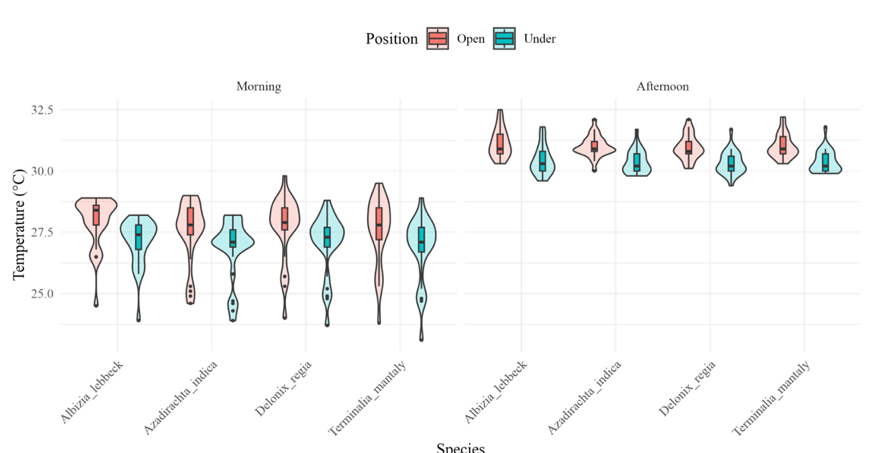
Rapid urbanization in Calabar is increasing heat stress, but detailed evidence on how urban trees control microclimate remains scarce. This study measured temperature and relative humidity (RH) beneath four common urban tree species in Calabar using a temperature and relative humidity meter. Data were collected from Azadirachta indica, Albizia lebbeck, Delonix regia, and Terminalia mantaly canopies, as well as from nearby open areas, during morning and afternoon periods. Linear mixed-effects models revealed strong daily fluctuations: afternoon temperatures were 3.22°C higher than in the morning (SE = 0.20; p < 0.001), while RH decreased by 9.36% (SE = 0.41; p < 0.001). Canopy shading consistently moderated these effects, lowering temperature by 0.81°C (SE = 0.20; p < 0.001) and raising RH by 2.52% (SE = 0.41; p < 0.001). Differences between species were generally minor; Azadirachta indica was slightly cooler than Albizia lebbeck (−0.408°C; p = 0.044) and showed a smaller afternoon RH decrease (+1.52%; p = 0.009). Most interactions were not significant, suggesting microclimate effects were broadly similar across species. The models accounted for a large portion of variation (Temperature marginal R² = 0.78; RH marginal R² = 0.91). Although boundary (singular) fits and short-term sampling limit the broad applicability of species-specific results, diagnostics confirmed the reliability of key fixed effects. Overall, the findings show that canopy cover, more than species type, determined microclimate buffering in Calabar and emphasize the importance of expanding and preserving urban tree cover to reduce heat.
References
Chen, X., Li, Z., Wang, Z., Li, J., & Zhou, Y. (2024). The impact of different types of trees on annual thermal comfort in hot summer and cold winter areas. Forests, 15(11), 1880. https://doi.org/10.3390/f15111880
De Frenne, P., Lenoir, J., Luoto, M., Scheffers, B. R., Zellweger, F., Aalto, J., Ashcroft, M. B., Christiansen, D. M., Decocq, G., De Pauw, K., Govaert, S., Greiser, C., Gril, E., Hampe, A., Jucker, T., Klinges, D. H., Koelemeijer, I. A., Lembrechts, J. J., Marrec, R., . . . Hylander, K. (2021). Forest microclimates and climate change: Importance, drivers and future research agenda. Global Change Biology, 27(11), 2279–2297. https://doi.org/10.1111/gcb.15569
Fadhlurrahman, M. M., & Nasrullah, N. (2020). Study of Thermal Comfort under The Shade of Varied Tree Canopy Form and Distance from The Stem. IOP Conference Series Earth and Environmental Science, 501(1), 012048. https://doi.org/10.1088/1755-1315/501/1/012048
Feng, X., Wen, H., He, M., & Xiao, Y. (2023). Microclimate effects and influential mechanisms of four urban tree species underneath the canopy in hot and humid areas. Frontiers in Environmental Science, 11. https://doi.org/10.3389/fenvs.2023.1108002
Huang, Z., Wu, C., Teng, M., & Lin, Y. (2020). Impacts of tree canopy cover on microclimate and human thermal comfort in a shallow street canyon in Wuhan, China. Atmosphere, 11(6), 588. https://doi.org/10.3390/atmos11060588
Jayasooriya, V., Sirimanne, A., Silva, R., & Muthukumaran, S. (2024). Role of urban trees in enhancing the thermal comfort of rapidly urbanizing cities: An analysis of tropical Asian tree species based on physiological equivalent Temperature (PET). Arboriculture & Urban Forestry, 50(5), 326–345. https://doi.org/10.48044/jauf.2024.014
Kemppinen, J., Lembrechts, J. J., Van Meerbeek, K., Carnicer, J., Chardon, N. I., Kardol, P., Lenoir, J., Liu, D., Maclean, I., Pergl, J., Saccone, P., A, R., Senior, Shen, T., Słowińska, S., Vandvik, V., Von Oppen, J., Aalto, J., Ayalew, B., Bates, O., . . . De Frenne, P. (2024). Microclimate, an important part of ecology and biogeography. Global Ecology and Biogeography, 33(6). https://doi.org/10.1111/geb.13834
Lefevre, A., Malet-Damour, B., Boyer, H., & Rivière, G. (2025). Urban heat island in the tropics: A review of advances, challenges, and future directions. City and Environment Interactions, 28, 100265. https://doi.org/10.1016/j.cacint.2025.100265
Lin, C., Wu, Z., Li, H., Huang, J., & Huang, Q. (2024). Comprehensive analysis on the thermal comfort of various greening forms: a study in hot-humid areas. Environmental Research Communications, 6(2), 025010. https://doi.org/10.1088/2515-7620/ad277e
Meili, N., Manoli, G., Burlando, P., Carmeliet, J., Chow, W. T., Coutts, A. M., Roth, M., Velasco, E., Vivoni, E. R., & Fatichi, S. (2020). Tree effects on urban microclimate: Diurnal, seasonal, and climatic temperature differences explained by separating radiation, evapotranspiration, and roughness effects. Urban Forestry & Urban Greening, 58, 126970. https://doi.org/10.1016/j.ufug.2020.126970
Morakinyo, T. E., Balogun, A. A., & Adegun, O. B. (2013). Comparing the effect of trees on thermal conditions of two typical urban buildings. Urban Climate, 3, 76–93. https://doi.org/10.1016/j.uclim.2013.04.002
Olawade, D. B., McLaughlin, M., Adeniji, Y. J., Egbon, G. O., Rahimi, A., & Boussios, S. (2025). Urban Microclimates and Their Relationship with Social Isolation: A Review. International Journal of Environmental Research and Public Health, 22(6), 909. https://doi.org/10.3390/ijerph22060909
Ononyume, M. O., & Edu, E. A. B. (2025). Assessment of growth, biomass, and carbon sequestration potential of three urban tree species in Calabar. Journal of Wildlife and Biodiversity, 9(3), 436–449. https://doi.org/10.5281/zenodo.17390404
Oyeniyi, M. A., Odunsi, O. M., Rienow, A., & Edler, D. (2025). Spatiotemporal analysis of land use change and urban heat island effects in Akure and Osogbo, Nigeria between 2014 and 2023. Climate, 13(4), 68. https://doi.org/10.3390/cli13040068
Pattnaik, N., Honold, M., Franceschi, E., Moser-Reischl, A., Rötzer, T., Pretzsch, H., Pauleit, S., & Rahman, M. A. (2024). Growth and cooling potential of urban trees across different levels of imperviousness. Journal of Environmental Management, 361, 121242. https://doi.org/10.1016/j.jenvman.2024.121242
Pereira, M. H., Isidorio, C. B., Jasmim, J. M., & Pereira, M. E. C. (2021). Reduction of apparent temperature under urban trees in a hot-humid green area. Scientific Electronic Archives, 14(5), 65–72. https://doi.org/10.36560/14520211333
Richter, R., Ballasus, H., Engelmann, R. A., Zielhofer, C., Sanaei, A., & Wirth, C. (2022). Tree species matter for forest microclimate regulation during the drought year 2018: disentangling environmental drivers and biotic drivers. Scientific Reports, 12(1), 17559. https://doi.org/10.1038/s41598-022-22582-6
Sanusi, R., Johnstone, D., May, P., & Livesley, S. J. (2016). Microclimate benefits that different street tree species provide to sidewalk pedestrians relate to differences in Plant Area Index. Landscape and Urban Planning, 157, 502–511. https://doi.org/10.1016/j.landurbplan.2016.08.010
Seun, A. I., Ayodele, A. P., Koji, D., & Akande, S. O. (2022). The potential impact of increased urbanization on land surface temperature over South-West Nigeria. Current Research in Environmental Sustainability, 4, 100142. https://doi.org/10.1016/j.crsust.2022.100142
Yu, H., Zahidi, I., & Fai, C. M. (2025). Mitigating Urban Heat Islands (UHI) through vegetation restoration: Insights from mining communities. Global Challenges, 9(3), 2400288. https://doi.org/10.1002/gch2.202400288
Zhang, J., Zhang, F., Gou, Z., & Liu, J. (2022). Assessment of macroclimate and microclimate effects on outdoor thermal comfort via artificial neural network models. Urban Climate, 42, 101134. https://doi.org/10.1016/j.uclim.2022.101134
Zhang, S., Landuyt, D., Verheyen, K., & De Frenne, P. (2022). Tree species mixing can amplify microclimate offsets in young forest plantations. Journal of Applied Ecology, 59(6), 1428–1439. https://doi.org/10.1111/1365-2664.14158
Zhao, D., Lei, Q., Shi, Y., Wang, M., Chen, S., Shah, K., & Ji, W. (2020). Role of species and planting configuration on transpiration and microclimate for urban trees. Forests, 11(8), 825. https://doi.org/10.3390/f11080825
Zhou, S., Yu, Z., Ma, W., Yao, X., Xiong, J., Ma, W., Xiang, S., Yuan, Q., Hao, Y., Xu, D., Wang, B., & Zhao, B. (2024). Vertical canopy structure dominates cooling and thermal comfort of urban pocket parks during hot summer days. Landscape and Urban Planning, 254, 105242. https://doi.org/10.1016/j.landurbplan.2024.105242
Downloads
Published
Issue
Section
Categories
License
Copyright (c) 2026 Martin Ogheneriruona Ononyume, Esther Aja Bassey Edu

This work is licensed under a Creative Commons Attribution 4.0 International License.


