
EFFECTS OF SELECTED HERBICIDES ON SOIL BENEFICIAL BACTERIA AND DEHYDROGENASE ACTIVITY
DOI:
https://doi.org/10.33003/fjs-2025-0912-4241Keywords:
Dehydrogenase activity, Herbicides, Plant growth-promoting traits, Soil bacteriaAbstract
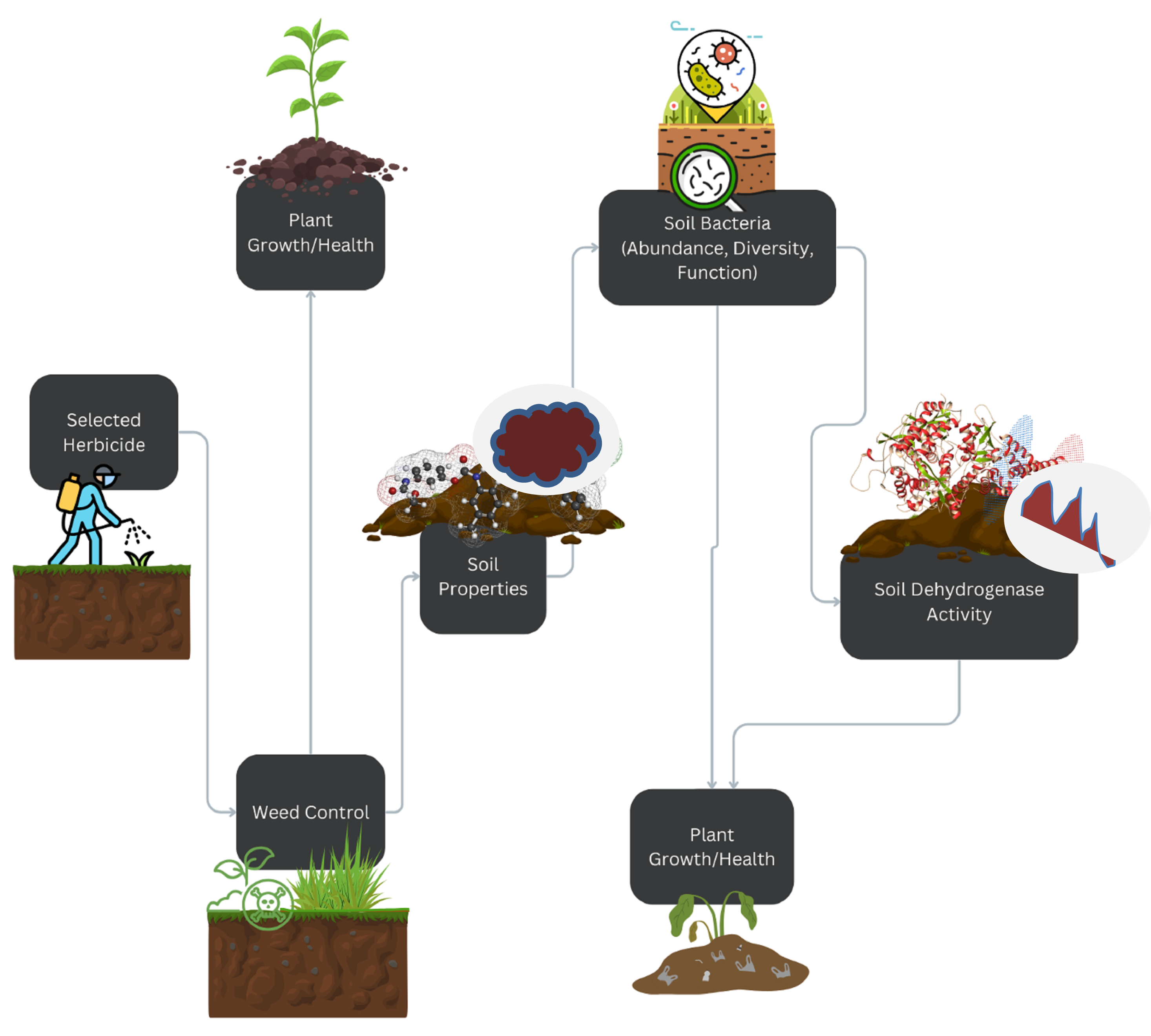
Herbicides are weeds control agents but their misuse can negatively affect soil beneficial microorganisms and dehydrogenase activity. This study evaluated the effects of herbicides on soil bacterial populations and dehydrogenase activity (DHA). Glyphosate, isopropylamine, paraquat dichloride, atrazine, and dimethylamine salt were employed. An 8000 g composite soil sample was collected using soil a soil auger from 10 different points on the botanical farm of Adekunle Ajasin University, Akungba-Akoko with no herbicide application for at least five years. The physicochemical properties of the soil were determined using standard methods. Each 500 g soil sample was treated weekly with varying herbicide concentrations [manufacturer’s specification (X): ½X, X or 2X] for 21 days. Bacteria were isolated and identified using cultural, morphological, and biochemical characterization techniques. DHA was measured using a spectrophotometric assay and all data were subjected to analysis of variance (ANOVA). The findings revealed that untreated soil had the highest bacterial counts (14.67x10⁶±0.882 CFU/mL), while glyphosate, isopropylamine, paraquat dichloride, atrazine, and dimethylamine salt exhibited significant reductions to 4.33x10⁶±0.333, 3.67x10⁶±0.333, 4.33x10⁶±0.333, 3.67x10⁶±0.667, and 4.33x10⁶±0.333, respectively after 21 days of treatment. Similarly, glyphosate, isopropylamine, paraquat dichloride, atrazine, and dimethylamine salt reduced soil DHA to 11.02, 13.66, 22.94, 17.78, and 9.30 µg TPFg-1h-1, respectively compared to untreated soil (31.75 µg TPFg-1h-1). The results contribute to a broader understanding of herbicide-soil interactions and highlight how herbicide misuse can negatively affect soil health. Therefore, farmers are encouraged to always follow manufacturer’s specification, avoid prolong herbicides usage, and adopt practices that promote overall soil health.
References
Adeoyo, O. R. (2019). Plant Growth-Promoting Potentials of Some Indigenous Bacterial Isolates. IOSR Journal of Pharmacy and Biological Sciences, 14(6), 05–10. https://doi.org/10.9790/3008-1406010510 18
Adeoyo, O. R. (2025). Evaluation of rhizobacteria and siderophores-producing bacteria from roots of selected leguminous crops. Asian Journal of Microbiology and Biotechnology 10(2), 285–293. https://doi.org/10.56557/ajmab/2025/v10i29911
Almario, J., Prigent-Combaret, C., Muller, D., & Moënne-Loccoz, Y. (2013). Effect of rhizobacterial inoculation on the abundance of native bacterial communities in the rhizosphere of tomato plants. FEMS Microbiology Ecology, 84(2), 317–331. https://doi.org/10.1111/1574-6941.12068
Azeem, H., Ali, A., Zeshan, M. A., Iftikhar, Y., Ashraf, W., Ghani, M. U., ... & Sajid, M. (2020). Biological control of plant pathogens by using antagonistic bacteria: a review. Pakistan Journal of Phytopathology, 32(2), 273-290. https://doi.org/10.33866/phytopathol.030.02.0590
Adomako, M. O., & Akyeampong, S. (2016). Effect of Some Commonly Used Herbicides on Soil Microbial Population. Journal of Environment and Earth Science, 6(1), 30–38.
Ayansina, A. D. V. & Oso, B. A. (2006). Effect of two commonly used herbicides on soil microflora at two different concentrations. Africa Journal of Biochemistry, 5(2), 129-132.
Barghavi, V., Swain, L., Gurudeo, S., & Sadhu, S. (2024). Microbial Production of Water-Soluble Vitamins. In Microbial Products for Health and Nutrition. Singapore: Springer Nature Singapore. pp. 333-363.
Bhat, M. A., Kumar, V., Bhat, M. A., Wani, I. A., Dar, F. L., Farooq, I., ... & Jan, A. T. (2020). Mechanistic insights of the interaction of plant growth-promoting rhizobacteria (PGPR) with plant roots toward enhancing plant productivity by alleviating salinity stress. Frontiers in Microbiology, 11, 1952.
Bharathi, J. M., Anbarasu, M., Ragu, R., & Subramanian, E. (2024). Assessment of soil microbial diversity and soil enzyme activities under inorganic input sources on maize and rice ecosystems. Saudi Journal of Biological Sciences, 31(5), 103978. https://doi.org/10.1016/j.sjbs.2024.103978
Buxton, R. (2005). Blood Agar Plates and Hemolysis Protocols. American Society for Microbiology, May 2019, 1–9. www.asmscience.org
Chen, X., Zhao, Y., Zhu, X., Wang, J., Liu, X., Guo, L., & Li, X. (2020). The effects of paraquat on the bacterial community and enzyme activity in soil. Environmental Science and Pollution Research, 27(19), 24549–24561.
Chen, L., & Liu, Y. (2024). The Function of Root Exudates in the Root Colonization by Beneficial Soil Rhizobacteria. Biology, 13, 95. https://doi.org/10.3390/biology13020095
Cui, E., Fan, X., Li, Z., Liu, Y., Neal, A. L., Hu, C., & Gao, F. (2019). Variations in soil and plant-microbiome composition with different quality irrigation waters and biochar supplementation. Applied Soil Ecology, 142, 99-109. https://doi.org/10.1016/j.apsoil.2019.04.026
Dandwate, S. C. (2020). Analysis of soil samples for its physicochemical parameters from Sangamner city. GSC Biological and Pharmaceutical Sciences, 12(2), 123–128. https://doi.org/10.30574/gscbps.2020.12.2.0243
Dennis, P. G., Kukulies, T., Forstner, C., Orton, T. G., & Pattison, A. B. (2018). The effects of glyphosate, glufosinate, paraquat and paraquat-diquat on soil microbial activity and bacterial, archaeal and nematode diversity. Scientific Reports, 8(1), 1–9. https://doi.org/10.1038/s41598-018-20589-6
Devi, R., Thakur, R., & Rajni Devi, C. (2018). Screening and identification of bacteria for plant growth promoting traits from termite mound soil. Journal of Pharmacognosy and Phytochemistry, 7(2), 1681–1686.
Ejeagba, T. E., Obi, C. C., & Umanu, G. (2023). Isolation and Molecular Characterization of Phosphate-Solubilizing Bacteria from Root Nodules of Cowpea (Vigna unguiculata) Seeds Planted at Ota, Ogun State, Nigeria. Journal of Applied Sciences and Environmental Management, 27(11), 2525–2531. https://doi.org/10.4314/jasem.v27i11.23
Etesami, H., Adl, S. M. (2020). Plant Growth-Promoting Rhizobacteria (PGPR) and Their Action Mechanisms in Availability of Nutrients to Plants. In: Kumar, M., Kumar, V., Prasad, R. (eds) Phyto-Microbiome in Stress Regulation. Environmental and Microbial Biotechnology. Springer, Singapore. pp 147–203. https://doi.org/10.1007/978-981-15-2576-6_9
FAO (2019). The State of Food and Agriculture 2019. Moving forward on food loss and waste reduction. Rome.
Fahde, S., Boughribil, S., Sijilmassi, B., & Amri, A. (2023). Rhizobia: A Promising Source of Plant Growth-Promoting Molecules and Their Non-Legume Interactions: Examining Applications and Mechanisms. Agriculture (Switzerland), 13, 1279. https://doi.org/10.3390/agriculture13071279
Filimon, M.N., Roman, D.L., Caraba, I.V., & Isvoran, A. (2021). Assessment of the effect of application of the herbicide S-metolachlor on the activity of some enzymes found in soil. Agriculture, 11, 469.
Gamalero, E., Lingua, G., & Glick, B. R. (2023). Ethylene, ACC, and the plant growth-promoting enzyme ACC deaminase. Biology, 12(8), 1043.
Gao, W., Li, Y., Liang, J., Chen, Y., Zhang, X., & Ma, X. (2020). Impact of soil type and herbicides on soil bacterial communities: A comparative study of a Mollisol and a Vertisol. Applied Soil Ecology, 145, 103329. https://doi.org/10.1016/j.apsoil.2019.103329
García-Berumen, J. A., Flores de la Torre, J. A., de los Santos-Villalobos, S., Espinoza-Canales, A., Echavarría-Cháirez, F. G., & Gutiérrez-Bañuelos, H. (2025). Phosphorus dynamics and sustainable agriculture: The role of microbial solubilization and innovations in nutrient management. Current Research in Microbial Sciences, 8(November 2024). https://doi.org/10.1016/j.crmicr.2024.100326
He, X., Wu, C., Tan, H., Deng, X., & Li, Y. (2023). Impact of Combined Exposure to Glyphosate and Diquat on Microbial Community Structure and Diversity in Lateritic Paddy Soil. Sustainability (Switzerland), 15(11). https://doi.org/10.3390/su15118497
He, S., Li, L., Lv, M., Wang, R., Wang, L., Yu, S., & Li, X. (2024). PGPR: key to enhancing crop productivity and achieving sustainable agriculture. Current Microbiology, 81(11), 377.
Hernandez, J. C. (2025). Glyphosate-microbial interactions : metagenomic insights and future directions. May. https://doi.org/10.3389/fmicb.2025.1570235
Kaur, J., & Kaur, G. (2021). Dehydrogenase activity as a biological indicator of soil health. Chemistry Science Review Letters, 10(39), 326–329. https://doi.org/10.37273/chesci.cs205205338
Liu, Y., Shi, J., Wang, H., Zhou, J., & Sun, X. (2017). Acetochlor reduced soil bacterial diversity and activated the dehydrogenase activity by changing soil physicochemical properties. Environmental Science and Pollution Research, 24(29), 22851–22862. https://doi.org/10.1007/s11356-017-9969-8
Mathiyalagan, S., Arthanari, P. M., & Chinnusamy, C. (2015). Effect of herbicides application on dehydrogenase activity. 25th Asian-Pacific Weed Science Society Conference on “Weed Science for Sustainable Agriculture, Environment and Biodiversity”, Hyderabad, India during 13-16 October, 2015, 430.
Mei, L., Xia, X., Cao, J., Zhao, Y., Huang, H., Li, Y., & Zhang, Z. (2024). Degradation of Three Herbicides and Effect on Bacterial Communities under Combined Pollution. Toxics, 12(8). https://doi.org/10.3390/toxics12080562
Oyeshomo, A. V. (2024). Hydrogeological and Groundwater Evaluation of Adekunle Ajasin University, Campus, Akungba-Akoko, Southwestern Nigeria. Pakistan Journal of Geology, 8(1), 12-23. https://doi.org/10.26480/pjg.01.2024.12.23
Peng, Q., Ding, C., Zeng, H., Chen, H., & Xu, P. (2019). Effects of the herbicides butachlor and pyribambenz on soil microbial communities and enzyme activities. Ecotoxicology and Environmental Safety, 171, 447–454. https://doi.org/10.1016/j.ecoenv.2018.12.009
Pertile, M., Antunes, J. E. L., Araujo, F. F., Mendes, L. W., Van den Brink, P. J., & Araujo, A. S. F. (2020). Responses of soil microbial biomass and enzyme activity to herbicides imazethapyr and flumioxazin. Scientific Reports, 10(1), 1–9. https://doi.org/10.1038/s41598-020-64648-3
Qingwei, Z., Lushi, T., Yu, Z., Yu, S., Wanting, W., Jiangchuan, W., Xiaolei, D., Xuejiao, H., & Bilal, M. (2023). Isolation and characterization of phosphate-solubilizing bacteria from rhizosphere of poplar on road verge and their antagonistic potential against various phytopathogens. BMC Microbiology, 23(1), 1–12. https://doi.org/10.1186/s12866-023-02953-3
Rawat, P., Das, S., Shankhdhar, D., & Shankhdhar, S. C. (2021). Phosphate-solubilizing microorganisms: mechanism and their role in phosphate solubilization and uptake. Journal of Soil Science and Plant Nutrition, 21(1), 49-68.
Renoud, S., Abrouk, D., Prigent-Combaret, C., Wisniewski-Dyé, F., Legendre, L., Moënne-Loccoz, Y., & Muller, D. (2022). Effect of Inoculation Level on the Impact of the PGPR Azospirillum lipoferum CRT1 on Selected Microbial Functional Groups in the Rhizosphere of Field Maize. Microorganisms, 10, 325. https://doi.org/10.3390/microorganisms10020325
Ruangpan, L., & Tendencia, E. A. (2004). Chapter 1. Bacterial isolation, identification and storage. Laboratory Manual of Standardized Methods for Antimicrobial Sensitivity Tests for Bacteria Isolated from Aquatic Animals and Environment, 3–11. https://repository.seafdec.org.ph/handle/10862/1616%0Ahttp://hdl.handle.net/10862/1616
Sebiomo, A., Ogundero, V. W., & Bankole, S. A. (2011). Effect of four herbicides on microbial population, soil organic matter and dehydrogenase activity. African Journal of Biotechnology, 10(5), 770–778. https://doi.org/10.5897/AJB10.989
Shi, J., Li, Y., Chen, J., Wang, X., Yang, L., Chen, L., & Sun, T. (2019). Effects of the herbicide acetochlor on soil microbial community and enzyme activity. Environmental Science and Pollution Research, 26(8), 8281–8292. https://doi.org/10.1007/s11356-019-04158-9
Siddagangamma, K. R., Channabasavanna, A. S., devaswamy, M., Rao, K. N., Ajayakumar, M. Y., & Yadahalli, G. S. (2021). Effect of Herbicides on Soil Microflora and Dehydrogenase Activity in Transplanted Bt Cotton Based Intercropping System. International Journal of Current Microbiology and Applied Sciences, 10(01), 902–909. https://doi.org/10.20546/ijcmas.2021.1001.108
Sosnowski, J., Truba, M., & Vasileva, V. (2023). The impact of auxin and cytokinin on the growth and development of selected crops. Agriculture, 13(3), 724.
Srividhya, N., Ayyappan, S., & Saranya, S. (2020). In-vivo assessment of soil enzymes of different herbicides in paddy cultivated soils and its risk assessment. Journal of Advanced Scientific Research, 11(2), 112–118. http://www.sciensage.info/journal/1359303580JASR_3006121.pdf
Sun, W., Shahrajabian, M. H., & Soleymani, A. (2024). The Roles of Plant-Growth-Promoting Rhizobacteria (PGPR)-Based Biostimulants for Agricultural Production Systems. Plants, 13(5), 1–37. https://doi.org/10.3390/plants13050613
Vacheron, J., Desbrosses, G., Bouffaud, M. L., Touraine, B., Moënne-Loccoz, Y., Muller, D., Legendre, L., Wisniewski-Dyé, F., & Prigent-Combaret, C. (2013). Plant growth-promoting rhizobacteria and root system functioning. Frontiers in Plant Science, 4, 1–19. https://doi.org/10.3389/fpls.2013.00356
Vocciante, M., Grifoni, M., Fusini, D., Petruzzelli, G., & Franchi, E. (2022). The role of plant growth-promoting rhizobacteria (PGPR) in mitigating plant’s environmental stresses. Applied Sciences, 12(3), 1231.
Wang, C., Liu, Y., Zheng, M., Wang, P., & Zhou, Q. (2016). Effects of glyphosate on the rhizosphere soil microbial communities and enzyme activities in non-target areas. Chemosphere, 145, 59–65. https://doi.org/10.1016/j.chemosphere.2015.10.029
Wang, S., Wu, M., Zhong, S., Sun, J., Mao, X., Qiu, N., & Zhou, F. (2023). A rapid and quantitative method for determining seed viability using 2, 3, 5-triphenyl tetrazolium chloride (TTC): with the example of wheat seed. Molecules, 28(19), 6828.
Wolińska, A., Stępniewska, Z., & Stępniewski, W. (2015). Dehydrogenase activity of soil microorganisms and the total organic carbon content in soil. International Agrophysics, 29(2), 219–226.
Yu, H., Ma, X., Cui, H., Chen, J., & Li, X. (2024). Responses of soil enzymes, bacterial communities and soil nitrification to the pre-emergence herbicide pyroxasulfone. Ecotoxicology and Environmental Safety, 285, 117141. https://doi.org/10.1016/j.ecoenv.2024.117141
Zain, N. M. M., Mohamad, R. B., Sijam, K., Morshed, M. M., & Awang, Y. (2013). Effects of selected herbicides on soil microbial populations in oil palm plantation of Malaysia : A microcosm experiment. African Journal of Microbiology Research, 7(5), 367–374. https://doi.org/10.5897/AJMR12.1277
Zulfiqar, F., & Ashraf, M. (2023). Proline alleviates abiotic stress induced oxidative stress in plants. Journal of Plant Growth Regulation, 42(8), 4629-4651.
Downloads
Published
Issue
Section
Categories
License
Copyright (c) 2025 Toluwani Samuel Faith, Olusegun Richard Adeoyo, Abiola Olanike Adesina, Marcus Oluyemi Bello, Kehinde Tope Adegbehingbe, Timothy Olubisi Adejumo

This work is licensed under a Creative Commons Attribution 4.0 International License.


