
Application of Weibull Survival Regression for Predicting Hospital Length of Stay Among Hepatitis B patients in Maiduguri, Nigeria
DOI:
https://doi.org/10.33003/fjs-2025-0912-4212Keywords:
Weibull Regression, Survival Analysis, Length of Stay (LOS), Hepatitis BAbstract
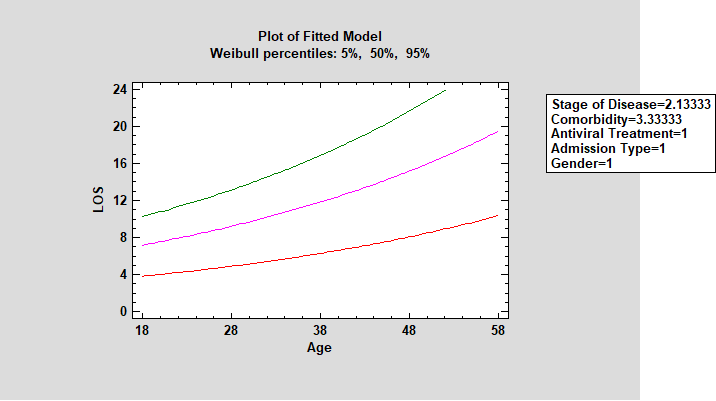
Hepatitis B virus (HBV) infection continues to pose major challenges for global health systems, particularly in resource-limited areas where hospital congestion and prolonged hospital stays strain available services. This study aims to model and identify the predictors of hospital length of stay (LOS) among HBV patients using a Weibull survival regression approach. Retrospective clinical and demographic data from 60 HBV patients managed in Maiduguri, Nigeria, were analyzed. Key variables included age, gender, comorbidity status, and antiviral treatment, and the Weibull model was specified to estimate time-to-discharge while accounting for the skewed distribution of LOS. The results show that antiviral therapy significantly reduces LOS, whereas older age, comorbid conditions, and male gender were associated with increased LOS. The model demonstrated strong statistical adequacy (log-likelihood = –148.264), supported by residual diagnostics and goodness-of-fit plots. Only 5% of patients remained hospitalized beyond 14.8 days, with an average LOS of 10.4 days. In conclusion, the Weibull regression model effectively captured LOS dynamics and highlighted key risk factors influencing hospitalization duration. These findings provide evidence useful not only for hospital management but also for public health planning, optimized clinical decision-making, and resource allocation strategies for high-risk HBV patients.
References
Auwal, M., Ali, B., & Mohammed, A. (2024). A comparative analysis of Log-logistic and Exponential survival regression models for predicting pediatric trauma length of stay. Journal of Health Statistics, 12(3), 45-59.
Awad, A., Bader-El-Den, M., & McNicholas, J. (2017). Patient length of stay and mortality prediction: A survey. Health Services Management Research, 30(2), 105–120. https://doi.org/10.1177/0951484817696212
Brown, J., Johnson, K., & Smith, L. (2016). Key performance indicators in healthcare: A practical guide. Academic Press.
Chen, Y., Li, W., & Zhang, H. (2023). Determinants of prolonged hospitalization in patients with chronic hepatitis B: A multivariate analysis. Hepatology International, 17(4), 892-905. https://doi.org/10.1007/s12072-023-10522-z
Collett, D. (2015). Modelling survival data in medical research (3rd ed.). Chapman and Hall/CRC.
Cui, F., Blach, S., & Ott, J. J. (2025). The impact of antiviral therapy on the global burden of hepatitis B: A predictive model. The Lancet Gastroenterology & Hepatology, 10(1), 45-55.
Faddy, M., Graves, N., & Pettitt, A. (2009). Modeling length of stay in hospital and other right-skewed data: Comparison of phase-type, gamma and log-normal distributions. Value in Health, 12(2), 309–314. https://doi.org/10.1111/j.1524-4733.2008.00421.x
Fattovich, G., Bortolotti, F., & Donato, F. (2008). Natural history of chronic hepatitis B: Special emphasis on disease progression and prognostic factors. Journal of Hepatology, 48(2), 335–352. https://doi.org/10.1016/j.jhep.2007.11.011
Gao, F., Liu, N., & Liu, Y. (2022). A flexible parametric competing risks model for the analysis of hospital length of stay. Statistical Methods in Medical Research, 31(5), 875-889. https://doi.org/10.1177/09622802221084123
Gürsakal, N., Tüzüntürk, S., & Aydın, K. (2019). Modeling length of stay with generalized linear models: A case study in a Turkish university hospital. Journal of Applied Statistics, 46(15), 2830–2840. https://doi.org/10.1080/02664763.2019.1615550
Ho, J. K., Lee, C. H., & Wu, T. Y. (2024). Risk factors and outcomes of hospitalized hepatitis B patients: A retrospective cohort study. Clinical Infectious Diseases, 78(2), 245-254.
Hougaard, P. (2000). Analysis of multivariate survival data. Springer-Verlag.
Jack, E. P. (2019). The impact of patient complexity on hospital length of stay: An integrative review. Journal of Healthcare Management, 64(5), 304–317. https://doi.org/10.1097/JHM-D-18-00188
Klein, J. P., & Moeschberger, M. L. (2003). Survival analysis: Techniques for censored and truncated data (2nd ed.). Springer.
Lewis, H. (2021). The economic and clinical burden of hepatitis B-related complications. Health Economics Press.
Lim, S. C. (2009). Measuring hospital performance: A handbook of indicators. Jones & Bartlett Learning.
Liu, V., Kipnis, P., & Escobar, G. J. (2022). Length of stay: A misunderstood measure of healthcare efficiency. JAMA Internal Medicine, 182(12), 1232-1233. https://doi.org/10.1001/jamainternmed.2022.3675
Predictors of mortality in patients under treatment for chronic hepatitis B. (2019). Hepatology Research, 49(8), 912-923. https://doi.org/10.1111/hepr.13345
Sallam, M. (2024). The burden of viral hepatitis in sub-Saharan Africa: A focus on Nigeria. Journal of Global Health, 14, 04045. https://doi.org/10.7189/jogh.14.04045
Stone, P. W., Glied, S. A., & McNair, P. D. (2022). The challenges of predicting hospital length of stay in an era of value-based care. Health Services Research, 57(1), 5-8. https://doi.org/10.1111/1475-6773.13915
Trepo, C., Chan, H. L. Y., & Lok, A. (2014). Hepatitis B virus infection. The Lancet, 384(9959), 2053–2063. https://doi.org/10.1016/S0140-6736(14)60220-8
World Health Organization. (2019). Global hepatitis report, 2019. WHO. https://www.who.int/publications/i/item/9789241565455
World Health Organization. (2021). Hepatitis B fact sheet. WHO. https://www.who.int/news-room/fact-sheets/detail/hepatitis-b
Downloads
Published
Issue
Section
Categories
License
Copyright (c) 2025 Ibrahim Ali Ibrahim Ali, Mohammed Abbas

This work is licensed under a Creative Commons Attribution 4.0 International License.


