
EVALUATION OF BIOACTIVE COMPOUNDS, IN-VITRO ANTIOXIDANT PROFILE AND ANTI-INFLAMMATORY PROPERTIES OF ETHANOLIC EXTRACTS OF ISOBERLINIA TOMENTOSA
DOI:
https://doi.org/10.33003/fjs-2025-0912-4188Keywords:
Anti-inflammatory, Antioxidant, GC-FID, Isoberlinia tomentosa, Oxidative stress, PhytochemicalsAbstract
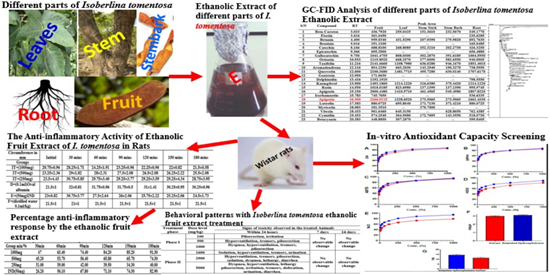
Oxidative stress and chronic inflammation are interlinked pathological processes implicated in the onset and progression of various chronic diseases. Isoberlinia tomentosa, a Fabaceae family species traditionally used in African medicine, has limited scientific validation despite its ethnomedicinal relevance. This study evaluated the phytochemical composition, in-vitro antioxidant profile, and in-vivo anti-inflammatory activity of the ethanolic fruit extract of I. tomentosa. Qualitative screening revealed significant levels of phenolic compounds, tannins, saponins, terpenoids, and alkaloids. Quantitative GC-FID analysis identified 22 bioactive compounds, including catechin, quercetin, kaempferol, rutin, and apigenin. Acute toxicity testing in Wistar rats indicated an LD₅₀ greater than 5000 mg/kg, suggesting a favorable safety profile. Antioxidant assays (DPPH, ABTS, H₂O₂, OH•, NO• scavenging, FRAP, and TAC) demonstrated strong, dose-dependent radical-scavenging and reducing activities. In an oval albumin-induced paw edema model, the extract significantly reduced inflammation in a dose-dependent manner, with the 1000 mg/kg dose outperforming indomethacin (p < 0.05). These findings provide scientific evidence for the traditional use of I. tomentosa, highlighting its potent antioxidant and anti-inflammatory activities, high safety margin, and potential as a source of plant-based therapeutics for oxidative stress- and inflammation-related disorders.
References
Gambini, J., & Stromsnes, K. (2022). Oxidative stress and inflammation: from mechanisms to therapeutic approaches. Biomedicines, 10(4), 753. https://doi.org/10.3390/biomedicines10040753.
Krzemińska, J., Wronka, M., Młynarska, E., Franczyk, B., & Rysz, J. (2022). Arterial hypertension—Oxidative stress and inflammation. Antioxidants, 11(1), 172. https://doi.org/10.3390/antiox11010172.
Wronka, M., Krzemińska, J., Młynarska, E., Rysz, J., & Franczyk, B. (2022). The influence of lifestyle and treatment on oxidative stress and inflammation in diabetes. International journal of molecular sciences, 23(24), 15743. https://doi.org/10.3390/ijms232415743.
Bezerra, F. S., Lanzetti, M., Nesi, R. T., Nagato, A. C., Silva, C. P. E., Kennedy-Feitosa, E., & Valenca, S. S. (2023). Oxidative stress and inflammation in acute and chronic lung injuries. Antioxidants, 12(3), 548. https://doi.org/10.3390/antiox12030548.
Yilangai, R. M., Onoja, J. D., Saha, S., Elisha, E. B., Manu, S. A., Barshep, Y., & Molokwu‐Odozi, M. (2023). Diversity, abundance, and conservation status of woody species in a West African dry forest. Conservation Science and Practice, 5(3), e12888.
Forghe, B. N., & Nna, P. J. (2020). Phytochemical screening and antimicrobial activities of methanolic extract of Newbouldia laevis roots. World J Pharm Res, 9(4), 73-83. https://doi.org/10.20959/wjpr20204-16950.
Akinloye, O. A., Alagbe, O. A., Ugbaja, R. N., & Omotainse, S. O. (2020). Evaluation of the modulatory effects of Piper guineense leaves and seeds on egg albumin-induced inflammation in experimental rat models. Journal of ethnopharmacology, 255, 112762. https://doi.org/10.1016/j.jep.2020.112762.
Najmi, A.; Javed, S.A.; Al Bratty, M.; Alhazmi, H.A. Modern Approaches in the Discovery and Development of Plant-Based Natural Products and Their Analogues as Potential Therapeutic Agents. Molecules 2022, 27, 349. https://doi.org/10.3390/molecules27020349.
Dehelean, C.A.; Marcovici, I.; Soica, C.; Mioc, M.; Coricovac, D.; Iurciuc, S.; Cretu, O.M.; Pinzaru, I. Plant-Derived Anticancer Compounds as New Perspectives in Drug Discovery and Alternative Therapy. Molecules 2021, 26, 1109. https://doi.org/10.3390/molecules26041109.
Hadiza B, Umar KA, Aminu AA, Bashir AY. Qualitative and Quantitative Phytochemicals Studies of Ethanol Stem bark Extracts of Isoberlinia doka Craib & Stapf and Isoberlinia tomentosa (Harms) Craib & Stapf. Trop J Nat Prod Res. 2020; 4(10):756-764. https://doi.org/10.26538/tjnpr/v4i10.16
Saleh, H. A., Yousef, M. H., & Abdelnaser, A. (2021). The anti-inflammatory properties of phytochemicals and their effects on epigenetic mechanisms involved in TLR4/NF-κB-mediated inflammation. Frontiers in immunology, 12, 606069. https://doi.org/10.3389/fimmu.2021.606069.
Culhuac, E. B., Maggiolino, A., Elghandour, M. M., De Palo, P., & Salem, A. Z. (2023). Antioxidant and anti-inflammatory properties of phytochemicals found in the yucca genus. Antioxidants, 12(3), 574. https://doi.org/10.3390/antiox12030574.
Khalid, S., Tiwana, H., Saddiqi, F., Ali, K., Adil, M., Javed, T., & Riaz, S. (2021). In vitro antimutagenic, cytotoxic and anticancer potential of Fagonia indica phytochemicals. Pakistan Journal of Pharmaceutical Sciences, 34. https://doi.org/10.36721/PJPS.2021.34.6.SUP.2325-2331.1.
Ali, M. A., Khan, N., Ali, A., Akram, H., Zafar, N., Imran, K., Khan, T., Khan, K., Armaghan, M., Palma-Morales, M., Rodríguez-Pérez, C., Caunii, A., Butnariu, M., Habtemariam, S., & Sharifi-Rad, J. (2024). Oridonin from Rabdosia rubescens: An emerging potential in cancer therapy - A comprehensive review. Food science & nutrition, 12(5), 3046–3067. https://doi.org/10.1002/fsn3.3986.
Medzhitov, R. (2021). The spectrum of inflammatory responses. Science, 374(6571), 1070-1075. https://doi.org/10.1126/science.abi5200.
Hannoodee, S., & Nasuruddin, D. N. (2024). Acute inflammatory response. In StatPearls [Internet]. StatPearls Publishing. https://www.ncbi.nlm.nih.gov/sites/books/NBK556083/.
Soliman, A. M., & Barreda, D. R. (2022). Acute inflammation in tissue healing. International journal of molecular sciences, 24(1), 641. https://doi.org/10.3390/ijms24010641.
Zhao, H., Wu, L., Yan, G., Chen, Y., Zhou, M., Wu, Y., & Li, Y. (2021). Inflammation and tumor progression: signaling pathways and targeted intervention. Signal transduction and targeted therapy, 6(1), 263. https://doi.org/10.1038/s41392-021-00658-5.
Ramírez-Pérez, S., Hernández-Palma, L. A., Oregon-Romero, E., Anaya-Macías, B. U., García-Arellano, S., González-Estevez, G., & Muñoz-Valle, J. F. (2020). Downregulation of inflammatory cytokine release from IL-1β and LPS-stimulated PBMC orchestrated by ST2825, a MyD88 dimerisation inhibitor. Molecules, 25(18), 4322. https://doi.org/10.3390/molecules25184322.
Shin, S. A., Joo, B. J., Lee, J. S., Ryu, G., Han, M., Kim, W. Y., ... & Lee, C. S. (2020). Phytochemicals as anti-inflammatory agents in animal models of prevalent inflammatory diseases. Molecules, 25(24), 5932.
Prasad, S., Kumar, V., Singh, C., & Singh, A. (2023). Crosstalk between phytochemicals and inflammatory signaling pathways. Inflammopharmacology, 31(3), 1117-1147. https://doi.org/10.3390/molecules25245932.
Al-Khayri, J. M., Sahana, G. R., Nagella, P., Joseph, B. V., Alessa, F. M., & Al-Mssallem, M. Q. (2022). Flavonoids as potential anti-inflammatory molecules: A review. Molecules, 27(9), 2901. https://doi.org/10.3390/molecules27092901.
Ge, J., Liu, Z., Zhong, Z., Wang, L., Zhuo, X., Li, J., ... & Bai, R. (2022). Natural terpenoids with anti-inflammatory activities: Potential leads for anti-inflammatory drug discovery. Bioorganic Chemistry, 124, 105817. https://doi.org/10.1016/j.bioorg.2022.105817.
Wijesekara, T., Luo, J., & Xu, B. (2024). Critical review on anti‐inflammation effects of saponins and their molecular mechanisms. Phytotherapy Research, 38(4), 2007-2022. https://doi.org/10.1002/ptr.8164.
Oluwole, O., Fernando, W. B., Lumanlan, J., Ademuyiwa, O., & Jayasena, V. (2022). Role of phenolic acid, tannins, stilbenes, lignans and flavonoids in human health–a review. International Journal of Food Science and Technology, 57(10), 6326-6335. https://doi.org/10.1111/ijfs.15936.
Atchan, A. P. N., Monthe, O. C., Tchamgoue, A. D., Singh, Y., Shivashankara, S. T., Selvi, M. K., ... & Dell’Agli, M. (2023). Anti-inflammatory, antioxidant activities, and phytochemical characterization of edible plants exerting synergistic effects in human gastric epithelial cells. Antioxidants, 12(3), 591. https://doi.org/10.3390/antiox12030591.
Zhou, X., Münch, G., Wohlmuth, H., Afzal, S., Kao, M. H., Al-Khazaleh, A., ... & Li, C. G. (2022). Synergistic inhibition of pro-inflammatory pathways by ginger and turmeric extracts in RAW 264.7 cells. Frontiers in pharmacology, 13, 818166. https://doi.org/10.3389/fphar.2022.818166.
Afzal, S., Abdul Manap, A. S., Attiq, A., Albokhadaim, I., Kandeel, M., & Alhojaily, S. M. (2023). From imbalance to impairment: the central role of reactive oxygen species in oxidative stress-induced disorders and therapeutic exploration. Frontiers in pharmacology, 14, 1269581. https://doi.org/10.3389/fphar.2023.1269581.
Unsal, V., Dalkıran, T., Çiçek, M., & Kölükçü, E. (2020). The role of natural antioxidants against reactive oxygen species produced by cadmium toxicity: a review. Advanced pharmaceutical bulletin, 10(2), 184. https://doi.org/10.34172/apb.2020.023.
Sahoo, B. M., Banik, B. K., Borah, P., & Jain, A. (2022). Reactive oxygen species (ROS): key components in cancer therapies. Anti-Cancer Agents in Medicinal Chemistry-Anti-Cancer Agents), 22(2), 215-222. https://doi.org/10.2174/1871520621666210608095512.
Muscolo, A., Mariateresa, O., Giulio, T., & Mariateresa, R. (2024). Oxidative stress: the role of antioxidant phytochemicals in the prevention and treatment of diseases. International journal of molecular sciences, 25(6), 3264. https://doi.org/10.3390/ijms25063264.
Saleem, S., Ul Mushtaq, N., Shah, W. H., Rasool, A., Hakeem, K. R., & Ul Rehman, R. (2022). Beneficial role of phytochemicals in oxidative stress mitigation in plants. In Antioxidant defense in plants: molecular basis of regulation (pp. 435-451). Singapore: Springer Nature Singapore. https://doi.org/10.1007/978-981-16-7981-0_20.
Namadina, M. M., Aliyu, B. S., Haruna, H., Sunusi, U., Kamal, R. M., Balarabe, S., ... & Tasiu, S. (2020). Pharmacognostic and acute toxicity study of Burkea africana root. Journal of Applied Sciences and Environmental Management, 24(4), 565-573. https://dx.doi.org/10.4314/jasem.v24i4.4.
Oseni, T. E., Adejoh, M. E., Omowaye, O. S., Attah, F., Peter, J., Tennyson, M. A., Oladipe, T. T., Olubiyo, C. K., Oludare, T. T., Odiba, J. C., Ocean, H. O., & Olopade, T. T. (2024). GC-MS ANALYSIS, QUALITATIVE AND QUANTITATIVE PHYTOCHEMICAL COMPOSITION OF Boerhavia diffusa (Linn.) LEAF EXTRACT CHARACTERIZING ITS MEDICINAL USE. FUDMA JOURNAL OF SCIENCES, 8(6), 144-151. https://doi.org/10.33003/fjs-2024-0806-2889.
Alkali, K., Hamza, M. M., Shehu, M. M., Abdulhamid, M. B., & Audu, H. (2025). Qualitative and Quantitative Phytochemical Screening of Aqueous, Methanol, and Hexane Leaf Extracts of Senna siamea. Sahel Journal of Life Sciences FUDMA, 3(1), 328–336. https://doi.org/10.33003/sajols-2025-0301-40.
Namadina, M. M., Haruna, H., & Sanusi, U. (2020). PHARMACOGNOSTIC, ANTIOXIDANT AND ACUTE TOXICITY STUDY OF Ficus sycomorus (Linn) (Moraceae) ROOT AND STEM BARK. FUDMA JOURNAL OF SCIENCES, 4(2), 605-614. https://doi.org/10.33003/fjs-2020-0402-244
Eidangbe, G. O. (2025). ANTIOXIDANT AND ANTI-INFLAMMATORY ACTIVITIES OF STEVIA REBAUDIANA LEAF EXTRACT IN DIABETIC RATS. FUDMA JOURNAL OF SCIENCES, 9(1), 301-306. https://doi.org/10.33003/fjs-2025-0901-2944.
Sulyman, R. A., & Ibrahim, A. S. (2024). AMELIORATIVE POTENTIALS OF Trigonella foenum-graecum (FENUGREEK) SEEDS ON PROTEIN-ENERGY MALNOURISHED RATS. FUDMA JOURNAL OF SCIENCES, 8(6), 385-392. https://doi.org/10.33003/fjs-2024-0806-2946
Downloads
Published
Issue
Section
Categories
License
Copyright (c) 2025 Ajibola Habeebulahi Adekilekun, Olorunshola Dave Omodamiro, Ngozi Kalu Achi, Habeebat Adekilekun Oyewusi, Rachel Majekodunmi Omodamiro, Bashar Adekilekun Tijani, Oluwatosin Olubunmi Oladipo, Bolaji Fatai Oyeyemi

This work is licensed under a Creative Commons Attribution 4.0 International License.


