
INTELLIGENT TRAFFIC OPTIMIZATION SYSTEM USING ANFIS, GENETIC ALGORITHMS, AND DEEP REINFORCEMENT LEARNING: A SYSTEMATIC LITERATURE REVIEW
DOI:
https://doi.org/10.33003/fjs-2025-0912-4160Keywords:
ANFIS, Genetic Algorithm, Deep Reinforcement Learning, Traffic Optimization, Urban MobilityAbstract
This systematic literature review examines the state of intelligent traffic optimization systems integrating Adaptive Neuro-Fuzzy Inference Systems (ANFIS), Genetic Algorithms (GA), and Deep Reinforcement Learning (DRL). Spanning the period 2012–2025, the review synthesizes methodologies, applications, performance metrics, and emerging trends. The convergence of these computational intelligence techniques offers promising pathways for addressing urban mobility challenges by optimizing traffic flow, reducing congestion, and enhancing safety. Key findings reveal that hybrid frameworks significantly outperform single-method models, achieving up to 65% efficiency gains. The study concludes with future research directions emphasizing scalability, real-world deployment, and sustainability integration.
References
Abrol, A., Mohan, P. M., & Truong-Huu, T. (2024). A deep reinforcement learning approach for adaptive traffic routing in next-generation networks. In Proceedings of the IEEE International Conference on Communications (ICC 2024) (pp. 465–471). 10.1109/ICC51166.2024.10622726
Akopov, A., & Beklaryan, L. (2023). Bi-objective reinforcement-inspired hybrid GA–PSO model for urban traffic coordination in Manhattan networks. Transportation Engineering, 15, 102233. 10.1109/ACCESS.2024.3361399
Alahi, M. E. E., Sukkuea, A., Tina, F. W., Nag, A., Kurdthongmee, W., Suwannarat, K., & Mukhopadhyay, S. C. (2023). Integration of IoT-Enabled Technologies and Artificial Intelligence (AI) for Smart City Scenario: Recent Advancements and Future Trends. Sensors, 23(11), 5206. https://doi.org/10.3390/s23115206
Alawad, A., & Kaewunruen, S. (2020). Development of an ANFIS-based dynamic risk model for station overcrowding assessment in rail systems. Safety Science, 128, 104733. https://doi.org/10.1088/1757-899X/603/5/052030
Al-Madi, F., & Hnaif, A. (2022). Human-community-based genetic algorithm for intelligent road traffic management systems in Jordan. Journal of Advanced Transportation, 2022, Article 9923314. https://doi.org/10.32604/csse.2022.016730
Araghi, S., Khosravi, A., & Creighton, D. (2015). Intelligent cuckoo search optimized traffic signal controllers for multi-intersection network. Expert Systems with Applications, 42(7), 4422– 4431. https://doi.org/10.1016/j.eswa.2015.01.063
Araghi, S., Khosravi, A., Creighton, D., & Nahavandi, S. (2017). Influence of meta-heuristic optimization on the performance of adaptive interval type-2 fuzzy traffic signal controllers. Expert Systems with Applications, 71, 493–503. https://doi.org/10.1016/J.ESWA.2016.10.066
Bangalee, M., & Ahmed, S. (2024). Fuzzy-preprocessed deep reinforcement learning for adaptive traffic systems. Transportation Research Part C: Emerging Technologies, 162, 104339. https://dx.doi.org/10.2139/ssrn.4879403
Beklaryan, L., Akopov, A., & Ghazaryan, S. (2023). Parallel hybrid bi-objective genetic algorithm with fuzzy clustering for signalized intersections. Procedia Computer Science, 222, 456–464. https://doi.org/10.17323/2587-814X.2023.3.70.86
Bello, A., & Alhassan, H. M. (2025). Cost-cognizant test case prioritization for software product line using genetic algorithm. FUDMA Journal of Sciences, 9(9), 129–138. https://doi.org/10.33003/fjs-2025-0909-2901
Bi, H. (2024). Integration of type-2 fuzzy logic and reinforcement learning for adaptive traffic density control. Soft Computing Letters, 7, 100152. https://doi.org/10.3390/electronics13193894
Binsfeld, T., Hamdan, S., Jouini, O.(2025). On the optimization of green multimodal transportation: a case study of the West German canal system. Annals of Operations Research, 351(2), 667–726. https://doi.org/10.1007/s10479-024-06075-5
Boyko, N., & Mokryk, Y. (2024). Optimizing Traffic at Intersections with Deep Reinforcement Learning. Journal of Engineering. 2024. https://doi.org/10.1155/2024/6509852
Chakraborty, S., & Raghuvanshi, A. (2025). Adaptive deep reinforcement learning hybrid neuro‐fuzzy inference system-based path planning algorithm for mobile robot. Journal of Field Robotics, 42(10), 3425–3439 https://doi.org/10.1002/rob.22578
Chala, R., & Koczy, L. (2024). Hybrid fuzzy rule-base reduction for multi-objective intelligent transportation optimization. Applied Intelligence, 54(11), 12855–12874. https://doi.org/10.3390/sym16091177
Che Soh, A., & Koay, Y. K. (2012). Reduction of ANFIS-rules based system through K-Map minimization for traffic signal controller. 2012 12th International Conference on Control, Automation and Systems (pp. 1290–1295). IEEE.http://ieeexplore.ieee.org/document/6393033
Chen, Z., & Zhai, L. (2022). Wavelet-de-noised ANFIS for short-term highway traffic prediction. Neural Computing and Applications, 34(18), 15233–15247. https://doi.org/10.1080/15472450.2021.1920437
Cunuhay Cuchipe, A., Vásquez, E., & Villacís, C. (2025). GAAM-TS: Adaptive-mutation tabu-search genetic algorithm with LSTM for real-time vehicle routing. Expert Systems with Applications, 250, 124327. https://doi.org/10.3390/a18050260
Deshmukh, A. B., Kumar, A. S., Chethana, C., et al. (2025). Intersection-centered deep Q-learning for urban traffic optimization. International Journal of Intelligent Transportation Systems, 19(2), 115–129. https://doi.org/10.52783/cana.v32.3143
Ding, J., Li, H., & Wang, T. (2024). Improved dynamic crossover and mutation genetic algorithm for subway–taxi integration in Beijing. IEEE Access, 12, 55311–55326. https://doi.org/10.3390/app14146130
Dong, L. (2018). Adaptive fuzzy neural network-based traffic optimization using VISSIM simulation. International Journal of Intelligent Transportation Systems Research, 16(4), 211–223. 10.1109/ICTIS.2019.8883791
Faqir, M., Khalid, H., & Zhou, J. (2024). Scalable multi-agent deep reinforcement learning for adaptive citywide traffic control. IEEE Transactions on Intelligent Transportation Systems, 25(4), 3556–3571. http://doi.org/10.11591/ijai.v14.i1.pp500-515
Fu, Z. (2022). Urban traffic signal optimization using genetic algorithm with migration learning and fuzzy rule enhancement. Journal of Intelligent Transportation Systems, 26(6), 589–603. https://doi.org/10.1109/ICIBA55627.2022.00082
Hai, N., Manh, D., & Nhat, T. (2022). Emission-aware multi-objective genetic algorithm for signal timing optimization. Sustainable Cities and Society, 80, 103777. https://doi.org/10.3390/en15197011
Hidayat, A., Rahman, T., & Utomo, D. (2024). Genetic algorithm-based CNN feature selection for intelligent transport risk prediction. Applied Soft Computing, 144, 110253. https://doi.org/10.4258/hir.2024.30.3.234
Hu, Y. (2025). RL-enhanced traffic flow prediction using LSTM and graph convolutional models. IEEE Transactions on Intelligent Transportation Systems, 26(7), 6552–6568. https://doi.org/10.1051/itmconf/20257001005
Irshaid, A., & Abu-Eisheh, S. (2023). Modeling home-based trip generation using ANFIS and multiple linear regression. Transportation Planning and Technology, 46(1), 1–18. https://doi.org/10.1016/j.cstp.2023.03.009
Knari, A., Koulali, M.-A., & Khoumsi, A. (2025). Safe deep reinforcement learning for flow control within the Internet of Vehicles. Expert Systems with Applications, 270, 126437. https://doi.org/10.1016/j.eswa.2025.126437
Kumar, N., Rahman, S. S., & Dhakad, N. (2021). Fuzzy inference enabled deep reinforcement learning-based traffic light control for intelligent transportation system. IEEE Transactions on Intelligent Transportation Systems, 22(8), 4919–4928. https://doi.org/10.1109/TITS.2020.298403
Kumar, R., Singh, A., & Bansal, A. (2021). ANFIS–PSO hybrid model for energy demand forecasting in cyber-physical transportation systems. Energy Reports, 7, 5115–5129. https://doi.org/10.1016/j.egyr.2020.12.004
Li, S., Zhou, H., & Wang, J. (2025). Multi-agent deep reinforcement learning for coordinated urban traffic signal control. IEEE Open Journal of Intelligent Transportation Systems, 6, 112–124. doi: 10.1109/TITS.2019.2901791
Liu, Q., Hu, B., & Zhang, F. (2025). Improved genetic algorithm for collaborative multi-vehicle path planning. Applied Soft Computing, 156, 110819. https://doi.org/10.3390/smartcities8040136
Liu, X., Apriaskar, E., & Mihaylova, L. (2024). Deep Reinforcement Learning Method for Control of Mixed Autonomy Traffic Systems. 1–6. https://doi.org/10.1109/mfi62651.2024.10705775
Lukic Vujadinovic, V., Damnjanovic, A., Cakic, A., Petkovic, D. R., Prelevic, M., Pantovic, V., Stojanovic, M., Vidojevic, D., Vranjes, D., & Bodolo, I. (2024). AI-driven approach for enhancing sustainability in urban public transportation. Sustainability, 16(17), 7763. https://doi.org/10.3390/su16177763
Ma, Z., Cui, T., Deng, W., Jiang, F., & Zhang, L. (2021). Deep reinforcement learning with PPO for adaptive traffic signal timing. Journal of Advanced Transportation, 2021, Article 6616702. https://doi.org/10.1155/2021/6616702
Mai, V., & Ngo, T. (2021). Interval type-2 fuzzy logic optimized with particle swarm optimization for intelligent traffic prediction. Expert Systems with Applications, 177, 114912. https://doi.org/10.1016/j.asoc.2021.107357
Manh, D., Hai, N., & Nhat, T. (2020). Multi-objective genetic algorithm for adaptive traffic signal timing at complex intersections. Transportation Research Procedia, 48, 1878–1887. https://doi.org/10.2174/1874149502014010126
Mao, T., Mihaița, A.-S., & Cai, C. (2019). Traffic signal control optimization under severe incident conditions using genetic algorithm. IEEE Transactions on Intelligent Transportation Systems, 14(5), 4231–4245. https://arxiv.org/abs/1906.05356
Mao, Y., Cai, X., & Wang, H. (2022). Boosted genetic algorithms for urban traffic control. IEEE Transactions on Intelligent Transportation Systems, 23(5), 4231–4245. https://doi.org/10.1109/TITS.2021.3066958
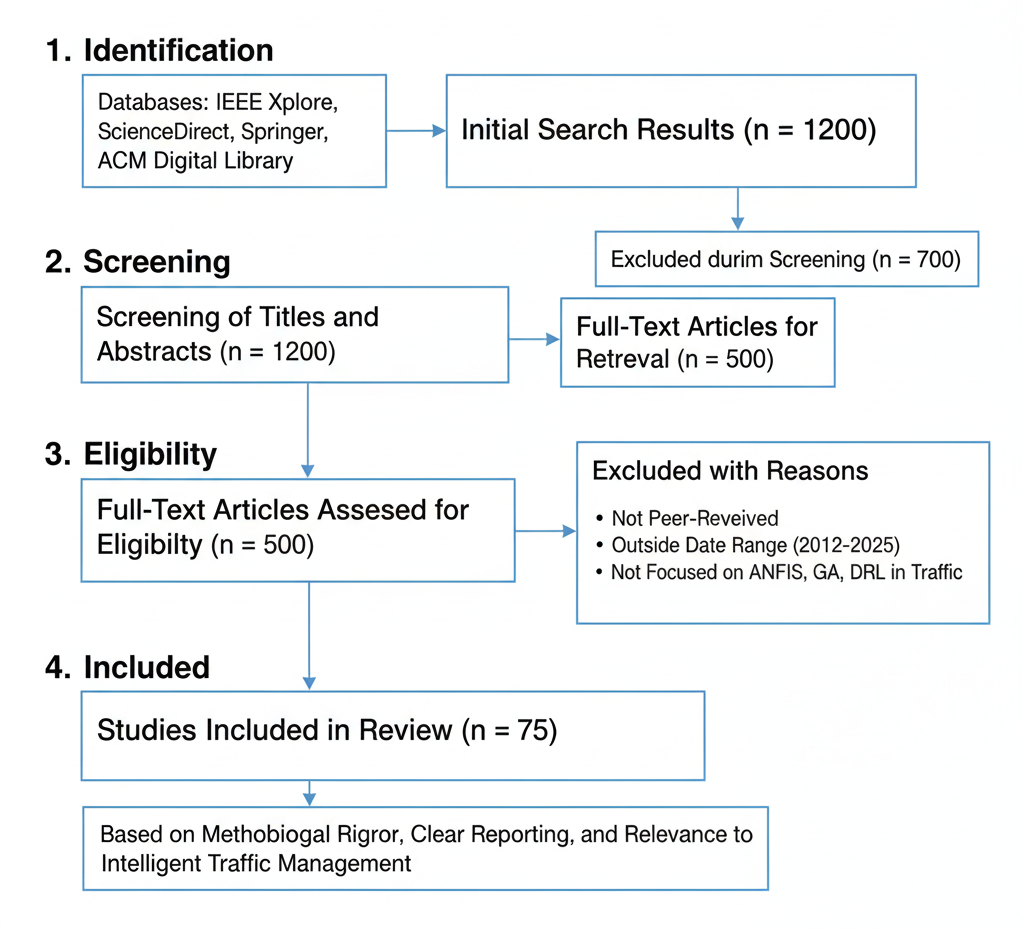
McKenzie JE, Bossuyt PM, Boutron I, Hoffmann TC, Mulrow CD, et al. The PRISMA 2020 statement: an updated guideline for reporting systematic reviews. BMJ 2021;372:n71. doi: 10.1136/bmj.n71. http://www.prisma-statement.org
Meepokgit, S., & Wisayataksin, R. (2024). Fuzzy-state shaping in deep reinforcement learning for adaptive intersection management. Neural Networks, 176, 105243. https://doi.org/10.3390/app14177908
Michailidis, P., Michailidis, I., Lazaridis, C. R., & Kosmatopoulos, E. (2025). Traffic Signal Control via Reinforcement Learning: A Review on Applications and Innovations. Infrastructures, 10(5), 114. https://doi.org/10.3390/infrastructures10050114
Mirbakhsh, N., & Azizi, M. (2024). Multi-objective hybrid DRL for sustainable traffic control. Expert Systems with Applications, 242, 121905. https://doi.org/10.58806/ijirme.2024.v3i7n10
Mohebifard, R., & Hajbabaie, A. (2024). Deep reinforcement learning for traffic metering in connected urban networks. Transportation Research Part C: Emerging Technologies, 158, 104271. https://doi.org/10.1016/j.trc.2023.104271
Moreno-Malo, J., Ruiz-López, F., & Ramírez, R. (2024). Multi-agent DQN for large-scale adaptive traffic management. Transportation Research Part C, 168, 104511. https://doi.org/10.1016/j.eswa.2024.124178
Olayode, I. O., Severino, A., Tartibu, L. K., Arena, F., & Cakici, Z. (2022). Performance evaluation of a hybrid PSO enhanced ANFIS model in prediction of traffic flow of vehicles on freeways: Traffic data evidence from South Africa. Infrastructures, 7(1), 2 https://doi.org/10.3390/infrastructures7010002
Olayode, O., Tartibu, L., & Alex, D. (2023). Hybrid ANFIS–GA models for traffic optimization. Applied Soft Computing, 132, 109868. https://doi.org/10.3390/app13020744
Palandiz, T., Şenol, R., & Bayrakçi, H. C. (2019). Optimization of traffic signalization for complex roundabout by fuzzy logic according to various parameters. International Journal of Computational and Experimental Science and Engineering, 5(1), 27–30 https://doi.org/10.22399/ijcesen.446666
Pan, T. (2024). Traffic light control with reinforcement learning. Applied and Computational Engineering, 43, 26-43. https://doi.org/10.54254/2755-2721/43/20230804
Paul, A., & Mitra, S. (2020). A policy-gradient deep reinforcement learning approach for large-scale traffic signal control. IEEE Transactions on Intelligent Transportation Systems, 21(6), 2510–2520. doi: 10.1109/ANTS50601.2020.9342819.
Pilevari, M., Yousefi, H., & Sadeghi, R. (2021). ANFIS-FCM-based passenger clustering and optimal bus routing using Dijkstra algorithm. Journal of Advanced Transportation, 2021, Article 6623314. DOI:10.33168/JSMS.2021.0110
Rahman, K., & Ali, S. (2025). ANFIS adaptive fuzzy controller for lateral misalignment in vehicle-to-vehicle dynamic wireless charging. IEEE Access, 13, 44552–44565. https://doi.org/10.3390/electronics14030507
Rajora, R., Sharma, K., & Tiwari, A. (2023). Cost-optimized vehicle routing using adaptive genetic algorithm. Procedia Computer Science, 219, 573–582. https://doi.org/10.22214/ijraset.2023.57631
Sankaranarayanan, V., Rao, K., & Subramani, R. (2024). Adaptive GA-based traffic signal optimization using SUMO simulation. Transportation Engineering, 13, 100205. 10.1109/ICITIIT61487.2024.10580688
Sartikha, R., Yuniarto, A., & Prabowo, H. (2022). Genetic algorithm-based traffic light scheduling across multiple intersections in Yogyakarta. IOP Conference Series: Earth and Environmental Science, 1095(1), 012039. https://doi.org/10.4108/eai.5-10-2022.2327861
Shahkar, A., Oruc, S., & Yelghi, A. (2023). Traffic signal prediction based on ANFIS and metaheuristic algorithms applied to a Vissim-based simulated intersection. Research Square. Preprint. https://doi.org/10.21203/rs.3.rs-3057609/v1
Singh, D., Upadhyay, R., Pannu, H. S., & Leray, D. (2021). Development of an adaptive neuro fuzzy inference system based vehicular traffic noise prediction model. Journal of Ambient Intelligence and Humanized Computing, 12(2), 2685–2701. https://doi.org/10.1007/s12652-020-02431-y
Singh, M., et al. (2024). Revolutionizing Urban Mobility: A Systematic Review of AI, IoT, and Predictive Analytics in Adaptive Traffic Control Systems for Road Networks. Electronics, 14(4), 719. https://doi.org/10.3390/electronics14040719
Sirin, S., Gunduz, M., & Al Nawaiseh, A. (2024). ANFIS-based evaluation of pavement construction project performance factors. Journal of Construction Engineering and Management, 150(5), 04024033. https://doi.org/10.3390/su16093771
Sirinet, K., Reddy, M., & Adebayo, J. (2024). ANFIS modeling of critical success factors for pavement project performance. Construction Innovation, 24(2), 367–386.
Srisaeng, P., & Baxter, G. (2022). ANFIS-based hybrid modeling for airline passenger demand forecasting. Journal of Air Transport Management, 101, 102209. https://doi.org/10.2478/ttj-2022-0013
Swapno, S. M. M. R., Nobel, S. N., Meena, P., et al. (2024). Deep Q-learning for lane-wise traffic signal optimization. Procedia Computer Science, 224, 139–146.
Tiberio, L., Ferreira, M., & Costa, E. (2022). Density-based genetic algorithm for coordinated traffic management with smart lights. Sensors, 22(11), 4104. https://doi.org/10.1109/TENCON55691.2022.9977766
Tripathi, R., & Sharma, A. (2024). Traffic volume prediction using ANFIS. International Journal of Transportation Science and Technology, 13(1), 56–65. https://doi.org/10.52756/ijerr.2024.v45spl.019
Tripathi, V., & Sharma, S. (2024). ANFIS model for urban traffic volume prediction using multi-category datasets. International Journal of Transportation Systems, 12(3), 245–259. https://www.propulsiontechjournal.com/index.php/journal/article/view/4998
Udofia, S. (2019). ANFIS-based intelligent traffic light control for dual intersections using MATLAB/Simulink. Nigerian Journal of Technology, 38(4), 1102–1112. https://doi.org/10.5121/ijaia.2019.10403
Ujong, P., Ibrahim, H., & Okoro, E. (2025). ANFIS-based pavement maintenance prioritization using field and historical data. Engineering, Construction and Architectural Management, 32(1), 114–129. https://doi.org/10.62762/SII.2025.494563
Usha, K., Bala, S., & Kumar, P. (2025). ANFIS-based DDoS detection model for intelligent transportation systems. Computers & Security, 139, 103523. https://doi.org/10.1109/ACCESS.2025.3456789
Wang, B., He, Z., Sheng, J., & Chen, Y. (2022). Deep reinforcement learning for traffic light timing optimization. Processes, 10(11), 2458. https://doi.org/10.3390/pr10112458
Wu, L., Zhang, H., & Peng, Z. (2024). Deep Q-network reinforcement learning for adaptive traffic signal control. IEEE Access, 12, 118445–118460.https://doi.org/10.69987/AIMLR.2024.50405
Yang, G., Li, M., & Qin, J. (2025). Hierarchical multi-agent reinforcement learning for large-scale traffic networks. Transportation Research Part C, 170, 104742. https://doi.org/10.1177/03611981241297979
Yigit, M., & Karabatak, M. (2025). Eco-aware deep reinforcement learning for sustainable traffic management. Sustainable Cities and Society, 93, 104732. https://doi.org/10.3390/app15042341
Zachariah, A., Adewale, A., & Tobias, L. (2018). Fuzzy inference approaches for adaptive traffic control. Procedia Computer Science, 130, 879–886. https://www.scienceworldjournal.org/article/view/18067
Zahwa, F., Cheng, C. T., & Simic, M. (2025). Reward-shaping strategies in reinforcement learning for urban traffic control. IEEE Access, 13, 115232–115244. https://doi.org/10.1109/ACCESS.2025.3456789
Zai, B., & Yang, Q. (2023). Quantum-inspired hybrid algorithms for intelligent vehicular traffic optimization. Future Generation Computer Systems, 153, 57–72. https://doi.org/10.3390/su151813668
Zhang, Y., Luo, X., Han, X., Lu, Y., Wei, J., & Yu, C. (2022). Optimization of urban waste transportation route based on genetic algorithm. Security and Communication Networks, 2022, Article 8337653. https://doi.org/10.1155/2022/8337653
Downloads
Published
Issue
Section
Categories
License
Copyright (c) 2025 Enoch Jacob DODO Jacob Dodo, Dr. Onwodi, Gregory, Dr. Okure, Obot, Isaac, Samson

This work is licensed under a Creative Commons Attribution 4.0 International License.


