
COMBINATIONS OF Hibiscus sabdariffa WITH Zingiber officinale AND Allium sativum INHIBIT α-AMYLASE AND α-GLUCOSIDASE: A GUIDE TO DOCKING OF H. sabdariffa CONSTITUENTS
DOI:
https://doi.org/10.33003/fjs-2026-1001-4157Keywords:
α-amylase, α-glucosidase, Acarbose, H. sabdariffa, Z. officinale, A. sativumAbstract
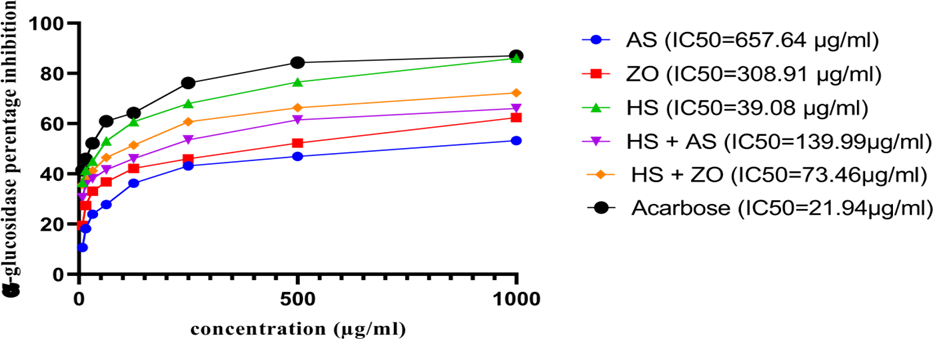
Conventional enzyme inhibitors such as acarbose are widely used for the control of postprandial hyperglycemia by virtue of their inhibitory action on carbohydrate-hydrolyzing enzymes, but are often associated with side effects, necessitating the development of safer plant-derived alternatives. In this study, the in vitro and in silico inhibitory activities of aqueous Hibiscus sabdariffa calyx, Zingiber officinale, and Allium sativum extracts against α-amylase and α-glucosidase were investigated. H. sabdariffa (HS) calyces, Z. officinale (ZO) roots and Allium sativum (AS) bulbs were extracted using an aqueous method. For α-glucosidase inhibition, IC50 values were 39.08 µg/mL (HS), 308.91 µg/mL (ZO), 657.64 µg/mL (AS), 139.99 µg/mL (HS + AS), 73.46 µg/mL (HS + ZO), and 21.94 µg/mL (acarbose). Against α-amylase, values were 70.81 µg/mL (HS), 396.43 µg/mL (ZO), 2483.28 µg/mL (AS), 92.04 µg/mL (HS + AS), 79.76 µg/mL (HS + ZO), and 56.14 µg/mL (acarbose). In silico XP docking, acarbose had higher docking scores (-10.699 kcal/mol for α-glucosidase and -13.09 kcal/mol for α -amylase) than 3-hydroxystigmast-5-en-7-one, a HS bioactive compound which showed higher docking scores (-7.463 kcal/mol for α-glucosidase and -4.795 kcal/mol for α -amylase) compared to other HS compounds, justifying the in vitro results that revealed acarbose as the most potent inhibitor based on IC50. Although the extracts were less potent than the reference drug acarbose, their natural origin and observed synergistic action are pointers to their prospect as safer controls for postprandial hyperglycemia. Further research elucidating active compounds of HS and validating in vivo antidiabetic activity of this combined extract is recommended
References
Adelusi, T. I., Boyenle, I. D., Tolulope, A., Adebisi, J., Fatoki, J. O., Ukachia, C. D., Oyedele, A.-Q. K., Ayoola, A. M., & Timothy, A. A. (2023). GC–MS fingerprints and phenolic extracts of Allium sativum inhibit key enzymes associated with type 2 diabetes. Journal of Taibah University Medical Sciences, 18(2), 337–346. https://doi.org/10.1016/j.jtumed.2023.01.010
Adeyeoluwa, T. E., Balogun, F. O., & Ashafa, A. O. T. (2020). In vitro comparative assessment of the inhibitory effects of single and combined spices against glucose-hydrolysing enzymes. Tropical Journal of Pharmaceutical Research, 19(6), 1209-1214. https://doi.org/10.4314/tjpr.v19i6.14
Apostolidis, E., Kwan, Y.I. and Shetty, K. (2006). Potential of cranberrybased herbal synergies for diabetes and hypertension management. Asia Pacific Journal of Clinical Nutrition (15):433-441.
Ayorinde, I. A., Esosa, I. V., Adebayo, S. O., Nokwanda, D. H., Fadele, L., & Oyawaluja, B. O. (2023). Molecular docking, ADME and SAR analysis of 383 phytochemicals in the quest for lead antidiabetic inhibitors targeting α-amylase and α-glucosidase enzymes. Tropical Journal of Drug Research. https://doi.org/10.26538/tjdr/v2i1.2
Dirir, A. M., El-Shazly, M., & Hamid, A. (2021). A review of alpha-glucosidase inhibitors from plants as promising therapeutic agents for type 2 diabetes. Pharmacognosy Reviews, 15(30), 1–17. https://doi.org/10.4103/phrev.phrev_27_21
Jain, A., Jangid, T., Jangir, R. N., & Bhardwaj, G. S. (2025). Antidiabetic activity of polyherbal formulations: a comprehensive review. Protoplasma, 262(5), 1031-1052. https://doi.org/10.1007/s00709-025-02057-x
Jamrozik, D., Borymska, W., & Kaczmarczyk-Żebrowska, I. (2022). Hibiscus sabdariffa in Diabetes Prevention and Treatment—Does It Work? An Evidence-Based Review. Foods, 11(14), Article 2134. https://doi.org/10.3390/foods11142134
Jha, R., Goyal, K., Mehan, S., & Singh, G. (2025). Dual α-amylase and α-glucosidase inhibitors: Recent progress from natural and synthetic resources. Bioorganic Chemistry, 163, Article 108762. https://doi.org/10.1016/j.bioorg.2025.108762
Jomova, K., Alomar, S. Y., Valko, R., Liska, J., Nepovimova, E., Kuca, K., & Valko, M. (2025). Flavonoids and their role in oxidative stress, inflammation, and human diseases. Chemico-Biological Interactions, 413, Article 111489. https://doi.org/10.1016/j.cbi.2025.111489
Rangel-Galván, M., Pacheco-Hernández, Y., Lozoya-Gloria, E., & Villa-Ruano, N. (2024). Dietary natural products as inhibitors of α-amylase and α-glucosidase: An updated review of ligand-receptor correlations validated by docking studies. Food Bioscience, 58, 104288. https://doi.org/10.1016/j.fbio.2024.104288
Salehi, B., Ata, A., Kumar, N. V. A., Sharopov, F., Ramírez-Alarcón, K., Ruiz-Ortega, A., ... & Martorell, M. (2020). Antidiabetic potential of medicinal plants and their active components. Biomolecules, 9(10), 551. https://doi.org/10.3390/biom9100551
Sehim, A. E., Amin, B. H., Yosri, M., Salama, H. M., Alkhalifah, D. H., Alwaili, M. A., & Abd Elghaffar, R. Y. (2023). GC-MS analysis, antibacterial, and anticancer activities of Hibiscus sabdariffa L. methanolic extract: In vitro and in silico studies. Microorganisms, 11(6), 1601. https://doi.org/10.3390/microorganisms11061601
Umar, H. I., Josiah, S. S., Saliu, T. P., Jimoh, T. O., Ajayi, A., & Danjuma, J. B. (2021). In-silico analysis of the inhibition of the SARS-CoV-2 main protease by some active compounds from selected African plants. Journal of Taibah University Medical Sciences, 16(2), 162–176. https://doi.org/10.1016/j.jtumed.2020.12.005
Yousefi, M., Rahmani, J., Teymoori, F., Zarezadeh, M., Safavi, S. M., & Clark, C. C. T. (2023). The effect of acarbose on lipid profiles in adults: A systematic review and meta-analysis of randomized clinical trials. BMC Pharmacology and Toxicology, 24, 79. https://doi.org/10.1186/s40360-023-00706-6
Downloads
Published
Issue
Section
Categories
License
Copyright (c) 2026 Rofiat A. Abdulrahman-Orire, Abdulhameed O. Alli, Kafayat A. Salaudeen, Rihanat I. Hassan

This work is licensed under a Creative Commons Attribution 4.0 International License.


