
COMPONENT-LEVEL ANTIOXIDANT CONTRIBUTIONS AND THERMAL STABILITY OF Azadirachta indica, Mangifera indica AND Persea americana LEAF EXTRACTS USED IN A POLYHERBAL FORMULATION
DOI:
https://doi.org/10.33003/fjs-2025-0912-4117Keywords:
Azadirachta indica,, Mangifera indica, Persea Americana, Antioxidant activity, Polyherbal formulationAbstract
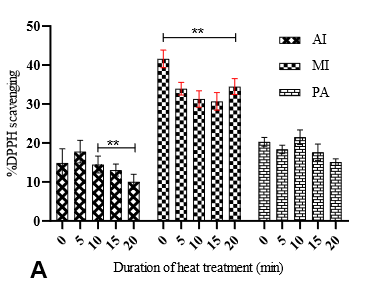
This study investigated the component-level antioxidant contributions of Azadirachta indica (AI), Mangifera indica (MI), and Persea americana (PA) leaf extracts, the components of a previously studied polyherbal formulation. The aim was to delineate the contribution of each extract to the overall antioxidant capacity and to evaluate the influence of heat treatment and concentration on their activities. The samples were divided into two groups: a fresh extract and a pre-heated extract (heated for 30 min at 80°C). The antioxidant activity was evaluated using spectrophotometric assays for DPPH radical scavenging activity and total antioxidant capacity of graded concentrations (10-1000 µg/ml) and thermal treatment of 100 µg/ml solutions of the extracts for 5, 10, 15 and 20 min at 80°C. Mangifera indica extract demonstrated a superior antioxidant activity in a concentration-dependent manner; for DPPH, the fresh extract significantly increased from 30.53 ± 2.93% to 81.32 ± 1.22% (IC50 = 358.41 µg/ml) while the pre-heated extract increased from 30.53 ± 3.00% to 86.05 ± 2.29% (IC50 = 359.81 µg/ml). For AI, the IC50 values were 4329.27 µg/ml (fresh) and 2738.82 µg/ml (pre-heated), respectively. The TAC increased with the duration of heating in the fresh AI and MI extracts but varied in the pre-heated extracts. It was concentration-dependent in both fresh and pre-heated AI and MI. The findings indicate that antioxidant activity in the AI-MI-PA formulation depends on both extract composition and processing conditions, suggesting the need for optimised thermal handling to preserve bioactivity.
References
Ahmed, M., Marrez, D. A., Mohamed Abdelmoeen, N., Abdelmoneem Mahmoud, E., Ali, M. A. S., Decsi, K., & Tóth, Z. (2023). Studying the antioxidant and the antimicrobial activities of leaf successive extracts compared to the green-chemically synthesized silver nanoparticles and the crude aqueous extract from Azadirachta indica. Processes, 11(6), 1–21. https://doi.org/10.3390/pr11061644
Barba-Ostria, C., Carrera-Pacheco, S. E., González-Pastor, R., Heredia-Moya, J., Mayorga-Ramos, A., Rodríguez-Pólit, C., Zúñiga-Miranda, J., Arias-Almeida, B., & Guamán, L. P. (2022). Evaluation of biological activity of natural compounds: Current trends and methods. Molecules, 27(14), 1–35. https://doi.org/10.3390/molecules27144490
Bhuyan, D. J., Alsherbiny, M. A., Perera, S., Low, M., Basu, A., Devi, O. A., Barooah, M. S., Li, C. G., & Papoutsis, K. (2019). The odyssey of bioactive compounds in Avocado (Persea Americana) and their health benefits. Antioxidants, 8(10), 1–53. https://doi.org/10.3390/antiox8100426
Braca, A., De Tommasi, N., Di Bari, L., Pizza, C., Politi, M., & Morelli, I. (2001). Antioxidant principles from Bauhinia tarapotensis. Journal of Natural Products, 64(7), 892–895. https://doi.org/10.1021/np0100845
Dhakad, A. K., Kumar, R., Choudhary, R., Singh, S., Khan, S., & Poonia, P. K. (2025). Traditional to modern perspectives on neem (Azadirachta indica): A gateway to bioactive compounds, sustainable agrochemicals and industrial applications. Industrial Crops and Products, 231, 1–31. https://doi.org/10.1016/j.indcrop.2025.121155
Ebhohimen, I. E., Agbamuche, R., Eromosele, E. O., & Idiakheua, O. D. (2024). Assessment of the Antiplasmodial and Haematoprotective Potential of a Polyherbal Extract of Azadirachta indica, Mangifera indica, and Persea americana leaves in mice infected with Plasmodium berghei. Tropical Journal of Natural Product Research, 8(11), 9115–9120. https://doi.org/https://doi.org/10.26538/tjnpr/v8i11.21
Ebhohimen, I. E., Idiakheua, O. D., Itamah, R. O., & Orowo, E. O. (2025). Antioxidant capacity of Azadirachta indica, Persea americana, and Mangifera indica leaves polyherbal extract. Tropical Journal of Natural Product Research, 9(6), 896–902. https://doi.org/10.26538/tjnpr/v9i6.64
Ebhohimen, I. E., Okanlanwon, T. S., Osagie, A. O., & Izevbigie, O. N. (2021). Vitamin E in Human Health and Oxidative Stress Related Diseases. In P. Erkekoglu & J. S. Santos (Eds.), Vitamin E in Health and Disease - Interactions, Diseases and Health Aspects (pp. 1–22). IntechOPen. https://doi.org/10.5772/intechopen.99169
Farahanah, I., Sahudin, S., Mohsin, H. F., Ariffin, S. A., & Aminuddin, L. D. (2025). Understanding Investigational Perspective of Antioxidant and Antibacterial Properties of Rice. Rice Science, 32(1), 15–31. https://doi.org/10.1016/j.rsci.2024.10.004
Ibrahim, S. O., Lukman, H. Y., Ebhohimen, I. E., Babamale, H. F., Abdulkadir, F. R., Zubair, M. F., & Atolani, O. (2024). Chemoinformatic-aided antidiabetic analysis of the therapeutic potential of phytoconstituents in Eremomastax speciosa extracts. Borneo Journal of Pharmacy, 7(2), 172–186. https://doi.org/10.33084/bjop.v7i2.6820
Kumar, M., Saurabh, V., Tomar, M., Hasan, M., Changan, S., Sasi, M., Maheshwari, C., Prajapati, U., Singh, S., Prajapat, R. K., Dhumal, S., Punia, S., Amarowicz, R., & Mekhemar, M. (2021). Mango (Mangifera indica l.) leaves: Nutritional composition, phytochemical profile, and health-promoting bioactivities. Antioxidants, 10(2), 1–23. https://doi.org/10.3390/antiox10020299
Lawrence, G., Marchaux, I., Pejcz, E., Wojciechowicz-Budzisz, A., Olędzki, R., Zając, A., Paroń, O., Aurore, G., & Harasym, J. (2025). Prescreening of mango (Mangifera indica L.) leaves as a potential functional food ingredient: Techno-functional and antioxidative characteristics. Molecules, 30(16), 1–18. https://doi.org/10.3390/molecules30163381
Li, H., Ren, J., Li, Y., Wu, Q., & Wei, J. (2023). Oxidative stress: The nexus of obesity and cognitive dysfunction in diabetes. Frontiers in Endocrinology, 14, 1–13. https://doi.org/10.3389/fendo.2023.1134025
Liu, Y., Wu, G., Feng, L., Li, J., Xia, Y., & Guo, W. (2025). Harnessing antioxidants in cancer therapy : Opportunities, challenges , and future directions. Antioxidants, 14, 1–33. https://doi.org/doi.org/10.3390/antiox14060674
Marra, A., Manousakis, V., Zervas, G. P., Koutis, N., Finos, M. A., Adamantidi, T., Panoutsopoulou, E., Ofrydopoulou, A., & Tsoupras, A. (2024). Avocado and its by-products as natural sources of valuable anti-inflammatory and antioxidant bioactives for functional foods and cosmetics with health-promoting properties. Applied Sciences, 14, 1–28.
Moussavi, N., Mounkoro, P. P., Dembele, S. M., Ballo, N. N., Togola, A., Diallo, D., Sanogo, R., Wangensteen, H., & Paulsen, B. S. (2024). Polyherbal combinations used by Traditional Health Practitioners against Mental Illnesses in Bamako, Mali, West Africa. Plants, 13(3), 1–22. https://doi.org/10.3390/plants13030454
Narra, F., Piragine, E., Benedetti, G., Ceccanti, C., Florio, M., Spezzini, J., Troisi, F., Giovannoni, R., Martelli, A., & Guidi, L. (2024). Impact of thermal processing on polyphenols, carotenoids, glucosinolates, and ascorbic acid in fruit and vegetables and their cardiovascular benefits. Comprehensive Reviews in Food Science and Food Safety , 23(6), 1–47. https://doi.org/10.1111/1541-4337.13426
Patil, A. D., Kasabe, P. J., & Dandge, P. B. (2022). Pharmaceutical and nutraceutical potential of natural bioactive pigment: astaxanthin. Natural Products and Bioprospecting, 12(1), 1–26. https://doi.org/10.1007/s13659-022-00347-y
Pelkonen, O., Xu, Q., & Fan, T. P. (2014). Why is research on herbal medicinal products important and how can we improve its quality? Journal of Traditional and Complementary Medicine, 4(1), 1–7. https://doi.org/10.4103/2225-4110.124323
Prieto, P., Pineda, M., & Aguilar, M. (1999). Spectrophotometric quantitation of antioxidant capacity through the formation of a phosphomolybdenum complex: Specific Application to the Determination of Vitamin E. Analytical Biochemistry, 269, 337–341. https://doi.org/10.1037/a0037168
Sarkar, S., Singh, R. P., & Bhattacharya, G. (2021). Exploring the role of Azadirachta indica (neem) and its active compounds in the regulation of biological pathways: an update on molecular approach. 3 Biotech, 11(4), 1–12. https://doi.org/10.1007/s13205-021-02745-4
Wang, H., Chen, Y., Wang, L., Liu, Q., Yang, S., & Wang, C. (2023). Advancing herbal medicine: enhancing product quality and safety through robust quality control practices. Frontiers in Pharmacology, 14, 1–16. https://doi.org/10.3389/fphar.2023.1265178
Downloads
Published
Issue
Section
Categories
License
Copyright (c) 2025 Israel Ehizuelen Ebhohimen, Queen Ayeni-Idris, Onosolesena Dennis Idiakheua, Abbas Omokhudu Idris

This work is licensed under a Creative Commons Attribution 4.0 International License.


